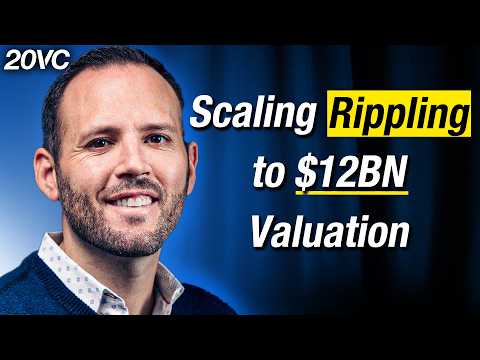
Matt Plank, Rippling's CRO: How to Build an Enterprise Sales Machine | E1241
Matt Plank (guest), Harry Stebbings (host)
In this episode of The Twenty Minute VC, featuring Matt Plank and Harry Stebbings, Matt Plank, Rippling's CRO: How to Build an Enterprise Sales Machine | E1241 explores rippling CRO Reveals How To Design A Relentless Enterprise Sales Engine Matt Plank, CRO of Rippling, breaks down how to build and scale a high-velocity, multi-segment enterprise sales organization from the basement stage to hundreds of millions in revenue.
Rippling CRO Reveals How To Design A Relentless Enterprise Sales Engine
Matt Plank, CRO of Rippling, breaks down how to build and scale a high-velocity, multi-segment enterprise sales organization from the basement stage to hundreds of millions in revenue.
He explains why founders should hire sales leaders much earlier than conventional wisdom suggests, and why they should not be the ones writing the sales playbook.
Plank dives into outbound’s central role, tight sales–marketing alignment, pricing discipline, deal management, and the evolution from single-product selling to a complex multi-product, multi-segment motion.
Throughout, he emphasizes operational rigor, uncomfortable ambition from the CEO, and the ability of leaders to continually replace themselves with people better than them at each stage.
Key Takeaways
Founders should not write the sales playbook—and should hire sales leadership earlier than they think.
Plank argues that while founders are best at articulating product vision and why the product matters, they rarely think like the buyer or know how to codify that into a repeatable sales motion. ...
Get the full analysis with uListen AI
Outbound is absolutely essential for scale; relying on inbound alone will cap growth.
Despite Rippling’s world‑class inbound engine, they hit a point where marketing couldn’t keep growing form fills fast enough, forcing them to rapidly stand up an outbound org—a process Plank calls a mistake for not doing earlier. ...
Get the full analysis with uListen AI
Price until you feel friction—high win rates often mean underpricing or too-narrow reach.
Plank challenges founders who brag about 60–70% win rates, saying that usually signals prices are too low or they’re not in enough deals. ...
Get the full analysis with uListen AI
Indecision is the top loss reason; treat ‘no’ and ‘not now’ as long-term assets, not dead ends.
Rippling’s biggest closed‑lost bucket is indecision—customers ghosting or deferring. ...
Get the full analysis with uListen AI
Account management must own both expansion and retention; comp plans need to reflect that.
Rippling moved from pure CSMs and hand-backs to original AEs, to a dedicated account management org with quota. ...
Get the full analysis with uListen AI
Multi-product companies eventually must split sales roles to maintain depth and win competitive battles.
As Rippling expanded from 3 to 30+ products, asking one AE to sell everything stopped working—especially against focused competitors like Ramp or Brex. ...
Get the full analysis with uListen AI
Sales leaders scale only if they can hire people better than themselves and stay hands-on.
The main reason early leaders get layered is their inability to bring in more senior talent or recognize when homegrown managers have hit their ceiling. ...
Get the full analysis with uListen AI
Notable Quotes
“Founders definitely should not create the playbook.”
— Matt Plank
“People that say outbound is dead either haven’t scaled something or they’re engagement‑baiting.”
— Matt Plank
“If you win 70% of deals, that’s not good. Your price is way too low or you’re not in enough deals.”
— Matt Plank
“You don’t get any credit for knowing how to do something yourself. Your job as a sales leader is to get everybody else to do that.”
— Matt Plank (relaying advice from Parker Conrad)
“You should work for a CEO whose ambition and expectations make you deeply, deeply uncomfortable.”
— Matt Plank
Questions Answered in This Episode
If founders shouldn’t own the playbook, what specific signals indicate it’s time to bring in that first sales leader—and how should they evaluate candidates?
Matt Plank, CRO of Rippling, breaks down how to build and scale a high-velocity, multi-segment enterprise sales organization from the basement stage to hundreds of millions in revenue.
Get the full analysis with uListen AI
How can early-stage startups with low ACVs pragmatically invest in outbound without blowing up efficiency or morale?
He explains why founders should hire sales leaders much earlier than conventional wisdom suggests, and why they should not be the ones writing the sales playbook.
Get the full analysis with uListen AI
What concrete steps can a team take to safely and systematically raise prices until they find the ‘right’ level of friction?
Plank dives into outbound’s central role, tight sales–marketing alignment, pricing discipline, deal management, and the evolution from single-product selling to a complex multi-product, multi-segment motion.
Get the full analysis with uListen AI
How should multi-product startups decide when to split into specialized product AEs versus keeping a single generalist AE model?
Throughout, he emphasizes operational rigor, uncomfortable ambition from the CEO, and the ability of leaders to continually replace themselves with people better than them at each stage.
Get the full analysis with uListen AI
For sales leaders worried they might be topping out, what early warning signs should they look for in themselves and their teams—and how can they proactively adapt?
Get the full analysis with uListen AI
Transcript Preview
Founders definitely should not create the playbook, but I think founders wait too long to hire a go-to-market. And I think they do that because they feel like they can't hire a good salesperson, potentially without a bunch of traction. The big mistake that people make, as they transition to the next phase, is people don't increase price into a point where they find friction.
Ready to go? (upbeat music) Matt, I'm excited for this, dude. I've heard so many good things, both from Ashley and from Parker. So thank you so much for joining me today, man.
Yeah, absolutely. Thanks for having me. I, uh, likewise have- have, uh, heard a lot of great things and watched a lot of great episodes on the podcast, so excited to join you.
Yeah. Bribery goes a long way, dude. Uh, listen, I think there's a moment when people fall in love with sales. Can you take me to, when did you fall in love with sales and realize that this was the career for you?
You know, candidly, I've been, uh, I think in love with sales since I was, you know, selling wrapping paper in fifth grade in elementary school. And I think for me, uh, it's always come from probably some part of competition, you know, wanting to, uh, to sell stuff and- and kind of be number one on whatever leaderboard it was. And believe it or not, that's- they get you primed for that in elementary school when you're selling wrapping paper or discount codes to your local stores or whatever. But then all the way through college, I was selling hot tubs and appliances at Sears and Cutco knives and really anything you could- you could think of that was a commission job. Uh, I was doing it from a pretty young age.
Do you think that people are born salespeople or do you think it's something that can be learned?
I think there's a lot of people that are born that could be salespeople. Um, you know, just given the- the kind of the attitude that you have. And I think there's certainly some people who are born who probably don't, you know, would like run in the opposite direction from any sales job. But, uh, I think it comes from, you know, wanting to be, uh, you know, wanting to be competitive and being okay when you lose, because in sales, like yes, of course you win, but you lose the majority of the time really. And so I think there's a- there's a lot of dynamics, uh, that I think are, uh, that you have to kind of have the ing- the right ingredients. But I think from there you can certainly, you know, teach a lot of the skills that, you know, that- that make a good salesperson good.
Do you think it's okay to be good with losing? Like, I fucking hate losing. I would- I would kill my kids if they ever said that they were okay to lose. It should hurt every time, in every way, and you should remember it so you never feel it again.
Install uListen to search the full transcript and get AI-powered insights
Get Full TranscriptGet more from every podcast
AI summaries, searchable transcripts, and fact-checking. Free forever.
Add to Chrome