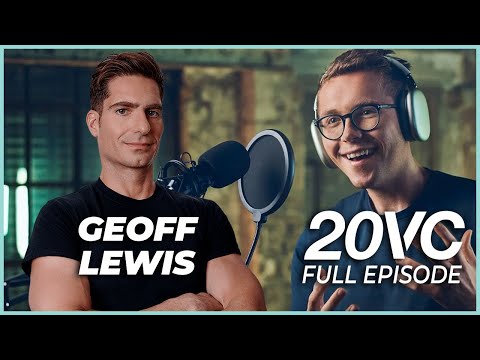
Geoff Lewis: Why I Put $200M into Rippling; Uncapped Notes; "Compound Startups" | 20VC #933
Harry Stebbings (host), Geoff Lewis (guest)
In this episode of The Twenty Minute VC, featuring Harry Stebbings and Geoff Lewis, Geoff Lewis: Why I Put $200M into Rippling; Uncapped Notes; "Compound Startups" | 20VC #933 explores inside Bedrock’s $200M Bet on Rippling and Compound Startups Geoff Lewis of Bedrock Capital explains why his firm has invested roughly $200M into Rippling across multiple rounds, making it a highly concentrated position in their first three funds.
Inside Bedrock’s $200M Bet on Rippling and Compound Startups
Geoff Lewis of Bedrock Capital explains why his firm has invested roughly $200M into Rippling across multiple rounds, making it a highly concentrated position in their first three funds.
He frames CEO Parker Conrad as a ‘life’s work’ founder and “ultimate narrative violation,” driven by a mix of ambition, vengeance, and resilience that Bedrock believes is key to building generational companies.
Lewis unpacks Rippling’s “compound startup” model: starting from payroll, expanding into a broad workforce management suite, owning the employee graph, and potentially becoming an “AdWords for SaaS” distribution layer.
The conversation also covers Bedrock’s philosophy on uncapped notes, capital concentration, reserves vs distributions, macro timing, and how they think about growth-stage investing and risk in a volatile market.
Key Takeaways
Back ‘life’s work’ founders with an extra motivator like vengeance.
Lewis argues that many great entrepreneurs (e. ...
Get the full analysis with uListen AI
Use capital concentration to maximize returns in truly exceptional companies.
Bedrock has concentrated roughly 20% of three funds into Rippling (plus more into a few other winners), rejecting traditional diversification limits and aligning with the view that position-sizing, not deal count, is often the real driver of venture returns.
Get the full analysis with uListen AI
Avoid competitive formal fundraises; catalyze rounds and move pre-emptively.
After losing the Series A and over-analyzing the Series B, Bedrock concluded that once a process memo goes to a dozen firms, the round is effectively ‘dead’ to them; instead, they now focus on originating or catalyzing rounds directly with founders.
Get the full analysis with uListen AI
Favor businesses where the preferred stack grows linearly or sublinearly with revenue.
Lewis emphasizes that many big-outcome companies require massive dilutive capital; he prefers models like Rippling’s, where strong unit economics and product-led expansion mean the amount of preferred capital needed scales modestly relative to revenue growth.
Get the full analysis with uListen AI
Exploit macro dislocations by moving up-market when others retreat to early stage.
In anticipating a growth and then crypto crash, Bedrock sold Bitcoin/Ethereum, recycled proceeds, and deliberately sought the “best growth-stage asset on the planet” where they believed they wouldn’t lose money and still had a credible 10x path—landing on Rippling.
Get the full analysis with uListen AI
Compound startups win by broadening product surface area and deepening customer lock-in.
Rippling started with payroll but expanded into a wide suite of workforce and HR tools; astronomical upgrade rates show customers keep adding modules, providing more value while enabling Rippling to cross-sell and flatten customers’ G&A cost curves.
Get the full analysis with uListen AI
Hiring ex-founders builds a culture of resilience and high personal stakes.
Lewis notes that Rippling’s unusually high density of former founders creates a team that understands hardship, carries a chip on its shoulder, and needs the company’s success for personal self-actualization—fueling an execution culture he believes competitors can’t match.
Get the full analysis with uListen AI
Notable Quotes
“When you find a transcendent life’s work entrepreneur with vengeance, you ought to invest.”
— Geoff Lewis
“I don’t like companies where the people don’t wear their shoes in the office.”
— Geoff Lewis
“It can become the AdWords for SaaS… the way that business software is sold.”
— Geoff Lewis
“By the time a company’s in a formal financing process, it’s kind of dead to us.”
— Geoff Lewis
“This is a rare human who, to wholly self-actualize, has to build one of the largest companies on the planet.”
— Geoff Lewis
Questions Answered in This Episode
How far can Rippling realistically go toward becoming the global ‘employer of record’ and displacing companies like Workday, ADP, and Deel?
Geoff Lewis of Bedrock Capital explains why his firm has invested roughly $200M into Rippling across multiple rounds, making it a highly concentrated position in their first three funds.
Get the full analysis with uListen AI
What specific product or distribution milestones would confirm Rippling’s potential to become the ‘AdWords for SaaS’ that Bedrock envisions?
He frames CEO Parker Conrad as a ‘life’s work’ founder and “ultimate narrative violation,” driven by a mix of ambition, vengeance, and resilience that Bedrock believes is key to building generational companies.
Get the full analysis with uListen AI
How does a culture heavily populated with ex-founders balance ambition and speed with the need for internal cohesion and operational discipline?
Lewis unpacks Rippling’s “compound startup” model: starting from payroll, expanding into a broad workforce management suite, owning the employee graph, and potentially becoming an “AdWords for SaaS” distribution layer.
Get the full analysis with uListen AI
What frameworks can investors use to distinguish between productive ‘vengeance’ in founders and destructive, derailment-prone behavior?
The conversation also covers Bedrock’s philosophy on uncapped notes, capital concentration, reserves vs distributions, macro timing, and how they think about growth-stage investing and risk in a volatile market.
Get the full analysis with uListen AI
In a world of uncertain growth valuations, how can other funds practically adopt Bedrock’s approach to capital concentration without overexposing themselves?
Get the full analysis with uListen AI
Transcript Preview
(beeping) Three, two, one, zero. You have now arrived at your destination. Jeff, this is such a joy. I always love our chats. There are any excuse for a chat with you, um, and I thought this would be the perfect one. Rippling is such an incredible company. Parker is amazing. Can't wait for the episode with him. But thank you so much for joining me today, Jeff.
Delighted to join you, Harry. Looks like you're all ready for vacation in that- in that cool hat.
Do you know what, my friend? I'm ready for the Amalfi Coast. Bring it on. But I wanna (laughs) start, um, with you and your relationship with Parker. Uh, I know that you met a long time before your founding of Bedrock. So take me back, and paint that picture and story. How did you first meet Parker, and what was that scene of the meeting?
Well, you know, it's a situation where I actually heard about Parker, I heard of him before I met him. Uh, one of my first pitches that I'd ever taken as a very young VC back in 2012, I was with a company called SigFig. And this was actually the first company that Parker co-founded. But Parker had been fired from SigFig right before I took the pitch, and so my pitch was with his co-founder. I believe his name was Michael. And I remember feeling like it was sort of this super smooth, super slick pitch. Um, felt like, uh, Michael seemed like a really good manager, like a good leader, but was missing what I kind of articulate as this sort of power plant energy, uh, that I really look for in entrepreneurs. Like, who's gonna just brute force this thing? Who's the entrepreneur who's gonna brute force this by sheer force of will into a huge company? And I didn't quite feel that that was there, so we passed on SigFig. Then a few months later, uh, one of my bosses at the firm I worked for, uh, referred a colleague and I, uh, an intro to Rippling. And I think they were, like, the hottest company in their Y Combinator batch at the time. This was also in 2012. And so we met him at our office, and this was way before I'd founded Bedrock with- with Eric, many years before. And, uh, it was a great... I mean, Parker was like, "Whoa, this guy is a power plant. This guy is gonna brute force a company into something one way or the other." But we felt, I think, at the time, I don't fully remember why we passed, but I think we felt at the time that it was sort of because it was the hottest company in the batch and because it was sort of being sent to every single VC in Silicon Valley. There weren't that many back then. There are like 100X more now, but still a lot of competition, that the seed round be too competitive. And- and the firm I worked for ultimately ended up investing in Zenefits later on, so I think I maybe misspoke. This was the Zenefits seed round back in 2012. But, you know, over the years, I sort of like... As Zenefits started to implode and the drama started to really kick in, I started reaching out to Parker. And I was sort of in the midst of thinking about starting, uh, Bedrock. This was sort of 2017. And we, you know, we had a dialogue. We had a few emails. We had a few, uh, messages back and forth. And I was sort of just rooting for him, because I'd- I'd been struck by his energy in that Zenefits seed pitch, I'd obviously been struck by the arc of Zenefits, and I'd been struck by my feeling that the- there- there was a missing element on that SigFig founding team, and Parker felt like that missing piece to me. And so I wanted to build a rapport with him. So in 2018, we finally closed our first fund on Bedrock. You know, it took us longer than I would've liked, but we- we got it done. We typically get things done when we say we're gonna do them. And, uh, our first email was like, to Parker, like, "We- we- we've got- we've gotta get involved in Rippling." And he'd just closed his seed round, unfortunately. We missed it. We missed it by a few months. But, you know, like Parker, uh, we- we consider ourselves quite relentless. So yeah, it dates back to 2012. It's been a decade of interactions.
Install uListen to search the full transcript and get AI-powered insights
Get Full TranscriptGet more from every podcast
AI summaries, searchable transcripts, and fact-checking. Free forever.
Add to Chrome