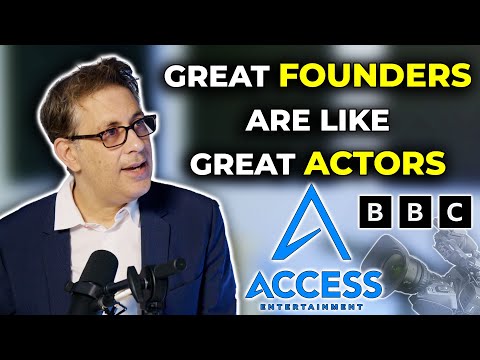
Danny Cohen: From Leading the BBC to Leading Venture Capitalist |E1079
Harry Stebbings (host), Danny Cohen (guest), Narrator
In this episode of The Twenty Minute VC, featuring Harry Stebbings and Danny Cohen, Danny Cohen: From Leading the BBC to Leading Venture Capitalist |E1079 explores from BBC boss to VC: Danny Cohen on talent, storytelling, disruption Danny Cohen, former head of BBC Television and now head of Access Entertainment at Access Industries, explains his transition from operating a massive legacy broadcaster to investing across the entertainment spectrum. He argues that the core constants in a turbulent media landscape are talent, storytelling, and clear-eyed self-awareness about one’s strengths and weaknesses. The conversation explores fragmentation of audiences, discovery challenges, AI-driven content explosion, the creator economy’s fragile economics, and how Access invests based on “attention and eyeballs” rather than narrow formats. Cohen also touches on leadership, giving hard feedback, the loneliness epidemic, brand storytelling, and his philosophy on work, marriage, and long-term happiness.
From BBC boss to VC: Danny Cohen on talent, storytelling, disruption
Danny Cohen, former head of BBC Television and now head of Access Entertainment at Access Industries, explains his transition from operating a massive legacy broadcaster to investing across the entertainment spectrum. He argues that the core constants in a turbulent media landscape are talent, storytelling, and clear-eyed self-awareness about one’s strengths and weaknesses. The conversation explores fragmentation of audiences, discovery challenges, AI-driven content explosion, the creator economy’s fragile economics, and how Access invests based on “attention and eyeballs” rather than narrow formats. Cohen also touches on leadership, giving hard feedback, the loneliness epidemic, brand storytelling, and his philosophy on work, marriage, and long-term happiness.
Key Takeaways
Invest around attention and talent, not rigid media formats.
Cohen structures Access Entertainment’s strategy around where audiences’ attention and “eyeballs” go—spanning film, TV, gaming, creator economy, theater, and immersive experiences—rather than restricting capital to a single category. ...
Get the full analysis with uListen AI
Audience fragmentation and digital shift demand youth-focused, content-first strategies.
He views young audiences as “pathfinders” whose behavior foreshadows mainstream adoption, stresses that linear TV isn’t dead but must coexist with on-demand platforms, and insists that great content and talent—“content is king or queen”—remain the essential starting point.
Get the full analysis with uListen AI
Discovery is a worsening bottleneck in an over-supplied content world.
High-quality shows routinely disappear on streaming platforms because algorithms underperform and marketing is thin, a problem Cohen expects AI-boosted content creation to exacerbate. ...
Get the full analysis with uListen AI
The creator economy is power-law driven; most don’t make real money.
Cohen agrees that value heavily accrues to the top 0. ...
Get the full analysis with uListen AI
Know your strengths, delegate the rest, and keep the bar high.
He emphasizes that leaders should only do what only they can do, ruthlessly delegate everything else, and surround themselves with people who are better at their weak spots (e. ...
Get the full analysis with uListen AI
Emotional intelligence and pattern recognition are central to backing great founders and artists.
Cohen looks for drive, obsession with quality, flexibility, and unusual depth of interest (often manifested in idiosyncratic hobbies) in both creators and entrepreneurs. ...
Get the full analysis with uListen AI
Storytelling is a learnable, monetizable superpower for companies and brands.
Drawing on his literature background, he argues that strong narrative structure—clear beginnings, middles, ends; reveals; emotional arcs—is as vital to pitches and brands as to novels or films. ...
Get the full analysis with uListen AI
Notable Quotes
“Whatever business you're in, whether you're an investor or you run a business, being honest about what your strengths are and where you need to lean on other people, that is the secret of success to me.”
— Danny Cohen
“We don't think about one investment vertical, film or television. We think about attention and eyeballs.”
— Danny Cohen
“If the thing you're doing on your list is something someone else in the company should be doing, you probably shouldn't be doing it.”
— Danny Cohen
“I believe in storytelling as an incredible source of revenue.”
— Danny Cohen
“If you know in your heart it's not working, do it sooner.”
— Danny Cohen
Questions Answered in This Episode
How can streaming platforms or startups best tackle the discovery problem as AI massively increases content supply?
Danny Cohen, former head of BBC Television and now head of Access Entertainment at Access Industries, explains his transition from operating a massive legacy broadcaster to investing across the entertainment spectrum. ...
Get the full analysis with uListen AI
If you were building a new media company from scratch today, how would you structure it around “attention and eyeballs” rather than a single format?
Get the full analysis with uListen AI
What practical steps can founders take to become significantly better storytellers when pitching investors or customers?
Get the full analysis with uListen AI
How should legacy media organizations balance chasing young audiences on new platforms with preserving trust, depth, and brand integrity?
Get the full analysis with uListen AI
In an era of rising loneliness and digital overconsumption, what kinds of media and experiences are most likely to enhance, rather than erode, people’s real-world wellbeing?
Get the full analysis with uListen AI
Transcript Preview
I love the theater. But I look at it, and I'm always like, "Is it a good business?"
You can make money, but you're never gonna make a huge amount of money. The real money comes in a- at access entertainment. We don't think about one investment vertical, film or television. We think about attention and eyeballs. If you think about attention and eyeballs, and you create an opportunity to pick the best in class right across the entertainment sphere. Whatever business you're in, whether you're an investor or you run a business, being honest about what your strengths are and where you need to lean on other people, that is the secret of success to me. I believe in storytelling as an incredible source of revenue. The entertainment world is all about storytelling, and storytelling by companies and founders is not always as good as it needs to be.
Which brand do you think tells the best stories today?
I think IKEA's very good at storytelling.
Why IKEA?
I just think-
Danny, this is such a joy to do. I've wanted to do this one for a long time. Lior and Akin have said so many wonderful things. So thank you so much for joining me today.
Oh, pleasure. It's very nice to be here. Um, you've had, uh, really amazing people actually on your podcast before. So nice to be, uh, in their company.
Do you know what, Danny? I think it's the British accent for the American audience. It, it makes a big difference. They put you 10 IQ points higher, actually.
Good. Good.
Tell me, it's a fascinating background that you have and not the usual in terms of starting in the entertainment industry and then moving to investing. How did you make that transition, Danny?
So my job before working for Access for Len Blevatnik was running the television division of the BBC. I ran networks, pre-BBC TV networks. I was in charge of production and all the green lighted content. And I'd been there about eight years. I was ready actually to just, to do something different. The way I think about it is, I want to work until I'm really old. I think that's what keeps you healthy. So I was about 43, 44, um, when I reflected on that. I thought, "Well, I'm not even halfway through my career if I'm gonna work till I'm old." Do I want to be doing the same thing with the same people in the same world, however wonderful and exciting it is, 'cause it is, you know, great, those jobs are great, and they're very, very fascinating, interesting and stimulating. Do I wanna be doing those for another 25, 30, 35 years? And I couldn't imagine that. So I left the BBC without deciding what I was gonna do next because I knew I needed some time to really think about it and decompress. Those jobs are very intense. And I went and had some nice meetings on the West Coast and, and so on, with, um, TV businesses and studios and so on. But around that time, Len Blevatnik had approached me. I'd known Len actually through my wife for quite a long time. And the proposition he offered was so much more interesting, so much more diverse, so much more learning and education for myself, so much more runway to have a long career in this rather than treading, you know, around the same turf I had been for the first 25 years of my career. It was just much, much more appealing.
Install uListen to search the full transcript and get AI-powered insights
Get Full TranscriptGet more from every podcast
AI summaries, searchable transcripts, and fact-checking. Free forever.
Add to Chrome