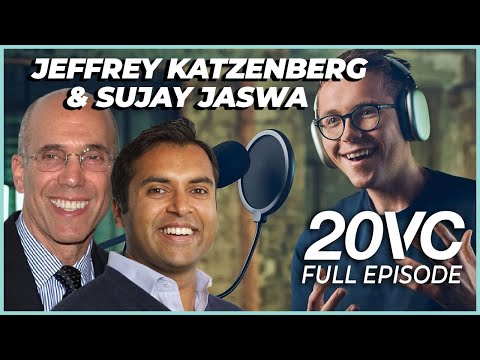
Jeffrey Katzenberg & Sujay Jaswa: Takeaways from Dreamworks; What happened with Quibi? | 20VC #952
Harry Stebbings (host), Sujay Jaswa (guest), Jeffrey Katzenberg (guest)
In this episode of The Twenty Minute VC, featuring Harry Stebbings and Sujay Jaswa, Jeffrey Katzenberg & Sujay Jaswa: Takeaways from Dreamworks; What happened with Quibi? | 20VC #952 explores katzenberg and Jaswa on hiring, pivots, Quibi, and culture shifts Sujay Jaswa and Jeffrey Katzenberg trace their paths into tech and explain how WndrCo blends company-building with investing to keep their operating instincts current.
Katzenberg and Jaswa on hiring, pivots, Quibi, and culture shifts
Sujay Jaswa and Jeffrey Katzenberg trace their paths into tech and explain how WndrCo blends company-building with investing to keep their operating instincts current.
They share core operating lessons: hire for potential and work ethic, place people where they “spike,” and constantly anticipate disruptive change—lessons shaped by Dropbox’s scale and DreamWorks’ pivot from hand-drawn to computer animation.
Katzenberg gives a candid postmortem on Quibi: strong content but no product–market fit, an overly “movie-like” launch mindset, and a decision to shut down quickly and return $600M to investors.
The conversation spans downturn tactics, recruiting intensity, firing decisively yet empathetically, Silicon Valley’s “rebirth” via layoffs, remote work tradeoffs, and skepticism about near-term generative AI product–market fit.
Key Takeaways
Talent density beats founder omniscience.
Jaswa’s biggest Dropbox lesson: hire highly capable, high-work-ethic people and place them in roles aligned with their strengths—then they’ll “figure it out” even when leaders don’t have all the answers.
Get the full analysis with uListen AI
Survival requires looking “around the corner.”
Katzenberg’s DreamWorks lesson is continual horizon-scanning and cultural readiness to pivot; the shift to computer animation was brutal but necessary—without it, he argues, the company would have gone bankrupt.
Get the full analysis with uListen AI
Quibi wasn’t a content failure; it was a PMF failure.
Katzenberg says the creative bar was met, but the product didn’t achieve product–market fit, and the team mistakenly treated launch like a one-shot movie opening rather than an iterative software rollout.
Get the full analysis with uListen AI
Shut down fast when the truth is clear—capital is not yours to “sit on.”
WndrCo ended Quibi within months once it was evidently a misfire and returned $600M of $1B; both criticize well-funded “zombie” companies that keep operating without traction instead of making hard calls.
Get the full analysis with uListen AI
If you keep a ‘living dead’ company alive, you must swing for a real pivot.
Jaswa advises stripping to the core to extend runway, then taking meaningful moonshots; merely maintaining a stagnant business wastes employees’ careers and investors’ capital.
Get the full analysis with uListen AI
Operating experience decays quickly; people management decays slower.
Jaswa argues most operator advice is time-bound because tools, platforms, and tactics commoditize fast (e. ...
Get the full analysis with uListen AI
To stay relevant as investors, keep operating—don’t just commentate.
WndrCo’s model (incubate/acquire 1–2 companies a year plus 10–12 investments) is positioned as a way to continuously refresh pattern recognition with current-market constraints and realities.
Get the full analysis with uListen AI
Network depth requires deliberate, high-frequency maintenance.
Katzenberg attributes his relationship breadth-and-depth to relentless effort: constant outreach via calls/texts and heavy “relationship time” (multiple meals, scheduled call lists), treating relationships like a compounding asset.
Get the full analysis with uListen AI
Silicon Valley isn’t dead; layoffs may seed the next wave.
Both predict downsizing will push talented people into startups, reviving innovation; Jaswa adds that a downturn can correct cultural excesses (entitlement, low output inside bigco comfort).
Get the full analysis with uListen AI
Decisive performance management is a force multiplier—especially for empathetic leaders.
Katzenberg warns that lingering on a mis-hire “kills you,” while Jaswa shares a Sequoia intervention that reframed firing as serving the broader team and mission, not just judging one individual.
Get the full analysis with uListen AI
Remote work can work—but it taxes apprenticeship and cultural transmission.
They argue on-the-road/in-person exposure accelerates learning (standards, pace, meeting discipline) in a way remote often misses; still, they acknowledge role- and leader-dependent exceptions (e. ...
Get the full analysis with uListen AI
Generative AI needs customer-impact PMF, not attention-driven narratives.
Jaswa calls current gen-AI “hype” in a bubble-end context, emphasizing a practical PMF test: does it make life meaningfully better, faster, easier, or cheaper right now?
Get the full analysis with uListen AI
The venture market’s main risk is delayed right-sizing.
Katzenberg worries companies and investors will hold on too long, postponing necessary restructures and slowing adaptation to the current economic environment.
Get the full analysis with uListen AI
Notable Quotes
““If you wanna do something that is original and unique, it equals risk.””
— Jeffrey Katzenberg
““We never had product market fit.””
— Jeffrey Katzenberg
““Don’t waste your time just keeping a living, dead company alive.””
— Sujay Jaswa
““If you don’t come to work on Saturday, don’t bother coming on Sunday.””
— Jeffrey Katzenberg
““Anything that gets this much attention this quickly at the tail end of a bubble is because people are grasping for something.””
— Sujay Jaswa
Questions Answered in This Episode
On Quibi: What specific user behaviors or retention metrics convinced you the product lacked PMF within 60–90 days?
Sujay Jaswa and Jeffrey Katzenberg trace their paths into tech and explain how WndrCo blends company-building with investing to keep their operating instincts current.
Get the full analysis with uListen AI
You said Quibi launched like a movie (binary opening). What would an iterative, software-native launch plan have looked like in the first 6 months?
They share core operating lessons: hire for potential and work ethic, place people where they “spike,” and constantly anticipate disruptive change—lessons shaped by Dropbox’s scale and DreamWorks’ pivot from hand-drawn to computer animation.
Get the full analysis with uListen AI
Returning $600M was unusual—what legal/structural choices (financing terms, contracts, content deals) enabled that speed and magnitude of capital return?
Katzenberg gives a candid postmortem on Quibi: strong content but no product–market fit, an overly “movie-like” launch mindset, and a decision to shut down quickly and return $600M to investors.
Get the full analysis with uListen AI
Sujay, you mentioned you and Jeffrey initially disagreed on “how to launch a company.” What were the biggest tactical disagreements (pricing, distribution, growth loops, MVP scope)?
The conversation spans downturn tactics, recruiting intensity, firing decisively yet empathetically, Silicon Valley’s “rebirth” via layoffs, remote work tradeoffs, and skepticism about near-term generative AI product–market fit.
Get the full analysis with uListen AI
For founders of ‘living dead’ companies: what are the top 3 signals that it’s time to shut down versus attempt a pivot?
Get the full analysis with uListen AI
Transcript Preview
chaps, I'm so excited for this! I have done my research. I've spoken to many, many mutual friends. So first, thank you so much for joining me today.
Great to be with you.
Great to join you.
Awesome. Well, listen, I'm gonna start and I'm gonna direct questions quite strictly today, 'cause we're gonna have- it's a very rare time for us to have s- two people on the show. So I wanna start with, how did you make your way into the world of tech and come to both, you know, co-found Wndr? And so Sujay, let's start with you, and then move to Jeffrey.
Well, I, I grew up in tech, Harry. I've been... Uh, I was basically born into it. My dad was a immigrant engineer. Uh, you know, your classic Silicon Valley story, came with very little. Um, started a company, uh, in 1988, in an era where it was really hard, uh, for, for folks with his background to, to get venture funding. So he actually- he and his three co-founders, who were... They were Taiwanese, he was Indian, uh, couldn't raise a dime. Um, they bootstrapped it, and five years later, it was the world's largest chipset maker. 40% of the personal computers in the world had their chipset. You know, the funny thing about the Valley is these stories get forgotten really fast because of creative destruction. Um, and then he started a software company in 1996, which, um, crazy story, went public on the day the NASDAQ peaked in 2000, the si- the single- the same day. And so it was, uh, not too dissimilar than this last year. It was 100, uh, you know, call it eight- 90, something like that, million or so of, of what you would call RR today, mega enterprise accounts, Cisco, BMW, IBM, LVMH, accounts like that. And in the first day, its market cap was about $5 billion-
Wow!
... and, uh, they raised something like $200 million in the IPO. Two years later, it was trading for a market cap of $200 million, the cash on the-
Wow!
... cash in the bank. So I've seen the... You know, I grew up, I grew up in this environment. I've seen the cycle multiple times, and so there's lots to talk about.
Jeffrey, hit me.
Yeah.
How did you make your way here?
Sure. Well, h- here's the thing, Harry, which is, as you, uh, well, well know, I spent 40 years in the media, entertainment, movie, TV business, but interestingly, there was a sort of theme through pretty much every chapter of that, where technology was a gigantic enabler of our storytelling. And if you think of the rate of innovation of- that has gone on in, particularly with movies and television, um, over these, say, let's just call it the last 30 years or so, uh, it's pretty astounding. So whether it's in the films, uh, in terms of special effects and the entire process end to end of making films, um, you know, for me, probably the most transformative moment is when, uh, you know, I reached out to Steve Jobs and John Lasseter and brought them into the Walt Disney Company, um, and made a home for Pixar. Uh, so it's just, you know, when I started DreamWorks Animation, um, we had a studio in Redwood Shores of over 800, um, uh, engineers and artists, so I sort of felt like, you know-
Install uListen to search the full transcript and get AI-powered insights
Get Full TranscriptGet more from every podcast
AI summaries, searchable transcripts, and fact-checking. Free forever.
Add to Chrome