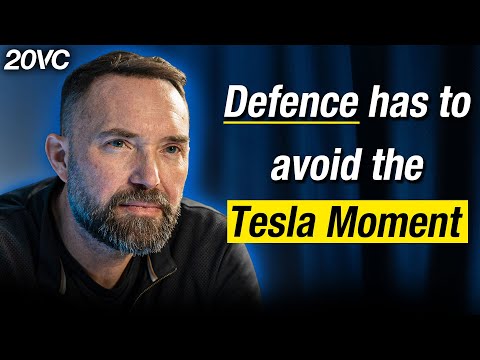
Torsten Reil, Helsing Founder: Raising $828M to Build the Defence Champion of Europe | E1237
Torsten Reil (guest), Harry Stebbings (host)
In this episode of The Twenty Minute VC, featuring Torsten Reil and Harry Stebbings, Torsten Reil, Helsing Founder: Raising $828M to Build the Defence Champion of Europe | E1237 explores helsing’s Founder on AI Warfare, European Sovereignty, and Relentless Talent Torsten Reil, founder of Helsing and former founder of NaturalMotion, discusses building a European defense AI champion focused on software, autonomy, and drones amid rising geopolitical threats from Russia and China.
Helsing’s Founder on AI Warfare, European Sovereignty, and Relentless Talent
Torsten Reil, founder of Helsing and former founder of NaturalMotion, discusses building a European defense AI champion focused on software, autonomy, and drones amid rising geopolitical threats from Russia and China.
He outlines Helsing’s operating philosophy: extreme talent density, small elite teams, aggressive performance management, and “Helsing speed” powered by substantial early capital and a willingness to blitzscale temporarily.
Reil argues Europe faces a serious sovereignty and security gap, calling for higher defense spending, a mandatory 20% allocation of equipment budgets to new defense companies, and faster procurement reform to avoid a “Tesla moment” where legacy primes are disrupted by software-first players.
He also dives into the ethics of autonomous weapons, the realities of war in Ukraine, the coming era of drone swarms and “precise mass,” and why founder ambition—not capital or regulation—is Europe’s real bottleneck.
Key Takeaways
Optimize for extreme talent density, not headcount growth.
Reil insists that 3–4 exceptional people outperform and cost less than 8–10 good ones; Helsing relentlessly recruits top performers, pays above market, and actively manages out low performers to keep teams small, fast, and high leverage.
Get the full analysis with uListen AI
Make performance management a core founder job, not an HR afterthought.
Helsing runs quarterly performance calibration sessions across leaders, forces clear standards of “what good looks like,” and addresses mis-hires in the first months—avoiding the cultural drift Reil experienced at NaturalMotion.
Get the full analysis with uListen AI
Use blitzscaling as a temporary mode to gain strategic advantage.
Armed with an early €8. ...
Get the full analysis with uListen AI
In defense, aim for programs of record, not just innovation grants.
Reil stresses that small “innovation projects” (e. ...
Get the full analysis with uListen AI
Software-first thinking can transform hardware categories like drones.
Helsing moved into strike drones only when it became clear no one in the West could produce cheap, scalable “precise mass”; by shifting complexity into software and using heavy simulation, they aim to simplify hardware and manufacture at large scale.
Get the full analysis with uListen AI
Autonomy and ‘precise mass’ will reshape the economics of war.
Ukraine and Russia already deploy huge drone volumes; Reil expects rapid evolution toward single operators controlling many drones, making saturated drone attacks economically overwhelming for expensive tanks, artillery, and air defenses.
Get the full analysis with uListen AI
Europe’s constraint is ambition and aggression, not capital.
Reil argues European ecosystems have plenty of seed and Series A money but lack founders willing to build multi-decade, sovereignty-defining companies; too many sell at ~€100m instead of aiming to become new primes in defense, energy, or semiconductors.
Get the full analysis with uListen AI
Notable Quotes
“Capital isn’t the problem in Europe, ambition is.”
— Torsten Reil
“We’d rather have four exceptional people than eight good people.”
— Torsten Reil
“There is a big wave coming towards us, and it is autonomy and software in defense, and it’s unstoppable.”
— Torsten Reil
“The thing that we have to avoid is the Tesla moment for the defense sector.”
— Torsten Reil
“I’m pretty sick of people just commenting… The only thing that matters is if people actually do something.”
— Torsten Reil
Questions Answered in This Episode
How should democratic societies practically balance ethical red lines with the need to keep pace in autonomous weapons and AI-driven warfare?
Torsten Reil, founder of Helsing and former founder of NaturalMotion, discusses building a European defense AI champion focused on software, autonomy, and drones amid rising geopolitical threats from Russia and China.
Get the full analysis with uListen AI
What structural changes in procurement and incentives are realistically achievable in the next 5–10 years to make Reil’s ‘mandatory 20% to new defense’ vision happen?
He outlines Helsing’s operating philosophy: extreme talent density, small elite teams, aggressive performance management, and “Helsing speed” powered by substantial early capital and a willingness to blitzscale temporarily.
Get the full analysis with uListen AI
If autonomy and drone swarms make traditional armor and artillery economically obsolete, what capabilities should militaries prioritize building right now?
Reil argues Europe faces a serious sovereignty and security gap, calling for higher defense spending, a mandatory 20% allocation of equipment budgets to new defense companies, and faster procurement reform to avoid a “Tesla moment” where legacy primes are disrupted by software-first players.
Get the full analysis with uListen AI
How can European founders be encouraged—or compelled—to aim for ‘sovereignty-scale’ companies instead of early exits at modest valuations?
He also dives into the ethics of autonomous weapons, the realities of war in Ukraine, the coming era of drone swarms and “precise mass,” and why founder ambition—not capital or regulation—is Europe’s real bottleneck.
Get the full analysis with uListen AI
What governance structures inside a defense-AI company best ensure that ethics workshops and export decisions genuinely influence product direction rather than serve as PR?
Get the full analysis with uListen AI
Transcript Preview
When we started Helsing in March 2021, we actually put one of our slides that we thought there were going to be two galvanizing events. One of them was going to be an invasion of Ukraine by Russia, the other one an invasion of Taiwan by China. There is a big wave coming towards us, and it's, it is autonomy and software in defense, and it's unstoppable. The thing that we have to avoid is the Tesla moment for the defense sector. If we collectively, including the primes, don't understand that and don't adapt, the same thing is going to happen to defense as happened to the car industry.
Where are we in three years with Russia-Ukraine? What happens in China and Taiwan?
Again, I think it's plausible that there will be a-
Ready to go? (instrumental music plays) Thorsten, I've wanted to do this for a long time. Thank you so much for joining me today.
Very good to see you. Thanks for having me.
Now, I wanna start, uh, with lessons from NaturalMotion actually. So over a 15-year period, you built the company before selling to Zynga, and I just wanted to start with, what did you do the first time that worked and you took with you to Helsing?
It, it was a long journey. Um, NaturalMotion started as a spin-out, uh, out of university, o- out of Oxford, and we were trying to create physically simulated creatures controlled by neural networks, which was a crazy idea at the time. This was a time, I think, of the Pentium processor or something. Um, so it was, it's hard to do computationally, but it worked quite well, and we ended up, um, using it in and, and licensing it for visual effects in big Hollywood movies like Lord of the Rings, Harry Potter, Spider-Man, then for big video games like GTA IV, GTA V, uh, Max Payne, um, and many others. And that worked quite well, um, but it only worked, I would say, okay, in terms of, in terms of revenues. You know, as a, as a founder, you, you wanna get to a hockey stick, um, movement eventually, and, and that wasn't the case with the technology business. It was growing, but it was growing reasonably slowly. And I think one of the things that we did do well was that we, we recognized that growth wasn't as strong as, as we wanted to, and we, we took a big, um, took a big risk and pivoted the company to doing games ourselves. Um, so you know how people say, "Focus, focus, focus." Wi- we did focus, um, but only up to a point. Uh, at one point, we said, "This isn't working the way we want it to, so let's pivot to actually making games ourselves." And we, we were very naive about how easy it was going to be. Um, we, we watched Rockstar work, and we were big fans of, of Rockstar Games, and we thought, "Well, we should give it a go as well," and ended up making games for iPhone, which, um, which worked out very well. We got a, a lot of support from Apple, um, ended up creating CSR Racing, which was one of the, uh, largest iPhone games, uh, at the time. And at that point, the company did take off, and this kind of approach to risk-taking and going all in, um, uh, stayed with me and I think stayed with, with Helsing now. We, we are big believers of focus, um, just doing very few things, um, and when things don't work, we try to adapt very quickly.
Install uListen to search the full transcript and get AI-powered insights
Get Full TranscriptGet more from every podcast
AI summaries, searchable transcripts, and fact-checking. Free forever.
Add to Chrome