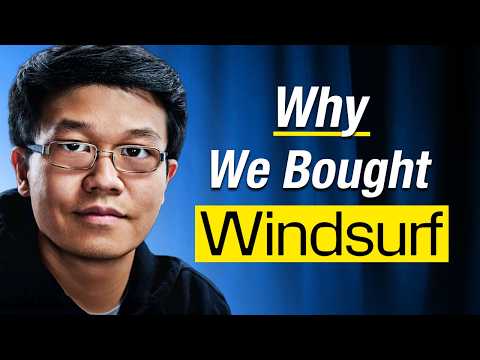
Cognition CEO Scott Wu on Acquiring Windsurf: The Process, The Deal, The Rationale
Scott Wu (guest), Harry Stebbings (host)
In this episode of The Twenty Minute VC, featuring Scott Wu and Harry Stebbings, Cognition CEO Scott Wu on Acquiring Windsurf: The Process, The Deal, The Rationale explores inside Cognition’s Blitz Deal for Windsurf and AI Coding’s Future Cognition CEO Scott Wu recounts how his team moved from first contact to signing an agreement to acquire Windsurf in a single weekend, seeing value in the "leftover" assets others dismissed. He explains why the combination of Cognition’s agentic coding product Devin and Windsurf’s IDE, GTM, and ops muscle is strategically complementary, and why the deal had to be executed at extreme speed. Beyond the transaction, Wu shares his views on where value will accrue in AI, why reinforcement learning (RL) is the underappreciated driver of recent breakthroughs, and how AI will reshape software engineering into intent-based ‘technical architecture.’ The conversation also touches on competition, talent wars, pricing, and why Cognition needs to tell its story more boldly despite strong usage growth.
Inside Cognition’s Blitz Deal for Windsurf and AI Coding’s Future
Cognition CEO Scott Wu recounts how his team moved from first contact to signing an agreement to acquire Windsurf in a single weekend, seeing value in the "leftover" assets others dismissed. He explains why the combination of Cognition’s agentic coding product Devin and Windsurf’s IDE, GTM, and ops muscle is strategically complementary, and why the deal had to be executed at extreme speed. Beyond the transaction, Wu shares his views on where value will accrue in AI, why reinforcement learning (RL) is the underappreciated driver of recent breakthroughs, and how AI will reshape software engineering into intent-based ‘technical architecture.’ The conversation also touches on competition, talent wars, pricing, and why Cognition needs to tell its story more boldly despite strong usage growth.
Key Takeaways
High-value acquisitions can and sometimes should be executed in days, not months.
Wu describes treating the Windsurf situation like a bank receivership: discovering the opportunity Friday, reaching a verbal agreement Saturday, finalizing legal terms Sunday, and announcing Monday to stabilize customers and employees amid chaos.
Get the full analysis with uListen AI
“Leftover” assets after big-platform deals can be treasure, not husks.
Contrary to the narrative that Windsurf was gutted, Cognition saw a strong product, full customer base, proprietary code/IP, and a high-caliber go-to-market and operations team that complemented Cognition’s deep engineering focus.
Get the full analysis with uListen AI
The real frontier in AI coding is deep context and ownership, not just autocomplete.
Wu argues that the key challenge is enabling agents to build durable representations of large codebases, tools, and prior work so they can truly “own” tasks—moving engineers from reading code to primarily shaping products and architectures.
Get the full analysis with uListen AI
AI already makes competent engineers roughly 1.5–2x faster, and 10x is plausible within a few years.
He cites customer behavior and internal metrics suggesting current gains are meaningful but early, and predicts a world with far more—and far better—software as AI amplifies both output and ambition (a Jevons paradox for code).
Get the full analysis with uListen AI
Reinforcement learning is the under-recognized driver of recent AI breakthroughs.
Wu frames RL as the ‘big story’ of the last 18 months: if you can define clear environments and success criteria, you can effectively solve arbitrary benchmarks and specialize models far beyond what imitation learning on internet text allows.
Get the full analysis with uListen AI
Where value accrues in AI depends on defensible differentiation, not a fixed layer.
He rejects simple “chips vs models vs apps” debates, arguing that both foundation labs and specialized application-layer companies can become massive, provided they own a distinct capability or experience that’s hard to copy.
Get the full analysis with uListen AI
Cognition’s real gap has been narrative and marketing, not product traction.
While Devin has grown 5–10x in usage recently (even before Windsurf) with serious adoption inside engineering teams, Wu concedes that more consumer-leaning products like Replit and Lovable own the zeitgeist—and admits Cognition must communicate its story and numbers more assertively.
Get the full analysis with uListen AI
Notable Quotes
“There’s an unspoken covenant that, as a founder, you go down with the ship… and I think it’s changed a bit over the last year, and it’s a bit disappointing.”
— Scott Wu
“We found out on Friday, the same time everyone else did… and we wanted to have something ready to go by Monday.”
— Scott Wu
“In AI code, to be truly honest, if there was zero progress from here, the world would still be entirely different.”
— Scott Wu
“If you’re not using AI, you are just slower as a software engineer. That is the truth already today.”
— Scott Wu
“None of us are that close to the future of software engineering… we’re really building the next generation of human–computer interface.”
— Scott Wu
Questions Answered in This Episode
How did Cognition assess technical and cultural fit with Windsurf’s team in under 48 hours, and what risks did they consciously accept by compressing diligence?
Cognition CEO Scott Wu recounts how his team moved from first contact to signing an agreement to acquire Windsurf in a single weekend, seeing value in the "leftover" assets others dismissed. ...
Get the full analysis with uListen AI
What concrete milestones would indicate that coding agents have truly achieved ‘ownership’ of complex engineering tasks rather than being advanced assistants?
Get the full analysis with uListen AI
How should engineering leaders rethink team structure, hiring, and training in a world where AI tools can make developers 5–10x more productive?
Get the full analysis with uListen AI
What are the most promising real-world benchmarks or feedback loops for applying reinforcement learning beyond code—e.g., in healthcare, finance, or legal work?
Get the full analysis with uListen AI
As foundation models and application-layer products both mature, what specific forms of differentiation will prevent commoditization and sustain long-term margins for companies like Cognition?
Get the full analysis with uListen AI
Transcript Preview
But I think there's an unspoken covenant that, as a founder, you go down with the ship. And I think that, uh, for better or for worse, it's changed a bit over the last year, and I- and I think it's a bit disappointing, to be honest. I think there's some real truth to your point that often there are actually a- a lot of really valuable pieces that get left behind.
The only thing that anyone wants to talk about this week is Cognition buying Windsurf. We unpack it all today with Scott Wu, co-founder and CEO at Cognition.
In AI code, to be truly honest, if there was zero progress, the world would still be entirely different.
Ready to go? (instrumental music plays) Scott, I am so excited for this, dude. I was literally just telling you, it is a cool prep when you get to call up, like, Vinod Kosler, uh, Joe Lonsdale, and you call them and you're like, "Hey, what should I ask?" And they're just like, "Ah, I love this guy." Um, so thank you so much for joining me.
Yeah, thanks for having me. It's, uh, it's been a crazy few days for us all. (laughs)
It's been pretty insane. I just want to start, a- and we're gonna start, like, at present day and work our way around.
Yeah.
But I just want to start with, like, how did you learn about the potential ability for you to acquire Windsurf, and how did that opportunity arise?
We found out, honestly, on Friday, the same time everyone else did, that all of this was happening, and that this was the split, and that it was Google, and- and- and here's what happens next, and here's what happens with the team. And- and we were kind of talking about it, which is, you know, on the dev inside, I- I- I- I- I think in a few ways, it- it seems to be a pretty natural fit. One, because I think obviously there was an incredible, um, you know, team left behind. And if anything, I think the, um, you know, what- what we have at Cognition, I would say, is- is es- especially focused on the- the core engineering and product team. Whereas, obviously, like, um, you know, I think Windsurf has built an amazing, um, go to market team, um, you know, marketing team, finance, operations. Uh, and then similarly, in terms of the products, you know, we found that actually it was- there was a very naturally complementary lean. Um, and so we reached out cold, um, uh, Friday evening. A- and our first conversation was Friday night, and, uh, and- and it was, I mean, I- I'm glad I- I- I-
So you knew this was gonna happen.
(laughs)
Just- just take me to it, then. You reach out to Jeff-
Yeah.
... and you're like, "Hey, figure something is going down. Should we jump on a call?"
Install uListen to search the full transcript and get AI-powered insights
Get Full TranscriptGet more from every podcast
AI summaries, searchable transcripts, and fact-checking. Free forever.
Add to Chrome