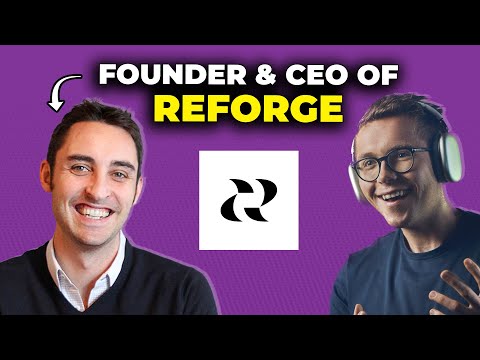
Brian Balfour: Startup Growth Secrets from HubSpot; Distribution Stratagies; Impact of AI | E1049
Brian Balfour (guest), Harry Stebbings (host), Narrator
In this episode of The Twenty Minute VC, featuring Brian Balfour and Harry Stebbings, Brian Balfour: Startup Growth Secrets from HubSpot; Distribution Stratagies; Impact of AI | E1049 explores brian Balfour Reveals Real Mechanics Behind Startup Growth and Channels Brian Balfour (Reforge, ex-HubSpot) explains how true growth comes from understanding your product’s growth model—how users create more users—rather than just piling on tactics or ad spend. He distinguishes product growth from business growth and stresses the importance of compounding growth loops, product–channel fit, and channel–model (pricing) fit for building venture-scale companies. Balfour details how to identify constraints in a growth system, when to persist versus kill experiments, and how to time and structure new channel or product bets without over-resourcing them. He also discusses how AI will change growth tooling and arbitrage opportunities, while leaving the core qualitative and strategic work of growth largely intact.
Brian Balfour Reveals Real Mechanics Behind Startup Growth and Channels
Brian Balfour (Reforge, ex-HubSpot) explains how true growth comes from understanding your product’s growth model—how users create more users—rather than just piling on tactics or ad spend. He distinguishes product growth from business growth and stresses the importance of compounding growth loops, product–channel fit, and channel–model (pricing) fit for building venture-scale companies. Balfour details how to identify constraints in a growth system, when to persist versus kill experiments, and how to time and structure new channel or product bets without over-resourcing them. He also discusses how AI will change growth tooling and arbitrage opportunities, while leaving the core qualitative and strategic work of growth largely intact.
Key Takeaways
Map a clear growth model before chasing tactics or metrics.
Founders must articulate, in a simple diagram, how a new user turns into more users via specific steps and loops; if the team can’t draw and explain this clearly, they don’t truly understand their growth machine.
Get the full analysis with uListen AI
Judge experiments by improving inputs, not just lagging outputs.
Instead of killing bets because traffic or revenue isn’t spiking yet, track whether leading indicators in the system (e. ...
Get the full analysis with uListen AI
Identify and focus on the true constraint in your growth system.
Translate your qualitative growth loop into metrics for each step, then run sensitivity analyses and stress tests (e. ...
Get the full analysis with uListen AI
Product–market fit alone is insufficient for venture-scale outcomes.
You also need product–channel fit (product molded to how a channel actually works) and channel–model fit (pricing and friction that match a channel’s economics), or your loops will never spin at venture scale.
Get the full analysis with uListen AI
Exploit one winning channel hard, but plant the next seeds early.
Once a core loop or channel is working, concentrate resources on it instead of premature diversification—but simultaneously seed a few small, well-structured bets (like internal ‘seed-funded’ teams) so you’re not blindsided by saturation.
Get the full analysis with uListen AI
Design metrics from a qualitative understanding of user problems and frequency.
Define what ‘active’ truly means based on the problem you solve and how often it naturally occurs (weekly, monthly, etc. ...
Get the full analysis with uListen AI
Use AI to automate analysis, not replace qualitative and psychological insight.
AI will increasingly handle regressions, pattern-finding, and tactical execution, but it will not replace the human work of understanding user psychology, discovering arbitrage in new channels, and designing growth systems that compound.
Get the full analysis with uListen AI
Notable Quotes
“There’s not an infinite world of growth options. It’s a fairly set menu, and it’s rare a new dish gets added.”
— Brian Balfour
“A growth model says, ‘When I put a user in, how do I get more than one user out?’ That’s very different from a financial model.”
— Brian Balfour
“We cannot mold channels to products. We have to mold the product to the channel.”
— Brian Balfour
“Usage is what creates revenue. Revenue does not create usage.”
— Brian Balfour
“Chaos is actually good for growth people because within that chaos lives these arbitrage opportunities, these new things that nobody else has figured out.”
— Brian Balfour
Questions Answered in This Episode
How would you practically build and validate a growth model diagram for an early-stage product with very little data?
Brian Balfour (Reforge, ex-HubSpot) explains how true growth comes from understanding your product’s growth model—how users create more users—rather than just piling on tactics or ad spend. ...
Get the full analysis with uListen AI
What concrete signals tell you it’s time to kill a ‘working’ awareness channel that isn’t translating into meaningful business value?
Get the full analysis with uListen AI
How can founders systematically search for and evaluate product–channel fit before they’ve committed heavily to a specific distribution motion?
Get the full analysis with uListen AI
In a world where AI automates much of the analytics, which specific qualitative skills should growth leaders prioritize developing in their teams?
Get the full analysis with uListen AI
What early warning indicators can help leadership see that their core channel is approaching saturation and it’s time to seed new growth bets?
Get the full analysis with uListen AI
Transcript Preview
Chaos is actually good for growth people because within that chaos lives these arbitrage opportunities, these new things that nobody else has figured out. And those sparks, those sparks are what give new companies and new things life and hope.
(instrumental music) Bryan, this is such a joy to do. I mean, I feel like I've interviewed like everyone from Reforge, and so I've been waiting for this show in anticipation. So thank you so much for joining me today.
Thanks for having me. I'll do my best to, uh, live up to all the rest of the folks you've interviewed, but, uh, we'll see how this goes. (laughs)
Listen, I heard nothing but wonderful things. I wanna start though with a little bit of an entry point, which is how did you first make your first foray into the world of growth as a starting point?
I made my way into growth where I would say like 70% of like the growth OGs made into growth, which was the early Facebook platform social gaming days. If you look at, like, some of the top people in growth, there's like a lineage. It's a- it- like almost like a coaching lineage, like, all the way back to the social gaming days. And so I had started this company, uh, shortly after school called Viximo, and, uh, we were in the social gaming space, uh, for a while, and then it kinda transitioned into mobile gaming. And that was like the perfect petri dish to essentially, like, create growth people, because what the Facebook platform did was that it opened up a ton of, like, viral channels as well as, like, paid acquisition channels. The games were very driven by, like, product-driven levers, uh, like virality. It was a highly quantitative game. You were playing this high, like, arbitrage game. You were constantly seeking out, like, the things and the APIs that people e- out- still, like, didn't understand. And games are so focused on, um, like, the psych- the psychological aspect of users to a degree that other software products aren't. And when you combine all of those things together, that's really kind of what growth turned into, which was understanding how your product grows, which is different than how your business and company grows. And we can talk a little bit about that later. Um, i- combining it with the quantitative elements of growth as well as with the psychological elements of growth, right? And so those three things combined, especially in a highly- high-pressure, high-competitive environment is what really formed, I think, the, like, initial injection into, uh, like, the growth scene. And so as a founder of that company, we- you know, there was like nobody who really knew what to do and how to do it. And so a big part of a founder's job is just, like, go solve the problems that you don't have other people for and figure it out. And that's how I got into it, and I just- I loved it. I actually loved the game of trying to find an opportunity that other people weren't seeing and figuring out how to exploit that. And, uh, there was just, like, that competitive nature of it that, like, really got to me combined with, like, my quantitative lean on, you know- like, on the world and my skillset. And so I just loved it, and I got into it and, uh, you know, been there ever since.
Install uListen to search the full transcript and get AI-powered insights
Get Full TranscriptGet more from every podcast
AI summaries, searchable transcripts, and fact-checking. Free forever.
Add to Chrome