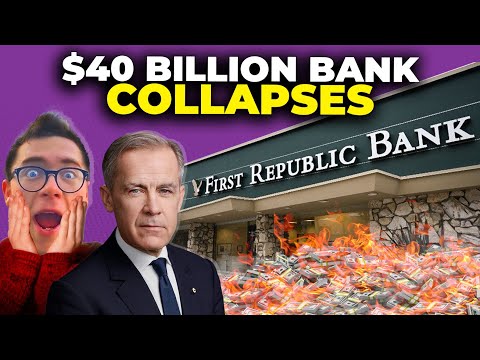
Mark Carney: First Republic Bank Fails; Will Interest Rates Rise? Global Warming's Net Zero | E1008
Mark Carney (guest), Harry Stebbings (host)
In this episode of The Twenty Minute VC, featuring Mark Carney and Harry Stebbings, Mark Carney: First Republic Bank Fails; Will Interest Rates Rise? Global Warming's Net Zero | E1008 explores mark Carney Dissects Bank Turmoil, Interest Rates, And Net Zero Transition Mark Carney explains the recent banking turmoil around regional US banks like Silicon Valley Bank and First Republic, arguing it’s serious but fundamentally different from the 2008 crisis due to far stronger capital, liquidity, and resolution regimes.
Mark Carney Dissects Bank Turmoil, Interest Rates, And Net Zero Transition
Mark Carney explains the recent banking turmoil around regional US banks like Silicon Valley Bank and First Republic, arguing it’s serious but fundamentally different from the 2008 crisis due to far stronger capital, liquidity, and resolution regimes.
He unpacks how rapid rate hikes exposed poor risk management, especially in regional banks with long-duration, low-yield assets, and predicts more consolidation and a barbell structure of very small locals and very large national banks.
Carney discusses deposit guarantees, the role of contingent capital (AT1s), why concentration in a few ‘too big to fail’ banks is problematic, and how this turmoil likely lowers the peak Fed funds rate and nudges the US into recession.
In the second half, he argues the world is finally bending onto a credible net zero path, driven by policy shifts (e.g., US IRA, EU responses), massive clean energy and EV investment, and competitive pressure from China, while stressing the need for nuclear and better capital flows into emerging markets.
Key Takeaways
Recent banking turmoil is serious but not a repeat of 2008.
Carney stresses that while many US regionals face asset–liability and earnings problems, the system now has over six times the loss-absorbing capacity, better liquidity, and fewer dangerous interconnections than before the global financial crisis.
Get the full analysis with uListen AI
Regional US banks must ‘go small or go home.’
The business model of mid-sized regionals with large uninsured corporate deposits has proven fragile; Carney expects a wave of consolidation, leaving either small, relationship-focused banks with insured deposits or very large national institutions.
Get the full analysis with uListen AI
Guaranteeing all deposits requires stronger non-deposit capital buffers.
Carney acknowledges the logic of full deposit backstops but argues that if deposits are effectively risk-free, you must rely on thick layers of equity, senior non-deposit debt, and contingent capital (AT1s) held by sophisticated investors to discipline banks and protect taxpayers.
Get the full analysis with uListen AI
Rapid rate hikes were necessary but created non-linear credit shocks.
He believes the speed of tightening was justified by inflation, yet policymakers underestimated that moving from 0% to ~5% can abruptly stop credit flows from certain channels, like regional banks and leveraged sectors, rather than just smoothly repricing loans.
Get the full analysis with uListen AI
Fed policy will be somewhat looser because bank stress tightens credit.
Carney estimates regional-bank strains will shave roughly 0. ...
Get the full analysis with uListen AI
Stablecoins face an existential challenge from bank-like risks.
The events in banking and money market funds show how hard flawless asset–liability matching is over long periods; Carney argues that to be truly safe at the core of payments, a ‘stablecoin’ would effectively need to be fully backed by central bank assets—becoming a central bank digital currency in all but name.
Get the full analysis with uListen AI
The net zero transition is accelerating faster than many realize.
He notes global temperature pathways have moved from ~3. ...
Get the full analysis with uListen AI
Climate is now about competitiveness and growth, not just virtue.
China has bet heavily on clean tech and EV supply chains; Carney argues other major economies (US, EU, Canada, etc. ...
Get the full analysis with uListen AI
There is no credible net zero path without nuclear power and emerging-market capital.
Carney insists global nuclear capacity must grow by ~50% and that large pools of concessional capital are needed to de-risk especially FX exposure for private investors in emerging markets, where over a third of global emissions originate outside China.
Get the full analysis with uListen AI
Notable Quotes
“This is turmoil, not crisis. It’s an absolutely different order of magnitude from what we experienced in 2008.”
— Mark Carney
“If you’re a regional bank in that awkward middle, you either go small or go home.”
— Mark Carney
“It was always the case that one of the very likely possibilities was we would eventually get out of the low‑for‑long interest rate world. To assume otherwise is irresponsible.”
— Mark Carney
“There’s no net zero without nuclear power.”
— Mark Carney
“The inflection points we need for net zero—we’re living through them right now.”
— Mark Carney
Questions Answered in This Episode
If all deposits were explicitly guaranteed, what concrete changes to bank capital and liability structures would be required to prevent moral hazard and taxpayer bailouts?
Mark Carney explains the recent banking turmoil around regional US banks like Silicon Valley Bank and First Republic, arguing it’s serious but fundamentally different from the 2008 crisis due to far stronger capital, liquidity, and resolution regimes.
Get the full analysis with uListen AI
How might the consolidation of regional banks into a small number of national giants reshape credit access and innovation for startups and small businesses?
He unpacks how rapid rate hikes exposed poor risk management, especially in regional banks with long-duration, low-yield assets, and predicts more consolidation and a barbell structure of very small locals and very large national banks.
Get the full analysis with uListen AI
What specific regulatory tools or supervisory practices failed in the case of SVB, and how should they be redesigned for a world of faster rate moves and digital bank runs?
Carney discusses deposit guarantees, the role of contingent capital (AT1s), why concentration in a few ‘too big to fail’ banks is problematic, and how this turmoil likely lowers the peak Fed funds rate and nudges the US into recession.
Get the full analysis with uListen AI
Given the likely ‘silver bullet’ to private stablecoins, what is the most realistic design for a safe, efficient, and innovation-friendly central bank digital currency?
In the second half, he argues the world is finally bending onto a credible net zero path, driven by policy shifts (e. ...
Get the full analysis with uListen AI
Where should climate-focused investors most aggressively deploy capital over the next decade: grid-scale renewables, nuclear, EV supply chains, industrial decarbonization, or emerging-market projects—and what risks matter most in each?
Get the full analysis with uListen AI
Transcript Preview
... the longer higher rates go on, and the more deposits move to perceived safer places, we're gonna see more consolidation in that sector.
(techno music) Mark, I am so excited for this. We had so much to discuss in our first episode that we couldn't, simply couldn't fit it into one. And so, first, thank you so much for joining me for a second time today.
Uh, well, Harry, thanks for having me back. I wasn't sure you would ask me back. But yeah, there's lots to, uh, lots to cover.
I, I think this is the perfect time to have you back, bluntly. I have so many open questions. Before we dive into the core of the show though, I just wanna do a CliffsNotes, which is really unfair, especially given your career. But what is the CliffsNotes on your career and the cool highlights you'd dive into?
Okay. Uh, well, quick CliffsNotes, I mean, I guess I'd say I've worked pretty much at the intersection of private markets and public policy most of my career. So, I started in the city, uh, just before the fall of the Berlin Wall, so p- probably before you were born. I kinda rode the globalization boom from there, uh, in, in Asia and New York, uh, a bit in Canada with Goldman. Uh, then I, uh, became a central bank governor in search of a quiet life. Um, I figured, you know, eight interest rate meetings a year, and I could spend time with my family and, uh, my timing was a bit off because I started, uh, a few weeks before Bear Stearns, uh, uh, failed. Uh, and then obviously, that cascaded into the subprime crisis, and, uh, Lehman, et cetera. And so, I got involved with, um, the financial reforms after that, uh, picked up from where Mario Draghi left off on leading the financial reforms. Uh, went to the Bank of England, uh, y- you know, during the euro crisis, uh, Brexit, uh, referendum, uh, focused a bit on climate when I was there, given the responsibilities. And now, I'm back more on the private side, so I, that was a long period on the public side, but a public side where, uh, working a lot, obviously, you know, trying to fix and reform private markets. And now, I'm back on the private side, focusing in a couple areas, most of which relate to climate. So, I work with Brookfield, uh, we have Big Transition Fund, we, you know, focus on going to where the emissions are and, and funding companies to get 'em down. I'm on the board of Stripe, a great fintech, uh, company, and, and more. I work with companies like Watershed, which help with the mechanics, the ERP, if you will, of climate to help companies get down. Uh, and I do spend, uh, just back on the public spi- side, I spend about half of my time, uh, as a special envoy, uh, for the United Nations. Sounds great. Uh, yeah, it's-
Install uListen to search the full transcript and get AI-powered insights
Get Full TranscriptGet more from every podcast
AI summaries, searchable transcripts, and fact-checking. Free forever.
Add to Chrome