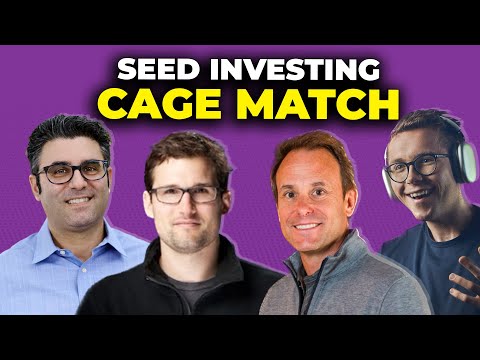
DEBATE: State of Seed Investing w/ Jason Lemkin, Sam Lessin, Frank Rotman & Harry Stebbings | E1047
Sam Lessin (guest), Harry Stebbings (host), Jason Lemkin (guest), Frank Rotman (guest), Harry Stebbings (host), Harry Stebbings (host)
In this episode of The Twenty Minute VC, featuring Sam Lessin and Harry Stebbings, DEBATE: State of Seed Investing w/ Jason Lemkin, Sam Lessin, Frank Rotman & Harry Stebbings | E1047 explores seed Investing’s Factory Era Is Over: Back To Bespoke, Brutal Reality The guests argue that the “factory line” era of seed investing—standardized playbooks, predictable Series A/B markups, and manufacturing middling unicorns—is dead and unlikely to return. Seed now reverts to a bespoke, power‑law game where weird, non‑obvious bets, smaller funds, and true conviction matter more than process and branding. They stress capital efficiency, real de‑risking, and building good, profitable companies first, instead of raising endlessly on narrative and TAM slides. The conversation also covers overpricing at seed, LP pullbacks, crowded cap tables, YC and party rounds, founder attitudes to capital, and when a real IPO window might reopen.
Seed Investing’s Factory Era Is Over: Back To Bespoke, Brutal Reality
The guests argue that the “factory line” era of seed investing—standardized playbooks, predictable Series A/B markups, and manufacturing middling unicorns—is dead and unlikely to return. Seed now reverts to a bespoke, power‑law game where weird, non‑obvious bets, smaller funds, and true conviction matter more than process and branding. They stress capital efficiency, real de‑risking, and building good, profitable companies first, instead of raising endlessly on narrative and TAM slides. The conversation also covers overpricing at seed, LP pullbacks, crowded cap tables, YC and party rounds, founder attitudes to capital, and when a real IPO window might reopen.
Key Takeaways
The industrial, “factory line” model of seed—optimizing companies for predictable Series A/B handoffs—is effectively over.
Cheap capital, AWS, and standardized playbooks once allowed funds to package startups to hit clear metrics, pass them down the stack, and reliably IPO middling companies; that pipeline collapsed when many of those companies got crushed in the public markets.
Get the full analysis with uListen AI
Seed must re-center on weird, non‑obvious, cheap bets where most investors aren’t bidding.
The biggest returns in their portfolios came from hard‑to‑package, off‑theme deals (e. ...
Get the full analysis with uListen AI
Capital efficiency and learning per dollar invested are once again critical.
Investors emphasize de‑risking specific theses cheaply, generating real proof (or anti‑proof) before scaling; companies that consume large amounts of capital without validating the model almost guarantee poor returns, even if revenue grows.
Get the full analysis with uListen AI
Overpriced seed rounds create a “no‑bid” risk at Series A and beyond.
If a startup raises at a high seed valuation and doesn’t go “far enough, fast enough,” later investors will quietly pass rather than force flat/down rounds, shrinking the funnel for follow‑on capital even if the business is okay on paper.
Get the full analysis with uListen AI
Owning meaningful stakes matters more than ever; tiny slices in crowded cap tables don’t move the fund needle.
Classic seed wins like The Trade Desk worked because small funds bought ~20% early; with YC‑style party rounds and 40–50 investors on the cap table, it’s almost impossible for a seed fund to get to double‑digit ownership and turn a 1,000x company into a meaningful fund outcome.
Get the full analysis with uListen AI
Founders and investors need to embrace profitable “good companies” with option value, not just unicorn-or-bust narratives.
There’s enormous value in businesses that can reach $100–300M outcomes on a few million of equity and real profitability; these can still return funds handsomely and may retain the option to compound into much larger companies over time.
Get the full analysis with uListen AI
LPs are actively pulling back from middling managers and oversized funds; fund size must match strategy.
LPs are consolidating into fewer, stronger relationships, cutting or combining funds, and are wary of mega seed/multi‑stage vehicles whose math doesn’t work if each big winner only returns a few times the fund instead of 10x+.
Get the full analysis with uListen AI
Notable Quotes
““My view when I say that seed is dead is that I think the factory model of seed which supported massive scaling of it is dead.””
— Sam Lessin
““Great companies are built on top of good companies. You have to get to good first, and then you can eventually get to great.””
— Frank Rotman
““The most depressing thing in the world is not being wrong, it’s being right and not making money.””
— Sam Lessin
““If pricing doesn’t correct at the earliest stage, you’re going to have a lot of no bids at the Series A because they haven’t earned their way into a significant increase in valuation.””
— Frank Rotman
““No one gives a shit about a company that does $200 million top line and grows with 30% margins. Right? No one cares.””
— Sam Lessin
Questions Answered in This Episode
If the factory model of seed is dead, how should emerging managers redesign their strategies and fund sizes to survive the next decade?
The guests argue that the “factory line” era of seed investing—standardized playbooks, predictable Series A/B markups, and manufacturing middling unicorns—is dead and unlikely to return. ...
Get the full analysis with uListen AI
What practical signals can founders use early on to know whether they’re generating true ‘proof’ or dangerous ‘anti‑proof’ before they raise more capital?
Get the full analysis with uListen AI
How can founders balance the desire for optionality and profitability with sectors—like SaaS—where undercapitalization can quickly become a competitive disadvantage?
Get the full analysis with uListen AI
Given LP pullbacks and overfunded mega‑funds, where will the most rational, founder‑friendly capital at seed and Series A actually come from in the next five years?
Get the full analysis with uListen AI
In a world dominated by tech megacaps and AI, what types of companies can still justify being independent public businesses rather than targets for roll‑ups or strategic acquirers?
Get the full analysis with uListen AI
Transcript Preview
No one gives a shit about a c- company that does $200 million top line and grows at 30% margins. Right? No one cares. It's like, you wanna bet on AI? Bet on Facebook, bet on Amazon, bet on Microsoft. It's so obvious.
(instrumental music) I am so excited for this. I've been really (laughs) looking forward to this one. I'm so used to having a one-on-one, now I get three brilliant brains joining my terrible British accent. And I'm just gonna dive straight in. We're doing the state of the seed market today. Sam, I'm quoting you, "Seed investors need to come to terms with the fact that this is not an 18-month timeout, it's likely much longer, and even the death of systematic thematic seed funds." Can you help me understand, Sam? What did you mean by this?
I think I said it. (laughs) No, I mean, like look, I think, (laughs) I think, um ... Look, I've, I've seen a lot of eras of seed investing in my life and career so far. Actually, hilariously, I was just reminded of this by someone. You know, my father, as he used to say, was an incredibly, uh, active seed investor in the late '90s in th- in, in the East Coast. He used to call himself, he say, "I was the big ..." He used to say, "I'm the largest seed investor in the East Coast, which is kinda like being the smartest utilities executive." Right? And so I, you know, but he, you know, I used to sit in on a ton of meetings when I was a kid in the late '90s and kind of watch the rise and the 2001 crash. Did a bunch of angel investing myself through the next decade. You know, ended up starting a seed fund with some friends, you know, in the last decade or so. So I've seen a few eras of this, and I think what was unique about the last era of seed funds, which really was the first time it got big and institutional, right, um, was this era where really the role of a seed fund was to kind of be the first step in a factory production line of startups that you popped out the backend $1 to $10 billion valuation companies pretty predictably, right? And, you know, i- it was a factory system. You found a company, you packaged it up, you knew what the series A firms were looking for, you knew the series A firms, you say, "Okay, we're gonna hit these two metrics, we're gonna pass you to the next line of production." Next line of production does their things, passes them to the Bs, pass them to the Cs, eventually pass them to Goldman Sachs, pop them out, $10 billion company, everyone makes money. That's over, right, because I think that was predicated ... It wasn't just zero interest rate policy, there was a bunch of things that was predicated on, but it was predicated on this idea that because of technology and things like AWS and platforms, that you could very predictably manufacture good companies, right? Not great companies. You weren't trying to manufacture a Facebook. Every once in a while you get lucky, right? But you could manufacture predictably the DTC companies, the companies on theme, you knew what people wanted, you passed it through the line. That's over, right, because it turned out that didn't work, right? Like everyone got excited about these companies and all these companies got crushed once they went public, right? They, they're not good companies, the market doesn't want, you know. And we, we were in plenty of them, right, along with everyone else. My view when I say that seed is dead is that I think the factory model of seed which supported massive scaling of it is dead. And we're kind of back to where we have been historically, which is spe- seed is a bespoke industry, it's a bespoke thing. Some people can do it well, it's about being better at pattern recognition. There's certain things you can get right about it, and it will be a power law game where you'll still have a few huge victories and a lot of losses, but, you know, the idea you can sit there and just manufacture pretty good outcomes from seed, I think, is over and not coming back.
Install uListen to search the full transcript and get AI-powered insights
Get Full TranscriptGet more from every podcast
AI summaries, searchable transcripts, and fact-checking. Free forever.
Add to Chrome