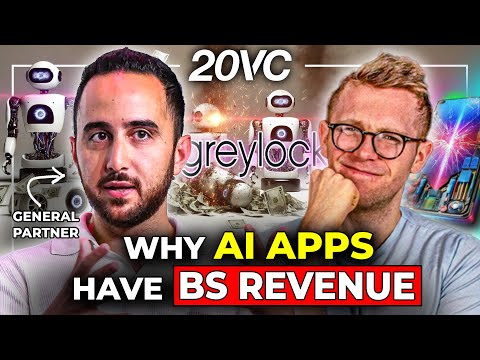
Saam Motamedi: Why Series B Won’t Make Money & Why $1M ARR is a BS Milestone for Series A | E1177
Saam Motamedi (guest), Harry Stebbings (host), Narrator
In this episode of The Twenty Minute VC, featuring Saam Motamedi and Harry Stebbings, Saam Motamedi: Why Series B Won’t Make Money & Why $1M ARR is a BS Milestone for Series A | E1177 explores aI Bubble, Overpriced Series B, And Why $1M ARR Misleads Investors Greylock partner Saam Motamedi argues that today’s AI and Series B markets are in an even more distorted bubble than 2021, driven by irrational buyers and exuberant valuation multiples disconnected from public comparables.
AI Bubble, Overpriced Series B, And Why $1M ARR Misleads Investors
Greylock partner Saam Motamedi argues that today’s AI and Series B markets are in an even more distorted bubble than 2021, driven by irrational buyers and exuberant valuation multiples disconnected from public comparables.
He explains why classic heuristics like “$1M ARR for Series A” are flawed, emphasizing founder quality, market size, and product defensibility over early revenue milestones.
Across stages, he outlines how Greylock underwrites expensive seeds, thinks about ownership vs. price, and when they will or won’t lead follow-on rounds—challenging notions like signaling risk and “playing the game on the field.”
Saam also discusses why now is a uniquely good time to build horizontal SaaS platforms in the AI era, how he evaluates foundation models vs. applications, and what younger investors should actually optimize for in their careers.
Key Takeaways
Today’s AI and Series B markets are more dislocated than 2021.
Seed and growth-stage AI companies are raising at 100–200x revenue while best-in-class public software trades at 15–20x, implying most investors are assuming unrealistically persistent growth or ignoring eventual public market benchmarks.
Get the full analysis with uListen AI
Valuation matters less than ownership and power-law outcomes at seed.
Debating $20M vs. ...
Get the full analysis with uListen AI
$1M ARR as a Series A milestone is a misleading heuristic.
Many companies get to $1–2M ARR and then stall; investors should start with founder quality and market dynamics, using ARR only as a secondary, partial signal of product–market fit—not a gate for writing a check.
Get the full analysis with uListen AI
Great SaaS opportunities emerge when data model, delivery model, and interface all shift.
Generative AI is changing how data is structured/queried (less rigid schemas), how software is priced (hybrid seat + work-based models), and how users interact (agents instead of static UIs), reopening the chance to build new Salesforces, Workdays, and ServiceNows.
Get the full analysis with uListen AI
Application-layer AI investing is more similar to traditional SaaS than many think.
Despite discourse about “wrappers,” Saam evaluates AI apps on the same fundamentals as SaaS: deep workflow integration, stickiness, pricing power, and distribution advantages—not on novel model tricks alone.
Get the full analysis with uListen AI
Signaling risk from seed investors is overblown relative to company fundamentals.
Saam notes that strong companies routinely raise follow-ons from new lead investors even when prior investors don’t lead; most sophisticated firms underwrite based on current fundamentals and founder quality, not whether a seed fund re-upped.
Get the full analysis with uListen AI
Junior investors should optimize for becoming meaningfully useful to founders, not deal volume.
The path to a durable career is building a true edge—such as deep domain networks or insight—so that top founders want to work with you; spraying term sheets to pad a résumé may help short-term signaling but hurts long-term credibility inside a firm.
Get the full analysis with uListen AI
Notable Quotes
“We are in an exuberant AI bubble, and we may not even fully appreciate how big of a bubble we’re in.”
— Saam Motamedi
“I really wonder if the Series B asset class as a whole is positioned to make money this vintage.”
— Saam Motamedi
“It drives me crazy when I hear, ‘Your checklist for the Series A: number one, a million dollars of ARR.’”
— Saam Motamedi
“Most people in venture capital are not helpful.”
— Saam Motamedi
“I sincerely believe it is the best time in a long time to be building SaaS companies and investing in SaaS.”
— Saam Motamedi
Questions Answered in This Episode
If public software multiples stay at today’s levels, how will that reshape acceptable private valuations for AI companies over the next three years?
Greylock partner Saam Motamedi argues that today’s AI and Series B markets are in an even more distorted bubble than 2021, driven by irrational buyers and exuberant valuation multiples disconnected from public comparables.
Get the full analysis with uListen AI
What concrete metrics or signals—beyond ARR—does Saam prioritize when deciding whether a founder is truly ‘iconic’ at the Series A stage?
He explains why classic heuristics like “$1M ARR for Series A” are flawed, emphasizing founder quality, market size, and product defensibility over early revenue milestones.
Get the full analysis with uListen AI
How should AI application founders design products and pricing so they replace real work, not just add ‘co-pilot’ features that customers won’t pay extra for?
Across stages, he outlines how Greylock underwrites expensive seeds, thinks about ownership vs. ...
Get the full analysis with uListen AI
In practice, how can a startup intentionally position itself in a ‘good zip code but wrong street’ market so it can pivot into a massive opportunity without restarting?
Saam also discusses why now is a uniquely good time to build horizontal SaaS platforms in the AI era, how he evaluates foundation models vs. ...
Get the full analysis with uListen AI
For emerging VCs, what are practical first steps to build a defensible sourcing edge in a specific domain, rather than just chasing hot AI or SaaS deals everyone else sees?
Get the full analysis with uListen AI
Transcript Preview
What's happening, I could argue is even crazier than what was happening in peak 2021. It's not unusual for us to see seed rounds for companies that are just getting started being priced in the many tens of millions of dollars, even $100 million plus post-money ranges. I think the series B market may be even frothier than it was in ’21. I think playing the game on the field would have cost you dearly at many different periods in time. And our view is most people in venture capital are not helpful.
Ready to go? Saam, I'm so excited for this, dude. Listen, we have so many mutual friends in common. I have been waiting for this one, so thank you so much for joining me today.
Thanks Harry for having me, and likewise. I've been a longtime listener and fan and I've heard the best things about you from a bunch of friends who have been on, so I'm excited uh, for this conversation.
You know, it's pretty expensive to buy Grady these days and so it's a large part of our marketing budget-
(laughs)
... but I'm pleased that it's working well. Uh, my question to you is, you know, when we look at your childhood, you grew up in Texas. You moved to California for college. I think people are shaped often a lot more by their childhood than they think. What element of your childhood do you think shaped you most?
Yeah, it's a great question. So I grew up in Houston, Texas, um, was born and raised there all through high school and then moved out to California for school. There's a lot in my childhood that shaped me. I think maybe two things are probably most formative. One is I- uh, I wasn't built for sports, but I was really good at debate and, um, really competitive in- in policy debate in school, traveling around the country with my team and competing. And I think what that taught me is just a love for competition. And whether it's on the venture business when we're competing to work with the best founders or the companies we partner with, I think you have to be mega competitive to be good, uh, good in our industry. And then- and then the second is, I also did a lot of biomedical research and- and work around designing, um, early cancer detection techniques that we published on when I was in school. And I think that taught me just the power of small teams. And with a small research team, we were able to produce some pretty cool work. And I think that's been quite formative to now what I do, which is invest in teams that are really, really small and then help them, you know, go on to build really formative companies.
I remember Peter Fenton saying the best, uh, a combination of hyper competitive and hyper curious.
Install uListen to search the full transcript and get AI-powered insights
Get Full TranscriptGet more from every podcast
AI summaries, searchable transcripts, and fact-checking. Free forever.
Add to Chrome