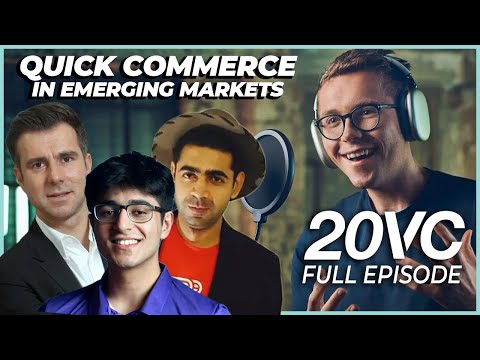
Q-Commerce in Emerging Markets with the CEOs of Airlift, JOKR, & Zepto | 20VC #892
Ralf Wenzel (guest), Harry Stebbings (host), Usman Gul (guest), Aadit Palicha (guest)
In this episode of The Twenty Minute VC, featuring Ralf Wenzel and Harry Stebbings, Q-Commerce in Emerging Markets with the CEOs of Airlift, JOKR, & Zepto | 20VC #892 explores emerging Market Q‑Commerce: High Density, Fresh Focus, Profitability Pathways Explained Founders of Airlift (Pakistan), JOKR (LatAm), and Zepto (India) discuss how so‑called “quick commerce” in emerging markets is structurally different from Western counterparts and why unit economics can be far stronger. They attribute this to low labor costs, high population density, fragmented offline retail, and the ability to vertically integrate supply chains—especially in fresh categories. The conversation dives into warehouse strategy, picking and delivery costs, average order value (AOV), and new revenue streams like retail media. Overall, they argue Q‑commerce is really “e‑commerce 3.0,” with multiple viable models and clear paths to free cash flow if operators achieve deep operational excellence.
Emerging Market Q‑Commerce: High Density, Fresh Focus, Profitability Pathways Explained
Founders of Airlift (Pakistan), JOKR (LatAm), and Zepto (India) discuss how so‑called “quick commerce” in emerging markets is structurally different from Western counterparts and why unit economics can be far stronger. They attribute this to low labor costs, high population density, fragmented offline retail, and the ability to vertically integrate supply chains—especially in fresh categories. The conversation dives into warehouse strategy, picking and delivery costs, average order value (AOV), and new revenue streams like retail media. Overall, they argue Q‑commerce is really “e‑commerce 3.0,” with multiple viable models and clear paths to free cash flow if operators achieve deep operational excellence.
Key Takeaways
Emerging markets offer fundamentally better economics for Q‑commerce than developed markets.
Low wages, high urban density, and weak supermarket penetration allow higher order volumes per dark store, lower rent as a percentage of revenue, and faster paths to free cash flow than in the West.
Get the full analysis with uListen AI
Vertical integration and local procurement are core, not optional, capabilities.
In fragmented supply environments, relying on distributors or partner supermarkets doesn’t work; operators must build their own procurement, distribution centers, and farm‑to‑fork fresh chains to unlock 40–50% product margins.
Get the full analysis with uListen AI
Fresh categories are both the anchor for retention and the engine for margins.
Fruits, vegetables, meat, milk, and bakery drive very high frequency in markets where people already shop multiple times per week and can yield 40–50% buy‑sell margins if wastage and quality are tightly controlled.
Get the full analysis with uListen AI
AOV alone is a blunt metric; gross profit per order is the real north star.
A lower AOV with a high share of high‑margin fresh can be more attractive than a higher AOV dominated by packaged goods; founders now optimize for gross profit per order rather than basket size alone.
Get the full analysis with uListen AI
Operational excellence in labor efficiency and capacity planning determines cost structure.
Picking cost percentages are the output; input metrics like orders picked per hour, rider orders per hour, idle time, and order stacking are what materially move total picking+delivery cost toward ~7–10% of revenue.
Get the full analysis with uListen AI
Delivery fees can be introduced without killing demand if timed to user maturity.
Zepto finds that after ~5 orders, retention probabilities exceed 95%, allowing fees to be added with minimal impact on GMV, especially as AOV rises and frequency only dips slightly.
Get the full analysis with uListen AI
Retail media and brand monetization can add 5–10% of revenue and turbocharge profitability.
With SKU‑level data, hyperlocal reach, and proximity to the point of purchase in markets lacking sophisticated ad channels, players like JOKR and Zepto are already at ~4–5% of revenue from ads and brand funding, aiming toward high single digits.
Get the full analysis with uListen AI
Notable Quotes
“Density is destiny.”
— Aadit (Zepto, quoting FedEx CEO Raj Subramaniam and applying it to Q‑commerce)
“In emerging markets, you have to be both a consumer‑facing company and a supplier and producer‑facing company at the same time.”
— Ralf (JOKR)
“The biggest misnomer about quick commerce is around challenging economics.”
— Usman (Airlift)
“This is not quick commerce—it is e‑commerce 3.0.”
— Ralf (JOKR)
“The north star to be focused on is gross profit per order, not AOV per order.”
— Aadit (Zepto)
Questions Answered in This Episode
How defensible are these vertically integrated supply chains if traditional retailers and CPGs aggressively respond in emerging markets?
Founders of Airlift (Pakistan), JOKR (LatAm), and Zepto (India) discuss how so‑called “quick commerce” in emerging markets is structurally different from Western counterparts and why unit economics can be far stronger. ...
Get the full analysis with uListen AI
What specific technologies or automation approaches do you see as most promising to push picking and delivery costs below 7% of revenue?
Get the full analysis with uListen AI
How do you balance rapid expansion into new neighborhoods with the need to reach economic maturity and free cash flow in existing dark stores?
Get the full analysis with uListen AI
To what extent could regulatory changes—around labor, data privacy, or urban zoning—disrupt the current Q‑commerce models in your markets?
Get the full analysis with uListen AI
How might retail media on Q‑commerce platforms evolve over the next five years, and could it rival or complement traditional digital channels like Meta or Google for CPG spend?
Get the full analysis with uListen AI
Transcript Preview
(beeping) Three, two, one, zero. You have now arrived at your destination.
Champs, this is such a joy to make this one happen. I've been looking forward to this one for a while. So I wanna start with a little bit of context and a little bit of background. Uh, let's start alphabetically. Airlift. Usman, hit me. What was the a-ha moment for you with Airlift? In about a minute, we're gonna go down.
Yeah. Uh, very, very excited to be on this show and, and thanks for having us. For us, you know, Airlift, our, our foray into quick commerce was really solving our own problem in the middle of the pandemic. We realized that the single biggest problem we had was getting grocery items delivered at our homes, uh, in a manner that was quick, that was instantaneous. And so, we set out to solve our own problem, and that's really where it all started, and we brought a small team together, and we, we looked at whether... what, what was, was operating efficient, um, uh, mechanism to do that, and, and that's how it all started.
I love it, and thank you so much. No one ever abides by the minute intro, so well done there. Uh, Ralf, hit me. Minute, what was the a-ha for you with Joker?
The a-ha moment for us... And by the way, Harry, thank you for having us as well. Um, the a-ha moment for us was how inefficient, uh, procurement-
Pleasure is mine, my friend. I miss your, I miss your dulcet tones.
It's mutual. It's mutual, yeah. Um, the a-ha moment for us was when we, um, figured out how inefficient, uh, supply chain and procurement processes are, um, globally, locally, um, how many people are involved, how much inefficiency, how much cost is being, uh, thrown away, um, and that there's a significant opportunity to literally vertically integrate, uh, and make supply chains become more efficient, more sustainable, um, and generating, like, a nice margin out of it.
Love it. Aadit, final one with you. Tell me, Zepto. How did it come about? And also, like, fuck, you're younger than me. This is a rarity.
(laughs)
But, uh, it's lovely to have you, Aadit. But how did Zepto come about?
And it's lovely to be here, uh, and, you know, get to be with Usman and Ralf as well. For us, I think the a-ha moment was actually a little bit less, uh, you know, vision-enticing. It was more methodical. Like, we were experimenting with grocery as a space for a very long time, also egged on by the fact that, you know, we were two bachelors in the middle of Mumbai when, you know, pretty much all offline and online forms of grocery were shut. Uh, but I think when we... you know, how we moved from online grocery, you know, as a marketplace or sort of longer format delivery to eventually Q-commerce was just in the data. Like, we, um, you, you know, it was Y Combinator, we were just iterating on different levers that we had and figured out that, hey, when we take our delivery times from 45 minutes to under 15 minutes, what we see with retention is two to three X goodness. NPS starts stabilizing at north of 85 points, and you have frequency of usage numbers that are off the charts. And when we saw that, we were blown away. And, and more importantly, we saw that coupled with, you know, 4X the assortment that we were operating with, better freshness and control over quality, and, you know, pricing levers, you know, with the economies of scale as well. Like, all those in one, you know, platform was just a very compelling user experience, and it just reflected in the numbers, and that's when we, you know, decided to double down on Q-commerce.
Install uListen to search the full transcript and get AI-powered insights
Get Full TranscriptGet more from every podcast
AI summaries, searchable transcripts, and fact-checking. Free forever.
Add to Chrome