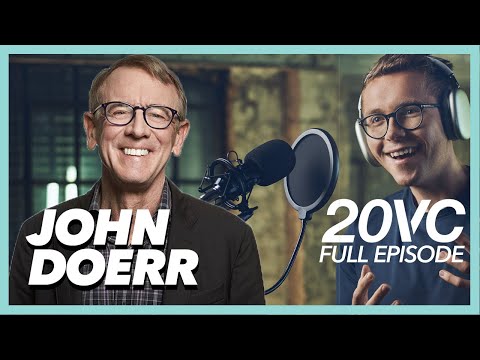
How I Bought 12% of Google for $12M; How VC is Fixing Climate Change | John Doerr Full Interview
John Doerr (guest), Harry Stebbings (host)
In this episode of The Twenty Minute VC, featuring John Doerr and Harry Stebbings, How I Bought 12% of Google for $12M; How VC is Fixing Climate Change | John Doerr Full Interview explores vC Legend John Doerr Maps Venture-Backed Plan To Solve Climate John Doerr discusses his shift from backing iconic tech companies like Google and Amazon to focusing heavily on climate, energy, and pandemic preparedness, explaining both the financial outcomes and hard lessons from early cleantech investing.
VC Legend John Doerr Maps Venture-Backed Plan To Solve Climate
John Doerr discusses his shift from backing iconic tech companies like Google and Amazon to focusing heavily on climate, energy, and pandemic preparedness, explaining both the financial outcomes and hard lessons from early cleantech investing.
He contrasts the 2006–2007 climate investing environment with today’s far more urgent and opportunity-rich landscape, arguing that the climate crisis is both a moral imperative and the greatest economic opportunity of the century.
Doerr outlines his “Speed & Scale” climate action plan, built around six major decarbonization objectives and a detailed OKR (Objectives and Key Results) framework with 55 measurable targets to reach net zero by 2050 and halve emissions by 2030.
He emphasizes the critical role of governments, youth movements, corporations, and investors, while also sharing his philosophy on timing, learning from failure, active listening, and how non‑climate VCs can thoughtfully enter climate-related investing.
Key Takeaways
Early climate investing was hard but ultimately validated.
Kleiner Perkins invested about $1B in ~70 climate companies over several funds; despite many setbacks (e. ...
Get the full analysis with uListen AI
Portfolio construction and asymmetric upside matter more than being right every time.
Doerr underscores Tom Perkins’ maxim that you can only lose 1x your money but can make many times that; a single winner like Enphase (microinverters) offset losses across seven failed solar panel bets.
Get the full analysis with uListen AI
Being early is preferable to being late, but timing is unpredictable.
Doerr would rather be too early than too late, pointing to Google (the 18th search engine) as proof that late entry can still win if the product is vastly superior and paired with the right business model.
Get the full analysis with uListen AI
A structured climate plan needs measurable, time-bound OKRs, not just goals.
His Speed & Scale framework defines six major objectives (transport, grid, food, nature, industry, carbon removal) with 55 key results—like EV price parity and green premiums below zero—to track real progress rather than vague ambition.
Get the full analysis with uListen AI
Government action is the biggest bottleneck to solving climate change.
Doerr is blunt that without governments increasing urgency and ambition, “we’re screwed”; his plan includes making climate a top-two voting issue in the 20 largest emitting countries by 2025 to force policy change.
Get the full analysis with uListen AI
Movements must become measurable action to matter.
He praises Greta Thunberg and youth movements for shifting public opinion and European voting priorities, but stresses that real success requires converting awareness into quantified policy and corporate commitments aligned with net-zero trajectories.
Get the full analysis with uListen AI
Non-climate VCs should invest where climate intersects their domain expertise.
Doerr advises that not every fund should be a climate fund; instead, investors should develop a ‘prepared mind’ in climate as it relates to their strengths (e. ...
Get the full analysis with uListen AI
Get the full analysis with uListen AI
Get the full analysis with uListen AI
Get the full analysis with uListen AI
Get the full analysis with uListen AI
Get the full analysis with uListen AI
Questions Answered in This Episode
How can policymakers realistically be pushed to make climate a top-two voting issue in major emitting countries within just a few years?
John Doerr discusses his shift from backing iconic tech companies like Google and Amazon to focusing heavily on climate, energy, and pandemic preparedness, explaining both the financial outcomes and hard lessons from early cleantech investing.
Get the full analysis with uListen AI
What specific signals should investors watch to distinguish enduring climate opportunities from the kind of bubbles seen in the first cleantech wave?
He contrasts the 2006–2007 climate investing environment with today’s far more urgent and opportunity-rich landscape, arguing that the climate crisis is both a moral imperative and the greatest economic opportunity of the century.
Get the full analysis with uListen AI
How can OKRs be effectively adopted by governments and NGOs, not just startups, to track climate progress?
Doerr outlines his “Speed & Scale” climate action plan, built around six major decarbonization objectives and a detailed OKR (Objectives and Key Results) framework with 55 measurable targets to reach net zero by 2050 and halve emissions by 2030.
Get the full analysis with uListen AI
In what ways can large corporations like Walmart most credibly influence their suppliers and peers to decarbonize faster?
He emphasizes the critical role of governments, youth movements, corporations, and investors, while also sharing his philosophy on timing, learning from failure, active listening, and how non‑climate VCs can thoughtfully enter climate-related investing.
Get the full analysis with uListen AI
For investors and operators outside climate, what are the most promising adjacent spaces (e.g., SaaS, fintech, logistics) where they can contribute meaningfully to decarbonization without deep technical climate expertise?
Get the full analysis with uListen AI
Transcript Preview
(beeping) Three, two, one, zero. You have now arrived at your destination.
John, this is such a pleasure to do. I've wanted to do this for a long, long time. As I've said, heard so many good things from Bing, from Juliet, from many more. So thank you so much for joining me today.
I- i- it's a privilege to be here. Let's do it.
-- about it. That is very kind of you. But I do wanna start, and I always normally start with context on getting into Venture, but bluntly, we're focusing on Climate today and the most important thing, so I wanna start there. You backed Google, you backed Amazon, some of the most legendary backs in Venture, and then you made the move to invest in energy, climate pandemics. Tell me, take me back to that moment. What first gave you that inspiration and transition to focus on energy and climate back then?
So it was Energy and Climate, and also interestingly, the mobile application store, the App Store, and the cloud. All of those came together in 2006 and in 2007.
Mm-hmm.
And so, yes, we made a major commitment to climate investing, but we also formed the iPhone with Steve Jobs, and did the crazy thing of backing entrepreneurs who were selling games for a dollar a copy on the iPhone.
(laughs)
And it's good that we made both of those bets because the climate investments took a lot longer and more money to produce returns. But over the course of three or four funds, we invested about a billion dollars in 70 or so climate-related investments. Those investments, on an as-it held basis today, are worth about $3 billion. It was hard, but it was not a financial failure, and it set the stage for, uh, a great deal of learning and a, a boom, really, of investment in Climate 2.0, a second wave, if you will, of innovations around electric vehicles, batteries, wind, solar. Well, that's the story and, and the basis for this conversation today.
Of cou- of course it is. I do have to ask you, I'm a Venture nerd, why the separate funds, and do you think for funds investing in climate today, we should have the same dedicated climate fund, you know, energy fund strategy in terms of the segregation of funds?
Well, I, I, I don't have an answer for the industry at large. In the case of Kleiner, we set up a separate fund to focus on pandemic preparedness, and the science told us there'd be a pandemic, simple observation said we're not well-prepared. We invested in nearly 20 companies, I think, one of which, Novavax, produced in- s- better vaccines, and other better ventilators. Others pivoted away from that initial mission. Uh, and overall, the returns for the fund were not really very good. Uh, we were hoping there wouldn't be a pandemic. That might have increased the returns, but it would have not been the point. Uh, I, I think that focus is a really powerful advantage when you're trying to serve entrepreneurs and help them succeed in their businesses. It's gonna be a lot better if you know more about what they're trying to do and can assist them. B- but the other force at work here is building a portfolio, and so the risk of a climate fund in early climate days is that all of the upside of the fund could be decimated by the actions of a nation state like China, which is what happened to the Kleiner Solar portfolio. We invested in seven solar companies. The Chinese crushed six of them, all six of which made solar panels. The seventh one made micro inverters. Its name is Enphase, and the gains from Enphase made up for the losses across all the rest of the solar investments. So it reminds me of a maxim from Tom Perkins which said, "You know, you can only lose one times your money in venture capital."
Install uListen to search the full transcript and get AI-powered insights
Get Full TranscriptGet more from every podcast
AI summaries, searchable transcripts, and fact-checking. Free forever.
Add to Chrome