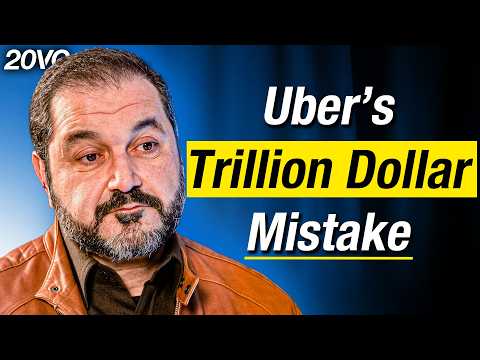
Shervin Pishevar: What Really Happened in the Firing of Travis Kalanick | E1245
Shervin Pishevar (guest), Harry Stebbings (host), Harry Stebbings (host), Harry Stebbings (host)
In this episode of The Twenty Minute VC, featuring Shervin Pishevar and Harry Stebbings, Shervin Pishevar: What Really Happened in the Firing of Travis Kalanick | E1245 explores shervin Pishevar Reveals Inside Story Behind Travis Kalanick’s Ouster Shervin Pishevar recounts his immigrant upbringing, early tech career, and path into venture capital that led to backing Uber at its earliest hyper-growth stage.
Shervin Pishevar Reveals Inside Story Behind Travis Kalanick’s Ouster
Shervin Pishevar recounts his immigrant upbringing, early tech career, and path into venture capital that led to backing Uber at its earliest hyper-growth stage.
He details how he won the Uber deal, his deep partnership with Travis Kalanick and Emil Michael, Uber’s aggressive global expansion strategy, and the massive financial upside it created.
The conversation then turns to Pishevar’s version of the internal power struggle at Uber: he alleges Benchmark’s Bill Gurley orchestrated a campaign, aided by political operatives and an independent investigation, that culminated in Kalanick’s removal during a period of personal tragedy.
Broader themes include the ‘drunken’ era of venture capital, the role of political and PE money in distorting Silicon Valley, his belief Uber forfeited a trillion‑dollar future, and his bullish views on AI, quantum computing, new network states, and the future of venture.
Key Takeaways
Winning iconic deals often depends on relentless relationship-building and being physically present.
Pishevar only secured the Uber investment after a year of persistent outreach, leveraging multiple high-powered referrals, and literally flying to Dublin on a day’s notice—leading to a term sheet that turned roughly $26. ...
Get the full analysis with uListen AI
The biggest outcomes come from backing ‘1000x founders,’ not just good companies.
He frames Travis Kalanick, Elon Musk, and Brian Chesky as rare, near–Nobel caliber founders whose intelligence and intensity can create trillion‑dollar outcomes, arguing it’s worth waiting and concentrating capital on such people.
Get the full analysis with uListen AI
Board composition and investor alignment can determine a company’s destiny.
Pishevar argues Uber had “the wrong VC on the board,” claiming Bill Gurley’s push for an earlier IPO, hiring of investigators, and alleged campaign to remove Kalanick destroyed hundreds of billions in potential value and changed Uber’s trajectory.
Get the full analysis with uListen AI
Founders should be extremely cautious about ‘independent investigations’ in politicized environments.
He views Uber’s decision to hire former Attorney General Eric Holder to investigate culture issues after the Susan Fowler memo as a strategic error that made Kalanick vulnerable to opponents during a broader MeToo and media storm.
Get the full analysis with uListen AI
Loyalty to founders can both protect reputation and invite retaliation.
Pishevar describes fighting publicly and legally on Kalanick’s behalf, which he says triggered a fabricated smear campaign against him; he spent millions on investigations and 1782 actions to uncover Fusion GPS’s role and clear his name.
Get the full analysis with uListen AI
Traditional venture capital is being structurally disrupted from multiple directions.
He contends that PE money pushing into late-stage VC, mega-funds, inflated valuations, and alternative financing (crypto, tokenization, self-funding) have effectively killed the classic boutique VC model, and that early-stage investing will be democratized to non-accredited investors.
Get the full analysis with uListen AI
AI and quantum advances could drive civilizational-scale change within decades.
Pishevar predicts AI–quantum convergence enabling ‘mind of God’ computation, curing most diseases, radically extending healthy lifespan, and reshaping geopolitics and nationhood via network states and new private cities.
Get the full analysis with uListen AI
Notable Quotes
““If Travis and Emil had stayed at Uber, Uber would be a trillion‑dollar company by now.””
— Shervin Pishevar
““You’re turning every car into an iPhone. You’re creating a network machine on wheels.””
— Shervin Pishevar, on Uber’s true vision
““We had the wrong venture capitalist on the board. Unfortunately, in my opinion, it was Bill Gurley at Benchmark.””
— Shervin Pishevar
““The Uber wars is something that should be studied in order to learn lessons about what to do right and what to avoid.””
— Shervin Pishevar
““I actually think the whole point of life is to become a grandparent.””
— Shervin Pishevar
Questions Answered in This Episode
How might Uber’s product roadmap, especially around autonomy and AI, have differed if Travis Kalanick had remained CEO?
Shervin Pishevar recounts his immigrant upbringing, early tech career, and path into venture capital that led to backing Uber at its earliest hyper-growth stage.
Get the full analysis with uListen AI
What governance safeguards should founders negotiate early to prevent board-led coups or misaligned investor actions later?
He details how he won the Uber deal, his deep partnership with Travis Kalanick and Emil Michael, Uber’s aggressive global expansion strategy, and the massive financial upside it created.
Get the full analysis with uListen AI
Where is the line between legitimate activist governance by VCs and unethical attempts to seize control from founders?
The conversation then turns to Pishevar’s version of the internal power struggle at Uber: he alleges Benchmark’s Bill Gurley orchestrated a campaign, aided by political operatives and an independent investigation, that culminated in Kalanick’s removal during a period of personal tragedy.
Get the full analysis with uListen AI
If traditional venture capital is ‘dead,’ what concrete models will replace it for funding the next generation of foundational companies?
Broader themes include the ‘drunken’ era of venture capital, the role of political and PE money in distorting Silicon Valley, his belief Uber forfeited a trillion‑dollar future, and his bullish views on AI, quantum computing, new network states, and the future of venture.
Get the full analysis with uListen AI
How realistic are Pishevar’s timelines for AI–quantum convergence, disease cures, and extended longevity, and what ethical frameworks are needed if he’s right?
Get the full analysis with uListen AI
Transcript Preview
I believe if Travis and Emil had stayed at Uber, Uber would be a trillion-dollar company by now. His true vision for Uber, which was to replace car ownership, and it was at that moment I realized, "Oh, the TAM is trillions."
We are actually full steam ahead. But things start to go wrong.
We had the wrong venture capitalist on the board. Unfortunately, in my opinion, it was Bill Gurley at Benchmark. We found out in our investigation that he hired some private investigators, had weekly meetings about, "How do we get rid of Travis?" That week, Travis tragically lost his mother in a boating accident. Benchmark, Gurley decide to go after Travis.
Ready to go? (instrumental music plays) Shervin, dude, I'm so excited for this. I've wanted to make this one happen for a while, so thank you so much for joining me.
Thank you, Harry. It's, uh, it's exciting to be here.
Now, I would love to start with a little bit of context. Your... I'm actually gonna start, if it's okay with your mother. Um, I'm so sorry for her passing, but I know she was also incredibly impactful to you getting into technology and so talk to me a little bit about her being impactful and getting into technology as a starting point.
Absolutely. Thank you. Um, my mom passed away last Wednesday, um, and, uh, um, we're gonna have our funeral, uh, in a, in a few days. Um, and she was just the most incredible human I've ever met. She was a teacher for 14 years in Iran and when we escaped the revolution, um, and came to America, she started all over again. We came with $35, um, and then, uh, we had to escape, and, uh, we started with nothing, uh, and my dad drove a taxi while getting his PhD. My mom was a maid, uh, and worked two jobs as a caf- cafeteria worker, uh, and a maid, and I used to go clean rooms with her. Uh, so this is the kinda classic, uh, American dream story. And she took computer programming classes at the, uh, at a college in Maryland while I was a, a kid. And so she, and she would take me to her classes. So I... And this was, like, when they had the, uh, the paper, you know, uh, with the holes in it, you'd punch, punch the holes and that, that was how they coded, um, i- in the '80s. And so I, I got to kinda see that, and then I saw, uh, the Apple, um, and I begged for an Apple. My mom and dad worked, uh, you know, overtime for three months to afford it. Back then it was, like, $3,000, which was a lot in 1985, '86. Um, and they bought me my first Apple IIc, uh, and I did my first code on it, uh, and that changed my life. Um, and then later, she secretly put on her credit card a laptop when I was at Berkeley and I didn't have enough money to get th- get a laptop, uh, and she, uh, put it on her credit card and I always said that she was my angel in- my first angel investor, my first believer. But she really taught me how to dream in color, and I'm finding this process of grieving profound, uh, in that I see her now in ways that I couldn't see her when she was alive.
Install uListen to search the full transcript and get AI-powered insights
Get Full TranscriptGet more from every podcast
AI summaries, searchable transcripts, and fact-checking. Free forever.
Add to Chrome