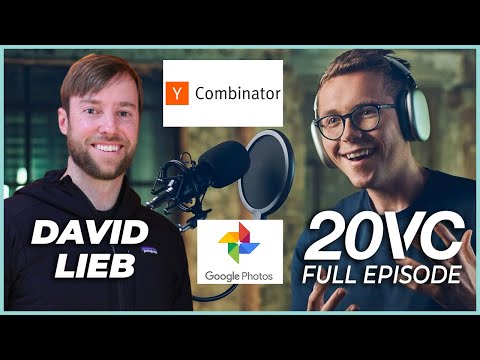
David Lieb: How I Founded Google Photos & Bump; Why I Left Google | 20VC #927
Harry Stebbings (host), David Lieb (guest)
In this episode of The Twenty Minute VC, featuring Harry Stebbings and David Lieb, David Lieb: How I Founded Google Photos & Bump; Why I Left Google | 20VC #927 explores from Bump to Google Photos: David Lieb’s Playbook for Product Mastery David Lieb recounts his journey from engineer and accidental founder of Bump to leading Google Photos for nearly a decade, then leaving Google after surviving leukemia to join Y Combinator. He explains how Bump’s failure to find a business model and its acquisition by Google led to the insight behind Google Photos: everyone would soon drown in unorganized mobile photos. Lieb dives deep into his product philosophy—why product is more art than science, how to truly understand users, and why founder and PM gut instinct is a powerful ‘machine learning model’ rather than something to dismiss. He also covers how to hire and structure product teams, run effective product reviews, recognize real product‑market fit, and avoid common scaling mistakes in both startups and big companies.
From Bump to Google Photos: David Lieb’s Playbook for Product Mastery
David Lieb recounts his journey from engineer and accidental founder of Bump to leading Google Photos for nearly a decade, then leaving Google after surviving leukemia to join Y Combinator. He explains how Bump’s failure to find a business model and its acquisition by Google led to the insight behind Google Photos: everyone would soon drown in unorganized mobile photos. Lieb dives deep into his product philosophy—why product is more art than science, how to truly understand users, and why founder and PM gut instinct is a powerful ‘machine learning model’ rather than something to dismiss. He also covers how to hire and structure product teams, run effective product reviews, recognize real product‑market fit, and avoid common scaling mistakes in both startups and big companies.
Key Takeaways
True product–market fit is unmistakable and all‑consuming.
If you’re unsure whether you have product–market fit, you don’t; when you do, demand is so strong that your time is overwhelmed by keeping systems up and satisfying eager customers, not searching for users.
Get the full analysis with uListen AI
Define a narrow, explicit mission—and be equally clear on what you will not do.
Google Photos succeeded by committing to being “the home for the world’s memories” and explicitly not building a social network or heavy editing tool; this mission filtered who joined, who left, and which features shipped.
Get the full analysis with uListen AI
Use your gut as a trained model, not a random hunch.
Lieb argues your gut is “the world’s most sophisticated ML model,” trained on years of experience; you should aggressively feed it with user research, experiments, and data, then trust it for big product calls and creative bets.
Get the full analysis with uListen AI
Cohort retention curves beat vanity metrics for understanding real usage.
Founders should obsess over whether cohorts flatten—showing a stable, recurring user base—rather than just MAUs or installs, and must beware misleading signals like accidental sessions or poorly qualified signups.
Get the full analysis with uListen AI
Founders usually delegate product and sales too early.
The founder should own core customer interaction and product decisions longer than feels comfortable, only hiring senior product or sales leaders once they are absolutely bottlenecked and the work remains mission‑critical.
Get the full analysis with uListen AI
Hire product people for ambition, user empathy, and first‑principles thinking—not domain pedigree.
Many of Lieb’s best PMs had non‑traditional or unrelated backgrounds; he screens for people who can deeply explain why products are good or bad, are willing to look foolish talking to users, and have a chip on their shoulder.
Get the full analysis with uListen AI
Product culture flows from visible, authentic obsession at the top.
By personally obsessing over tiny UX details (e. ...
Get the full analysis with uListen AI
Notable Quotes
“If you don't know if you've got product–market fit or not, you don't.”
— David Lieb
“Your gut is the world's most sophisticated machine learning model ever created.”
— David Lieb
“Magic happens when you bring all that stuff together in a very small number of people's heads.”
— David Lieb
“I just really wanted Google Photos to exist.”
— David Lieb
“Obsession is a form of love, and love is very hard to fake.”
— David Lieb
Questions Answered in This Episode
How can an early-stage founder practically distinguish between a product that has ‘some resonance’ and one that truly has product–market fit?
David Lieb recounts his journey from engineer and accidental founder of Bump to leading Google Photos for nearly a decade, then leaving Google after surviving leukemia to join Y Combinator. ...
Get the full analysis with uListen AI
What concrete steps can PMs take to better ‘train’ their gut so it becomes a more reliable decision tool rather than a source of bias?
Get the full analysis with uListen AI
How should a founder decide which parts of the product experience must be ‘Google Photos‑level’ polished at launch versus acceptable to ship rough and iterate?
Get the full analysis with uListen AI
In what ways can big tech companies structurally preserve the ownership mentality and product obsession Lieb describes, instead of defaulting to expert silos?
Get the full analysis with uListen AI
Given Lieb’s experience with Bump and Google Photos, how should founders balance a strong mission with the need to pivot when their initial model isn’t working?
Get the full analysis with uListen AI
Transcript Preview
(beeping) Three, two, one, zero. You have now arrived at your destination. Dave, I'm so excited for this. I feel like I know you so well. I spoke to so many people on your team from, you know, Juan to Jamie to James. So, thank you so much for joining me today.
You bet. It's my pleasure.
Now, I wanna start, you know, you've had the most incredible tenure with Google. Tell me, how did you make your way into the world of startups and products and come to, you know, lead Google Photos for the last seven or eight years?
Yeah, I would say it's largely accidental is the- is the true answer. Um, I was an engineer by training in school and I worked as an engineer at Texas Instruments, uh, early in my career. And then, I think like a lot of smart engineers of my era, um, the thing you do next is you leave and you go to business school to learn, quote, "Business," uh, which I did. And, uh, the first week of business school, I was faced with a personal problem, which was I was meeting all of my new classmates and we were trying to share our phone numbers with each other. And I just would like, like five times a day, I would like type in somebody's phone number and then ask them how to spell their name and then I would call them and they would like dismiss the call and add my number to their address book. And it was right when the iPhone had come out and they had just opened up the App Store. And I thought like, "Oh, why hasn't anybody solved this problem?" Like, this should be a solved problem in the world. Like, maybe I can make a side app that would like make it work. Uh, so I started building that as kind of like a side project in school with the aspiration of like maybe making enough money to pay for my business school, which would like, be like on the order of tens of thousands of dollars. And, uh, we launched it and people started using it, like way more than we thought. And so we decided like, "Okay, we should work on it next weekend too." Uh, (laughs) and we said that, you know, for ten successive weekends. And then we decided, "Okay, well maybe we should like try to make this bigger than what we thought it could be." And we had heard of this thing called Y Combinator, uh, which was like this nascent like startup incubator thing. Uh, only we applied to it on a whim and w- we got in and we came out to California that summer to like work on our startup and then we never went back to school and, uh, and I've been doing that. Um, and then, of course, like we pivoted a few times with Bump and ultimately decided to work on photo sharing and then got acquired by Google and then I was there for nine years. (laughs)
Install uListen to search the full transcript and get AI-powered insights
Get Full TranscriptGet more from every podcast
AI summaries, searchable transcripts, and fact-checking. Free forever.
Add to Chrome