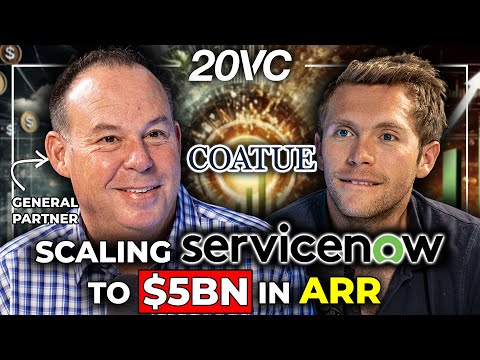
David Schneider: Why the Worst VCs are "Seagull VCs" & VC Value Add - Is it Real? | E1200
David Schneider (guest), Harry Stebbings (host)
In this episode of The Twenty Minute VC, featuring David Schneider and Harry Stebbings, David Schneider: Why the Worst VCs are "Seagull VCs" & VC Value Add - Is it Real? | E1200 explores from Seagull VCs to ServiceNow: David Schneider Redefines Value-Add David Schneider, ex–Data Domain and ServiceNow revenue leader and now growth investor at Coatue, discusses how real operating experience translates into meaningful VC value-add versus performative, low-value board behavior he calls “seagull VCs.”
From Seagull VCs to ServiceNow: David Schneider Redefines Value-Add
David Schneider, ex–Data Domain and ServiceNow revenue leader and now growth investor at Coatue, discusses how real operating experience translates into meaningful VC value-add versus performative, low-value board behavior he calls “seagull VCs.”
He walks through building Data Domain and ServiceNow from tens of millions to billions in revenue, highlighting lessons on urgency, ICP focus, sales playbooks, multi-product scaling, and avoiding ill-advised downmarket moves.
Schneider explains his investment approach: how he evaluates markets, timing, renewals, customer quality and pricing risk, why some 2020–2021 vintages will struggle, and where his sales background gives him an edge in diligence and post-investment support.
Throughout, he stresses people and culture—hiring scrappy talent with something to prove, giving direct feedback, empowering those closest to the customer, and choosing board members with real operating scars rather than pure “board CV” credentials.
Key Takeaways
Anchor products in concrete business value: make money, save money, or avoid disaster.
Schneider insists every enterprise product must clearly show how it increases revenue, reduces cost, or prevents catastrophic risk (e. ...
Get the full analysis with uListen AI
Build urgency and predictability with joint value cases, not end-of-quarter heroics.
At ServiceNow he used structured value discussions (“value prompters”) so executives understood the business case long before approvals, enabling him to reliably call quarters 90–180 days out and avoid chronic slip-driven mistrust.
Get the full analysis with uListen AI
Focus ICP and playbooks before blaming your sales team.
Winning GTM came from tightly defining the ideal customer profile, teaching reps specific stories, objections, and plays, and then hiring hungry, chip-on-shoulder sellers—“land of the misfit toys”—rather than just demanding more activity.
Get the full analysis with uListen AI
Don’t chase downmarket if you’re an enterprise company.
ServiceNow’s failed Express product showed that dumbing down an enterprise platform to fight low-end “ankle biters” created support headaches, unhappy customers, and distraction; it was better to own the high-value segment and let SMB competitors fight each other.
Get the full analysis with uListen AI
Expansion should follow customer pull, not board PowerPoints.
New billion‑dollar products at ServiceNow (HR, customer service, security) came from observing how customers were already repurposing the platform, then productizing those use cases—only after the core ITSM wedge was deeply penetrated.
Get the full analysis with uListen AI
Treat Customer Success headcount as a cost that must prove ROI.
He killed ServiceNow’s generic CS org, folding work into Support, Sales, and paid Services, because with 98%+ renewals he couldn’t get a clear answer to ‘what do these CS people actually do that makes us money? ...
Get the full analysis with uListen AI
Founders must actively manage boards and screen out “seagull VCs.”
He warns against investors who ‘fly in, shit, and fly away,’ advising CEOs to pre‑set board agendas, share three greens and three reds, do pre‑calls with directors, and prioritize board members with relevant operating experience over long board résumés.
Get the full analysis with uListen AI
Notable Quotes
“People buy product for three reasons: to make money, to save money, or to stay off the front page of a newspaper.”
— David Schneider
“There are VCs that are seagulls — they fly into a meeting, take a shit, and fly away.”
— David Schneider
“I realized these people were in the foxhole with me… and I should approach it from a human perspective: ‘I need help. Can you help me?’”
— David Schneider
“We were an enterprise company trying to act like something else.”
— David Schneider
“There is a difference between founder friendly and founder helpful.”
— David Schneider
Questions Answered in This Episode
How can an early-stage founder practically test whether their product truly drives one of Schneider’s three value levers (make money, save money, avoid disaster) before scaling GTM?
David Schneider, ex–Data Domain and ServiceNow revenue leader and now growth investor at Coatue, discusses how real operating experience translates into meaningful VC value-add versus performative, low-value board behavior he calls “seagull VCs.”
Get the full analysis with uListen AI
What specific signals should a CEO look for to know they’re ready to launch a second product or move up/down market, versus doubling down on their core segment?
He walks through building Data Domain and ServiceNow from tens of millions to billions in revenue, highlighting lessons on urgency, ICP focus, sales playbooks, multi-product scaling, and avoiding ill-advised downmarket moves.
Get the full analysis with uListen AI
How would Schneider redesign a modern SaaS company’s Customer Success function from scratch to meet his efficiency bar while still protecting NRR?
Schneider explains his investment approach: how he evaluates markets, timing, renewals, customer quality and pricing risk, why some 2020–2021 vintages will struggle, and where his sales background gives him an edge in diligence and post-investment support.
Get the full analysis with uListen AI
What are concrete ways founders can identify and avoid “seagull VCs” during a fundraising process, especially when capital is scarce?
Throughout, he stresses people and culture—hiring scrappy talent with something to prove, giving direct feedback, empowering those closest to the customer, and choosing board members with real operating scars rather than pure “board CV” credentials.
Get the full analysis with uListen AI
For companies that plateaued after raising at 2020–2021 valuations, what are the realistic strategic options Schneider would recommend: recap, sale, second act, or orderly wind down?
Get the full analysis with uListen AI
Transcript Preview
People buy product for three reasons. They either buy it because it's gonna help them make money, they buy product because it's gonna save them money, or it's gonna keep them off the front page of a newspaper. There are VCs that are seagulls, fly into a meeting, fly into a location, they basically take a shit-
(laughs)
... and they fly away. When you're interviewing potential board members, look for relevant experience, not the fact that they've been on eight other SaaS boards-
Yeah.
... but have they ever done anything themselves?
Ready to go? David, I am so excited for this. I mean, I spoke to so many great mutual friends beforehand. Doug Leone said many wonderful things, which is always wonderful to hear. So thank you so much for joining me today.
Oh, it's absolutely great to be here. I've been listening to the podcast and I feel like, uh, listening to your podcast was part of my education in becoming a better investor. So, uh, thank you for doing what you're doing and it's just great to be here.
Do you know what? It's the British accent, I get an extra 10 points on the IQ scale just with that. But I'm thrilled that you like it (laughs) . I do wanna start though, 'cause you have literally, I think, the most impressive operating career that I've had on the show, definitely for a long time. So when we look at your operating career, what are the single biggest achievements to you that you say to founders as, "Hey, I did this in my operating career."?
Well, thank you. It, it was a 30-plus year operating career. So in that 30 years, there were some, some tough years and some good years. But the two things that kinda stand out, I spent, uh, almost nine years at a company called Data Domain, where I joined, uh, at $0 in revenue, and by the time I left, we'd gone through an IPO, took it to about a billion dollars, and then we got acquired by EMC in a hostile acquisition in 2009. Whole story about hostile acquisitions, if you ever wanna get into that. Um, and then the next one is I spent, uh, 10 years at ServiceNow, uh, joining Frank Slootman, again, who I had the privilege of working with at Data Domain, um, into that company, which was about 80 million or so in size when I joined. And when I left, it was five billion in revenue and, uh, it felt like the job was well done, uh, to make that happen.
Uh, listen, you, you gave me such a great teaser there. Hostile acquisition? How can I, like, let that go under the rug? Wha- what was that process and what did you learn from it?
Oh, my God. So, um, in fact, w- here we are in London and this is a fun story, is, um, we knew that our business was very valuable, even though in 2009 the stock price went down because the market went down. And at the time, in 2009, there was another company called Network Appliance that had approached Frank Slootman about a potential acquisition. And we were close to them. We knew who they were, we're neighbors, they l- they're down the street. A lot of our early engineering team had worked there before and we did not know EMC and in fact, Joe Tucci, when we reached out to him to get to know him, he was always hidden from us, um, because of various reasons. So in, in '09 we sound- signed a definitive agreement to be acquired by Network Appliance, and it was a, it was a good offer and we had all these integration meetings. And I was actually here in London having dinner on Brick Lane, I know, judgment, okay, with my sales team. And my phone rings and it was, um, basically the news that EMC was, uh, launching a hostile acquisition for our company and outbidding, uh, Network Appliance. Now, we were not allowed to talk to the other company, 'cause in a definitive agreement, all we could do is stay quiet. But we had lots of, uh, interesting emails and texts that came in over the line. And it was apparent to us that they weren't gonna go away. But then NetApp, NetApp responded, uh, EMC takes full-page ads out in the Wall Street Journal, in the local paper, was driving trucks around our office saying, "Can't wait to work with you people at Data Domain." It was, it was, uh ... We were the prettiest girl at the dance for the first time in my life and it was really quite exciting.
Install uListen to search the full transcript and get AI-powered insights
Get Full TranscriptGet more from every podcast
AI summaries, searchable transcripts, and fact-checking. Free forever.
Add to Chrome