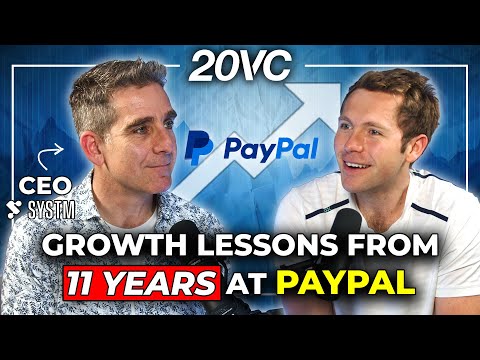
Matt Lerner: How to Hire Growth Leaders and Teams and Why in a World of AI | E1159
Matt Lerner (guest), Harry Stebbings (host), Narrator
In this episode of The Twenty Minute VC, featuring Matt Lerner and Harry Stebbings, Matt Lerner: How to Hire Growth Leaders and Teams and Why in a World of AI | E1159 explores matt Lerner Explains How To Truly Hire And Enable Growth Leaders Matt Lerner, ex-PayPal growth leader and former VC, explains why early-stage founders themselves must be the first heads of growth and why most growth work is information discovery, not playbook execution. He stresses that 90% of results typically come from 10% of initiatives, so the central challenge is quickly finding those few powerful growth levers. The discussion covers defining growth, choosing and evolving a north-star metric, picking and proving channels, and hiring and onboarding early growth talent. Lerner also explores how AI is raising the floor on creative and outbound, and why humility, curiosity, and cross-functionality matter more than classic “marketing experience” in great growth leaders.
Matt Lerner Explains How To Truly Hire And Enable Growth Leaders
Matt Lerner, ex-PayPal growth leader and former VC, explains why early-stage founders themselves must be the first heads of growth and why most growth work is information discovery, not playbook execution. He stresses that 90% of results typically come from 10% of initiatives, so the central challenge is quickly finding those few powerful growth levers. The discussion covers defining growth, choosing and evolving a north-star metric, picking and proving channels, and hiring and onboarding early growth talent. Lerner also explores how AI is raising the floor on creative and outbound, and why humility, curiosity, and cross-functionality matter more than classic “marketing experience” in great growth leaders.
Key Takeaways
Treat early-stage growth as discovery, not playbook execution.
Most startups fail by applying generic ‘best practices’ or last-job playbooks instead of deeply understanding their customer’s context, problems, and effective channels. ...
Get the full analysis with uListen AI
Anchor the company around a value-based north star, not revenue.
Choosing revenue or profit as the north star lets teams game the metric without creating lasting customer value and fragments functional priorities. ...
Get the full analysis with uListen AI
Start with a small set of plausible channels, then go deep on making them work.
There are only a handful of fundamental channels (sales, partners, search/content, paid, influencers), and many can be ruled out quickly by economics or context. ...
Get the full analysis with uListen AI
Use ‘locksmith moments’ to position your product at peak urgency.
Like a locksmith’s sticker on a building gate, the best growth strategies insert the product exactly where and when the customer realizes they have a painful problem. ...
Get the full analysis with uListen AI
Hire bright generalists and scientists as early growth talent, not ‘famous’ marketers.
The best growth people Lerner hired had no formal marketing background; they were scientists who understood data, causation, and experimentation and were humble about what they didn’t know. ...
Get the full analysis with uListen AI
Design interviews to test learning mindset, integrity, and problem-thinking.
Ask candidates what they want to learn, to describe real mistakes and lessons, and to identify open questions in your business to separate playbook-runners from playbook-writers. ...
Get the full analysis with uListen AI
Onboard growth hires as information sponges, then force hard prioritization.
First, have them absorb everything about customers, data, and internal capabilities (customer calls, historical experiments, funnel metrics, team strengths). ...
Get the full analysis with uListen AI
Notable Quotes
“Ninety percent of our growth came from like ten percent of the stuff that we did.”
— Matt Lerner
“So much of growth is just trying to figure stuff out as quickly as possible.”
— Matt Lerner
“Your first head of growth is your founder.”
— Matt Lerner
“There’s really only like six channels in the world.”
— Matt Lerner
“Science without art can deliver business results, and art without science… if it does, it’s very rare and exceptional, down to luck.”
— Matt Lerner
Questions Answered in This Episode
How can an early-stage founder practically distinguish between necessary experimentation and wasteful thrashing when exploring growth channels?
Matt Lerner, ex-PayPal growth leader and former VC, explains why early-stage founders themselves must be the first heads of growth and why most growth work is information discovery, not playbook execution. ...
Get the full analysis with uListen AI
What concrete signals show that it’s time to evolve or replace your current north-star metric?
Get the full analysis with uListen AI
How would you adapt Lerner’s ‘locksmith moment’ idea in a low-urgency, nice-to-have product category?
Get the full analysis with uListen AI
Given AI’s impact on creative and outbound, where should new growth leaders focus to build a durable, non-commoditized advantage?
Get the full analysis with uListen AI
What are the earliest warning signs that a growth hire—no matter how impressive their background—is a poor fit for a startup environment?
Get the full analysis with uListen AI
Transcript Preview
There's really only, like, six channels in the world. If you think about how are the ways you find out about stuff. You hear from a salesperson, some partner brings you in 'cause to enable you to do something, you do a Google search, or there's some content or inbound, paid ads, or maybe you hear about it from an influencer. I'll say categorically, the best growth people I hired and managed in my time at PayPal had no marketing experience, had no product experience at all. (camera shutter clicks)
Ready to go? (instrumental music plays) Matt, I cannot believe it has been, oh, I think it must be, I mean, eight, 10 years since we first met. You were one of the first people I met in tech in London, so thank you so much for doing this.
Likewise, it's my pleasure. Thanks for having me.
Now, I would love to start with some chronology. So how did you make your way into the world of growth and what was that entry point for you?
I guess, I mean, my career started in Silicon Valley. And, you know, I was, like, humanities, Philosophy and Rhetoric undergrad, and so I was kind of taking any job I could find, and what, what I sort of got pulled to was this figuring out how to get customers stuff. Um, and eventually in, in 2004, I joined the growth team at PayPal. And obviously, you know, we know how that story went. Um, and I learned just a ton of stuff in almost 10 y- almost 11 years there. And then after that, I left, I became a VC myself. That's kind of when we met. And I got to see, you know, as a VC, you just get to see so many startups rapid fire, and see inside of them, and what's happening, and their metrics and the people's personalities. And I just, to be honest, I started to see a lot of teams wasting a lot of money and a lot of real talent making the same mistakes over and over again, very preventable mistakes. And, you know, that combined with the fact that I didn't love fundraising-
(laughs)
... as we were just talking about. So I left VC and I started my own business where I work with startups and kind of help them avoid those preventable mistakes and find their, their high impact growth levers.
If we just unpack a, a couple of elements there-
Yeah.
... 11 years at PayPal is a hugely, uh, impactful, uh, segment of your career. What are one or two of your biggest lessons from that 11 years?
So many of them. I think, you know, towards the end it got to the point when you're in a big company where having the right answer is like 5% or 10% of the problem, and getting the entire organization and to change people's mindset and align resources ends up becoming like 80% or 90% of the problem. I'm sure I've messed up the math there, but something like that. And so I'm very much more shifting my time and my hiring strategy and everything more around influence. So, that was a big piece of it. The other big one is when I look back on my time at PayPal, 90% of our growth came from like 10% of the stuff that we did. And by that I mean like I could go back and say, you know, there are five or six things, obviously before my time, getting on eBay, uh, referral bonuses and, you know, network effects growth, getting early, getting engaged with web developers who were building the sites and implementing the payment systems, getting pre-integrated with shopping carts and hosts, some outbound sales. Like, that drove almost all their growth. But they did still, like, a ton of other stuff. They spent hundreds of millions of dollars on marketing campaigns, building products that frankly nobody ever used. And you can do that when you're generating hundreds of millions per year in free cashflow. But startups don't have that luxury. But then, you know, when I step back and, as a VC, and start to look at other success stories, I start to see that pattern repeat of like 90% coming from 10%, you know, and you can see it. You know, you've had these people on your show, Canva and Dropbox and, and all of these. And so that sort of got me into this question of like, okay, as an early stage startup without all that free cashflow, how can you figure out what that 10%-
Install uListen to search the full transcript and get AI-powered insights
Get Full TranscriptGet more from every podcast
AI summaries, searchable transcripts, and fact-checking. Free forever.
Add to Chrome