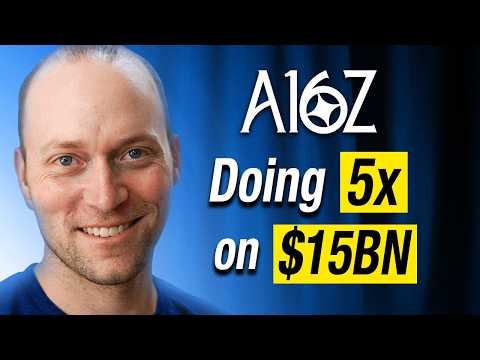
Alex Rampell: The Best Founders Materialise Capital, Customers & Labour | The Future of Venture
Alex Rampell (guest), Harry Stebbings (host), Harry Stebbings (host)
In this episode of The Twenty Minute VC, featuring Alex Rampell and Harry Stebbings, Alex Rampell: The Best Founders Materialise Capital, Customers & Labour | The Future of Venture explores alex Rampell on venture scale, founder traits, and enduring moats Rampell argues venture is experiencing a “death of the middle”: the winners will be either large generalist platforms (with massive networks and services) or small specialist funds (with deep domain credibility), while mid-sized generalists get squeezed on deal access and differentiation.
Alex Rampell on venture scale, founder traits, and enduring moats
Rampell argues venture is experiencing a “death of the middle”: the winners will be either large generalist platforms (with massive networks and services) or small specialist funds (with deep domain credibility), while mid-sized generalists get squeezed on deal access and differentiation.
He frames venture investing as buying out-of-the-money call options, emphasizing that the job is to “find, pick, and win” great deals—and winning is hardest exactly when the deal is best because founders can choose investors.
On founder quality, Rampell prioritizes people who can “materialize labor, capital, and customers,” who study the history of their domain, and who have unusually strong motivation (“Count of Monte Cristo” energy) beyond making money.
He also lays out three core theses for the apps fund—greenfield systems of record, software that replaces labor but must become sticky, and “walled gardens” built on proprietary data—and gives tactical advice on pricing/ownership, successive rounds, and selling companies via long-running relationship “cron jobs.”
Key Takeaways
Venture winners will be big platforms or small specialists—not mid-sized generalists.
Rampell believes a “death of the middle” is playing out across asset classes: founders pick investors who either bring massive platform leverage (network, services, brand) or deep specialty expertise; mid-sized generalists often can’t win the best deals.
Get the full analysis with uListen AI
At scale, LPs often prefer lower multiples on more dollars.
He argues returning gross dollars can matter more than headline multiples: a 3x on $1B can be preferable to 5x on $50M, even though small funds can mathematically post higher multiples.
Get the full analysis with uListen AI
Venture is selling founders, not buying companies at auction.
Unlike PE, the best venture deals are “won” through founder choice. ...
Get the full analysis with uListen AI
Back exceptional founders who can materialize labor, capital, and customers.
Rampell’s top founder heuristic: can they recruit great people quickly (even at pay cuts), raise capital effectively across rounds, and land the first critical customers—especially hard in enterprise/vertical SaaS.
Get the full analysis with uListen AI
Look for founders who study domain history—and guard against ‘knowing too much.’
He sees “studied history” as a hallmark (Collisons/Stripe, Vlad/Robinhood, Chesky/Airbnb). ...
Get the full analysis with uListen AI
In fast-copy software markets, moats come from ‘hostages’: data, workflows, and systems of record.
As building software becomes trivial, application-layer competition explodes. ...
Get the full analysis with uListen AI
Two deal types: ‘any % of what’s absolutely working’ vs ‘high ownership of what might work.’
If traction is undeniable (rare, decade-level winners), ownership rules loosen. ...
Get the full analysis with uListen AI
Successive rounds and big secondaries can introduce moral hazard.
Quick preemptive rounds (A→B with little progress) can work if founder-capital fit is strong, but excess capital can lead to ‘foie gras’ behavior—too many initiatives, slower decisions, worse culture. ...
Get the full analysis with uListen AI
AI creates ‘labor-replacement’ hypergrowth, but the best versions must evolve into sticky software.
Products that replace human work can scale extremely fast (e. ...
Get the full analysis with uListen AI
Selling a company is a long, choreographed process—not a last-minute corp dev sprint.
He advises CEOs to run a continuous ‘background process’ cultivating relationships with likely acquirers (often business-unit leaders, not corp dev), ideally through partnerships that make the acquisition feel inevitable.
Get the full analysis with uListen AI
Notable Quotes
“There is this kind of death of the middle that happens to a lot of asset classes.”
— Alex Rampell
“The entire job of venture capital is to find, pick, and win investments. If they're good investments, the winning is very, very hard.”
— Alex Rampell
“We are buying out-of-the-money call options, and we hope they expire in-the-money.”
— Alex Rampell
“The best companies have hostages, not customers.”
— Alex Rampell
“In 2025, the ability to go create a software product is so easy… This can take weeks, which is bonkers.”
— Alex Rampell
Questions Answered in This Episode
You describe “death of the middle” in venture—what specific capabilities (services, network density, brand, decision speed) separate a winning large generalist from a losing mid-sized generalist?
Rampell argues venture is experiencing a “death of the middle”: the winners will be either large generalist platforms (with massive networks and services) or small specialist funds (with deep domain credibility), while mid-sized generalists get squeezed on deal access and differentiation.
Get the full analysis with uListen AI
On “materialize labor, capital, and customers”: what are your top 3 signals in the first meeting that predict each of those (recruiting, fundraising, selling) will happen?
He frames venture investing as buying out-of-the-money call options, emphasizing that the job is to “find, pick, and win” great deals—and winning is hardest exactly when the deal is best because founders can choose investors.
Get the full analysis with uListen AI
Your ‘hostages not customers’ idea: what are concrete product architecture choices early-stage teams should make to become a system of record (data model, workflow ownership, integrations)?
On founder quality, Rampell prioritizes people who can “materialize labor, capital, and customers,” who study the history of their domain, and who have unusually strong motivation (“Count of Monte Cristo” energy) beyond making money.
Get the full analysis with uListen AI
Greenfield bingo depends on new-company formation. Which software categories today still have high enough ‘new logo’ creation to be viable, and which categories are effectively closed because incumbents have hostages?
He also lays out three core theses for the apps fund—greenfield systems of record, software that replaces labor but must become sticky, and “walled gardens” built on proprietary data—and gives tactical advice on pricing/ownership, successive rounds, and selling companies via long-running relationship “cron jobs.”
Get the full analysis with uListen AI
You said only ~5% of unicorns may go public—what operational or financial patterns distinguish that 5% from the 95% (retention, Rule of 40, margin structure, distribution)?
Get the full analysis with uListen AI
Transcript Preview
I think you wanna invest in people that can materialize labor, capital, and customers. We either wanna buy any percent, any percent, right, of something that is absolutely working, or high ownership of something that could work.
$15 billion. That is how much Andreessen Horowitz just raised. Today, I'm joined by Alex Rampell, where he leads their $1.7 billion apps fund.
The best companies have hostages, not customers. In 2025, the ability to go create a software product is so easy. This can take weeks, which is bonkers. The battle of every startup versus incumbent is whether the startup gets the distribution before the incumbent gets the innovation, right? So probably of the unicorn class, I would bet that maybe 5% will ever be able to go public. If you win 100% of the deals, that's a very, very good sign, but if you're winning them with very low ownership, you're probably not testing how far you can go. The entire job of venture capital is to find, pick, and win investments. If they're good investments, the winning is very, very hard. We are buying out-of-the-money call options, and we hope they expire in-the-money. I don't necessarily think you can take it as a given that a small fund will outperform a large fund. Ready to go? [upbeat music]
Alex, dude, it's been eight years. I'm hoping that my question-asking ability has gone up in terms of quality in those eight years. Now, listen, I wanna start: $15 billion you raised today, and I was just looking at that, and I was wondering, in an age of venture today, do you have to go really big or go crafts and very small and boutique to win in venture today?
Yeah, I mean, I think th- this is, um, uh, this sounds like a bad word when I say death, but there is this kind of death of the middle that happens to a lot of asset classes in general. In venture capital, it was a tiny, tiny asset class at the beginning. Um, right now, it's gotten bigger, but it's really more of the end state of a lot of these companies is huge. I mean, Sequoia used to brag about, I think it was like 20% of the market cap of the NASDAQ was Sequoia companies. Millions of pe- like, you know, Apple and Oracle and all of these, these amazing names. Um, they're very, very big, right? And companies go public much, much later today, so the ability to deploy more capital, more money into kind of venture capital, which is no longer, um... You know, kind of si- sidetrack here. Series D didn't exist in, like, 1992, right? It's like that was an IPO. Like, companies would go public. I think Amazon went public at, like, a $600 million market cap or something. Like, that was the norm. There was no Series I, Series K, Series, you know, W. You would just go pub- you'd raise, you know, Series A, raise Series B, raise Series C, then go public. Um, and consequently, venture firms back then were very, very small, but also the exits tended to be quite small as well. Right, like, if, if, if a very, very good scenario is you have a company that goes public at a sub-billion dollar market cap, it's like... And you get five of those a year, like, you, you can't raise lots of money, but now the opportunity is so much bigger. The five biggest companies on Earth are all technology companies. If you rewind 20 years, I think they were all banks. If you rewind 10 years before that, they were all oil companies. If you ri- rewind 10 years before that, they were all Japanese companies during, like, the Japanese stock market bubble. But, you know, the opportunity in technology is so much bigger, especially because these companies, you, you can- you could keep investing venture capital dollars later. Like, I think that's one of the main... If you look at the money that we just raised, you know, almost $7 billion of that is for the growth fund. And what is-
Install uListen to search the full transcript and get AI-powered insights
Get Full TranscriptGet more from every podcast
AI summaries, searchable transcripts, and fact-checking. Free forever.
Add to Chrome