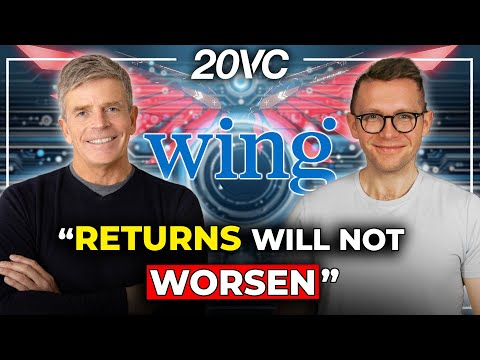
Peter Wagner: 27 Years of Investing Lessons of Picking Founders, Price Discipline & Reserve | E1123
Peter Wagner (guest), Harry Stebbings (host), Narrator
In this episode of The Twenty Minute VC, featuring Peter Wagner and Harry Stebbings, Peter Wagner: 27 Years of Investing Lessons of Picking Founders, Price Discipline & Reserve | E1123 explores veteran VC Peter Wagner On Discipline, Founders, And Venture Cycles Peter Wagner, co‑founder of Wing and longtime Accel partner, reflects on 27 years in venture capital, from accidentally entering the industry in 1996 to backing companies like Snowflake, Gong, and Pinecone.
Veteran VC Peter Wagner On Discipline, Founders, And Venture Cycles
Peter Wagner, co‑founder of Wing and longtime Accel partner, reflects on 27 years in venture capital, from accidentally entering the industry in 1996 to backing companies like Snowflake, Gong, and Pinecone.
He contrasts focused, returns‑driven early‑stage investing with large AUM ‘aircraft carrier’ firms, emphasizing price discipline, capital efficiency, and staying within sectors you deeply understand.
Wagner dives into founder selection (pissed‑off domain insiders with glaring problem insight), the dangers of over- or under-learning from past cycles, and how to approach AI, category creation, and market timing without being swept up in hype.
He also discusses building and developing investors, the tension between ownership and dilution, how ZIRP excess distorted behavior, and why he believes venture remains structurally attractive despite growing commoditization and capital inflows.
Key Takeaways
Differentiate between asset gathering and returns-focused venture models.
Large ‘aircraft carrier’ firms optimize for deploying vast AUM and achieving “good enough” returns, while focused boutiques like Wing constrain fund size, avoid capital-intensive bets, and optimize multiple on invested capital rather than dollars deployed.
Get the full analysis with uListen AI
Back deeply informed, ‘pissed off’ domain insiders in B2B.
Wagner’s best founders (e. ...
Get the full analysis with uListen AI
Use pattern recognition, but don’t be its prisoner.
Patterns are helpful, but the real pattern in breakout companies is often the anomaly—teams, markets, or structures that don’t fit standard templates but are uniquely suited to a specific opportunity.
Get the full analysis with uListen AI
Aim for a tight wedge into a truly large market.
Early-stage startups should have a narrowly defined ICP and clear pain (the wedge), but that wedge must naturally expand into a very large market; relying on multi-step ‘we’ll later add X and Y’ roadmaps is usually too risky.
Get the full analysis with uListen AI
Avoid venture models that rely on extreme capital intensity.
Telecom, clean tech, defense, and some climate/energy plays can be good businesses but often require high-yield debt, government money, or miracle financings; they typically don’t fit classic venture economics that depend on moderate capital and outsized IP-driven upside.
Get the full analysis with uListen AI
Price anxiety often reflects weak conviction, not just valuation.
In early stage, price matters but isn’t everything; Wagner notes that when he feels overly queasy about a price, it often signals that his underlying conviction isn’t deep enough, which is more important than haggling over a few points of dilution.
Get the full analysis with uListen AI
Great VCs and founders must balance individual accountability with group support.
Accel’s talent model mixed ‘sleepless night’ personal ownership for deals with guardrails and a flat partnership, giving juniors real responsibility while preventing catastrophic errors and accelerating learning.
Get the full analysis with uListen AI
Notable Quotes
“You wanna learn from the past, but you don’t wanna overlearn from the past.”
— Peter Wagner
“Anytime you meet an investor that talks about the amount of capital they deploy per year, you know you’re talking to an asset gatherer.”
— Peter Wagner
“The anomaly is the pattern sometimes.”
— Peter Wagner
“Some businesses might be good businesses but really aren’t venture‑appropriate.”
— Peter Wagner
“Hunger is important for everybody.”
— Peter Wagner
Questions Answered in This Episode
How should an early-stage founder practically decide between taking a ‘10 on 50’ round from a big platform fund versus a smaller, more engaged investor at a lower valuation?
Peter Wagner, co‑founder of Wing and longtime Accel partner, reflects on 27 years in venture capital, from accidentally entering the industry in 1996 to backing companies like Snowflake, Gong, and Pinecone.
Get the full analysis with uListen AI
In today’s AI hype cycle, what concrete criteria would you use to distinguish between frothy LLM infrastructure bets and durable, returns-driven AI applications?
He contrasts focused, returns‑driven early‑stage investing with large AUM ‘aircraft carrier’ firms, emphasizing price discipline, capital efficiency, and staying within sectors you deeply understand.
Get the full analysis with uListen AI
How can emerging managers design their firm structures to avoid drifting into AUM-driven behavior as they succeed and LPs push them to scale?
Wagner dives into founder selection (pissed‑off domain insiders with glaring problem insight), the dangers of over- or under-learning from past cycles, and how to approach AI, category creation, and market timing without being swept up in hype.
Get the full analysis with uListen AI
What specific signals help you distinguish between being ‘right but early’ on a new category versus simply being wrong on market timing?
He also discusses building and developing investors, the tension between ownership and dilution, how ZIRP excess distorted behavior, and why he believes venture remains structurally attractive despite growing commoditization and capital inflows.
Get the full analysis with uListen AI
Given his skepticism about capital-intensive plays, what would have to be true for Wagner to back a deep tech or defense company today?
Get the full analysis with uListen AI
Transcript Preview
The very best founders that I work with, the most talented, most capable, most sought after, are also the ones where, you know, we have the highest bandwidth engagement. You need to have just some glaring deficiency in, in the current, (laughs) in the current approaches. And so you almost need to find, you know, founders that are, like, just pissed off.
Peter, this is such a joy to do. I've heard so many great things from many different members on your team and founders that you've worked with. So thank you so much for joining me today.
Yeah. Thanks for having me. I'm a, I'm a big fan of your work, big fan of the show. It's, uh, it's great to be here.
That's very, very kind of you. I would love to start with a little bit of scene setting, though. Uh, you joined venture, um, a w- a while (laughs) ago, in July '96. Um, how did you get the job at Accel? Can you just take me to that and how you got into venture there?
It was kind of an accident. I was trying to get a job in a startup and I inadvertently became a venture capitalist. Um, but I, I was a product manager at a company called Silicon Graphics, which was a high-flyer in the early '90s. We were doing 3D graphics and digital media. And, uh, I'd been there about four years (clears throat) and it- you know, the reason I'd gone there was to try and get the base of experience that could make me, you know, somewhat valuable (laughs) in a startup. So I was starting to talk to some startup opportunities, and got to know a few of the venture backers in the course of that.
Mm-hmm.
And it turned out that none of those startups were quite right for me. But, uh, some of the venture people said, you know, "Hey, may- maybe you might wanna come and, and work with us for a while." And I, I thought that might be a decent, uh, position to, you know, identify a better startup opportunity. So, uh, so I ended up joining Accel. Um, I took a pay cut (laughs) to do it, uh, and I thought of it as like ... And, and I wasn't making a lot of money at SGI, so that, that kind of tells you how, how the industry worked then. But, um, I thought I might be there for, like, 18 months and, you know, it's been a little longer than that. (laughs)
At what point did you realize it was what you wanted to do?
Pretty quickly, actually. I was pretty lucky too, Harry. Like, if you remember, you know, those days, you know, joining in '96 and, and working in the late '90s, I mean, the internet boom was on, you know, the Netscape IPO had happened. Uh, and, uh, a lot of things, you know, were happening that n- no one had really seen (laughs) before. And so it was, it was really fertile ground. It was really fun. Um, you know, I got very lucky with, you know, a number of my early investments.
Install uListen to search the full transcript and get AI-powered insights
Get Full TranscriptGet more from every podcast
AI summaries, searchable transcripts, and fact-checking. Free forever.
Add to Chrome