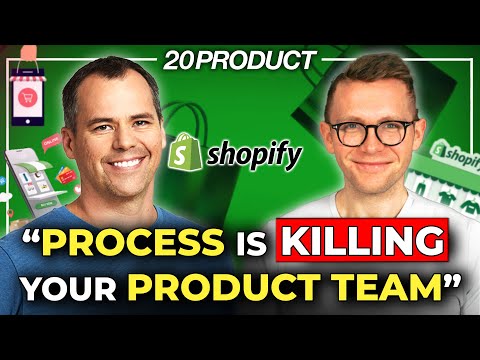
Jean-Michel Lemieux: Three Product Decisions Every Team Needs to Make | E1129
Jean-Michel Lemieux (guest), Harry Stebbings (host), Narrator, Narrator
In this episode of The Twenty Minute VC, featuring Jean-Michel Lemieux and Harry Stebbings, Jean-Michel Lemieux: Three Product Decisions Every Team Needs to Make | E1129 explores jean-Michel Lemieux: Build Movements, Ship Relentlessly, Kill Planning Theater Jean-Michel Lemieux, former CTO at Shopify and Atlassian, explains how great product and engineering orgs win by building movements around their products, obsessing over what they ship, and stripping away wasteful process. He contrasts Shopify’s bias toward quality with Atlassian’s bias toward speed, and argues founders must deliberately choose which things to polish and which to rush every month. Lemieux lays out his philosophy of minimizing planning ‘time-horizon friction,’ measuring teams by output rather than ceremonies, and using tight, frequent alignment instead of heavy process. He also covers hiring frameworks, the impact of AI on software teams, and why “hire great people and get out of the way” is dangerously incomplete advice.
Jean-Michel Lemieux: Build Movements, Ship Relentlessly, Kill Planning Theater
Jean-Michel Lemieux, former CTO at Shopify and Atlassian, explains how great product and engineering orgs win by building movements around their products, obsessing over what they ship, and stripping away wasteful process. He contrasts Shopify’s bias toward quality with Atlassian’s bias toward speed, and argues founders must deliberately choose which things to polish and which to rush every month. Lemieux lays out his philosophy of minimizing planning ‘time-horizon friction,’ measuring teams by output rather than ceremonies, and using tight, frequent alignment instead of heavy process. He also covers hiring frameworks, the impact of AI on software teams, and why “hire great people and get out of the way” is dangerously incomplete advice.
Key Takeaways
Build movements, not just products.
Both Shopify and Atlassian deliberately built communities and narratives—around entrepreneurship and team collaboration—so customers felt part of a movement, which made distribution, word-of-mouth, and long-term loyalty far easier than product alone.
Get the full analysis with uListen AI
Consciously split work into ‘polish’ and ‘rush’ buckets every month.
Founders shouldn’t choose speed or quality in aggregate; instead, they should decide which features must be world-class and shareable, and which can be good-enough, recalibrating those buckets monthly to maintain momentum without sacrificing key experiences.
Get the full analysis with uListen AI
Eliminate ‘time-horizon friction’ by radically shrinking planning.
Over-planning drags builders into endless meetings about work months away, creating friction between planners and coders; Lemieux combats this with a clear 3-year vision, one-month planning windows, and a single one-hour weekly team meeting focused on what’s shipping now and next.
Get the full analysis with uListen AI
Measure teams primarily by output: what shipped and how good it is.
He evaluates leaders by asking what their teams shipped and how they rank the work (good vs. ...
Get the full analysis with uListen AI
Replace ‘hire great people and get out of the way’ with intense early alignment.
True autonomy only works after leaders and new hires have ‘pair-programmed on leadership’—co-shipping a few critical initiatives together, exchanging feedback frequently (often daily via Slack) to build a shared quality bar and decision-making model.
Get the full analysis with uListen AI
Use the ‘snowboard test’ to hire for genuine motivation, not just credentials.
Lemieux asks candidates for their dream job at the company, then has them teach him their craft and describe the hardest thing they’ve built; this exposes what they truly want to do, their depth across layers (tech, people, process), and whether the role matches their instinctive drive.
Get the full analysis with uListen AI
AI copilots will shrink teams but massively expand what gets built.
He uses AI tools that write ~80% of his code, freeing him to focus on architecture and hard problems; he expects companies to ‘un-bloat,’ programmers to be more widely distributed into neglected domains like healthcare and government, and the overall software surface area to grow.
Get the full analysis with uListen AI
Notable Quotes
“You don't build a product, you build a movement.”
— Jean-Michel Lemieux
“Shopify will ship on quality. Atlassian will ship on speed.”
— Jean-Michel Lemieux
“Code talks and bullshit walks.”
— Jean-Michel Lemieux
“Most companies over-plan 100X. You end up having more meetings about work you’re not doing yet than doing the actual work.”
— Jean-Michel Lemieux
“Hiring great people and getting out of their way is some of the worst advice out there.”
— Jean-Michel Lemieux
Questions Answered in This Episode
How can an early-stage startup practically start building a ‘movement’ around its product rather than just focusing on features?
Jean-Michel Lemieux, former CTO at Shopify and Atlassian, explains how great product and engineering orgs win by building movements around their products, obsessing over what they ship, and stripping away wasteful process. ...
Get the full analysis with uListen AI
What would it look like to run a current team or company with Lemieux’s ultra-light process model—one weekly hour and one-month horizons—and what risks would you need to mitigate?
Get the full analysis with uListen AI
How do you decide, in your own roadmap, which features belong in the ‘polish’ bucket and which in the ‘rush’ bucket without hurting your brand?
Get the full analysis with uListen AI
If you adopted the ‘snowboard test’ in your hiring, how might it change the kind of people you bring in and the roles you place them into?
Get the full analysis with uListen AI
Given AI’s rapid impact on coding productivity, where in your organization could you most effectively ‘un-bloat’ teams and redeploy talent to higher-leverage problems?
Get the full analysis with uListen AI
Transcript Preview
Shopify will ship on quality. Atlassian will ship on speed. You don't build a product, you build a movement. I believe that one of the things that slows teams down the most is what I call time horizon friction. And time horizon friction is caused by a lot of process, and that process is you have a lot of people who want to put plans in place, and they feel comfort.
Jean-Michel, I've heard so many good things from Scott, from Harley. I mean, just brilliant references. What more could you want? But, uh, thank you so much for joining me today.
It's my pleasure to be here, finally.
Uh, finally. Uh, I wanna start with a little bit of context. So I always find, like, finding one's love in life is actually quite rare. Many people don't actually find their love. And so I wanna start on yours. When did you first fall in love with product and tech, and can you take me to that moment?
It's, I think love's a good word. I think, I, I think we, we use that word kind of, we throw it around, but I, I think love is a good word of describing where I'm at, and I'll, I'll tell you why. So I got into computer-y things through, uh, fine arts in high school. So we're going back to 1988. I'm in high school, and I, there's just too many things I like doing. So I picked I'm gonna do fine arts and music and math. And I ignored everything in between. I'd never taken any biology class. I'd never taken any history. I did, literally did fine arts, music, and math. So my days were, you know, drawing and painting, music, band class, and then I did, I did math.
Mm-hmm.
And then at one year, I told the band leader, I said, "Hey, my parents got me a computer, and it turns out that there's this protocol called MIDI, and I can, I have a keyboard, and I know we're doing a Phantom of the Opera, Les Miserables mix. What if I did all the music for it? Like, myself, you don't need the band." And she was like, "That's crazy." And I was like, I was like, "I think I can pull it off." So I used this program called Cubase, like, version 1.1 in 1988 and, um, I guess this is way before AI, but I basically fired the high school band that they didn't have to do anything for the whole musical that year. And I pulled off, um, uh, Les Mis, Phantom of the Opera medley, uh, with my computer and my keyboard, and I, I recorded a, you know, I recorded a bunch of tracks. I did, you know, some stuff, and then I did one, I played one live. And, um, you know, fact, that was like, I was in grade 11 or something. I'm in grade 13, and I'm like, "What am I gonna do with my life?" And my guidance counselor was like, "I think you should go into this computer thing." I'm like, "Ah, but my parents, like, I mean, they don't know any, like, I know no one who does this for a career, like, I'm, I'm just doing this for fun." And, um, she was right. I went into computer science and never looked back. So I think I, I stumbled into it kind of young, but I, I've, I've always seen computers as a tool, you know? For me, it was like, hey, it's really cool that I could do this thing. This computer's like a, a companion, a co-pilot for creativity, you know? So that's, I, I never got into, like, pro- I was not, like, a programmer. I was like, a computer's like a tool that can make really cool shit happen, right? And so that's how I, I fell in love with it.
Install uListen to search the full transcript and get AI-powered insights
Get Full TranscriptGet more from every podcast
AI summaries, searchable transcripts, and fact-checking. Free forever.
Add to Chrome