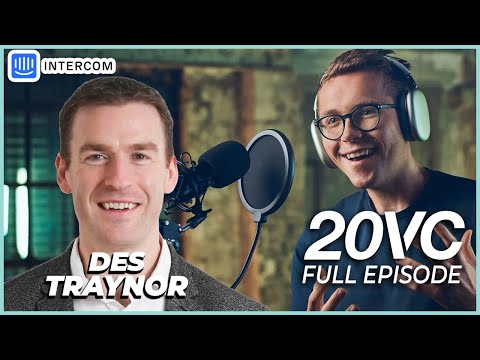
Des Traynor: How I Founded Intercom; Product Marketing Tips; Feature Creep | 20VC #907
Des Traynor (guest), Harry Stebbings (host), Narrator
In this episode of The Twenty Minute VC, featuring Des Traynor and Harry Stebbings, Des Traynor: How I Founded Intercom; Product Marketing Tips; Feature Creep | 20VC #907 explores des Traynor on Intercom, product focus, and ruthless startup clarity Des Traynor recounts Intercom’s origins, born from an internal tool to talk to customers in‑product that clearly rode major SaaS and messaging trends and quickly pulled demand from others. He explains how he evaluates ideas, founders, and markets as an angel, strongly favoring exceptional people, differentiated distribution, and real, recurring problems over clever concepts or early CAC/LTV spreadsheets.
Des Traynor on Intercom, product focus, and ruthless startup clarity
Des Traynor recounts Intercom’s origins, born from an internal tool to talk to customers in‑product that clearly rode major SaaS and messaging trends and quickly pulled demand from others. He explains how he evaluates ideas, founders, and markets as an angel, strongly favoring exceptional people, differentiated distribution, and real, recurring problems over clever concepts or early CAC/LTV spreadsheets.
A large portion of the conversation covers product strategy: when something is a feature vs. a product, when to launch a second product, how to fight inevitable feature creep, and how to decide when to kill underperforming features. Traynor also dives deep into product marketing, emphasizing clear positioning for buyers vs. users, verticalized messaging for horizontal tools, and the often invisible work required to move upmarket.
He shares candid views on startup patterns he avoids (e.g., “all your data in one place” and Google Doc clones), his approach to blunt but constructive feedback, and lessons from angel investing while still operating Intercom. The discussion closes on leadership, parenting parallels, hiring mistakes, personal insecurity, and the mental pressure of carrying long‑term responsibility for a company and its people.
Key Takeaways
Prioritize exceptional founders over unique ideas, because being first rarely matters.
Traynor argues that any good idea is quickly copied; sustained advantage comes from teams who are more capable, more focused, and care more, not from the originality of the concept.
Get the full analysis with uListen AI
Ship differentiators first, especially for long-road, hard-to-copy products.
For things like a new email client or a Figma‑style tool, he advises proving the unique value early rather than spending years just catching up to incumbents before adding what actually makes you different.
Get the full analysis with uListen AI
Treat most early-stage metrics like CAC/LTV as a distraction and obsess over distribution instead.
At seed and Series A, he cares far less about precise efficiency ratios and far more about whether a startup has a clearly differentiated, realistic route to customers that competitors can’t easily mimic.
Get the full analysis with uListen AI
Decide feature vs. product from the customer’s perspective, not the balance sheet’s.
If customers expect something as part of a contiguous workflow—and currently solve it inside your product or with basic tools—it should likely be a feature; if they already buy a separate product, you may have permission to make it a standalone offering.
Get the full analysis with uListen AI
Kill features and products based on trajectory and self‑propulsion, not just snapshots.
If a feature only shows life when heavily pushed by marketing and never builds its own sustained usage, it should be sunset, fully removed, and the mistaken assumptions that spawned it should be examined.
Get the full analysis with uListen AI
Moving upmarket requires adaptability, scalability, justifiability, and interoperability, not just UI polish.
Enterprise readiness means compliance, SSO, scale, deep reporting or data export, and tight integration into existing stacks; these are non‑visual, unsexy capabilities that must be deliberately built and marketed.
Get the full analysis with uListen AI
Complexity carries a hidden, organization‑wide cost that should be priced into every product decision.
Every new feature must be marketed, sold, supported, and understood by go‑to‑market teams; what looks like a small engineering addition can radically increase cognitive load, brand confusion, and long‑term maintenance burden.
Get the full analysis with uListen AI
Notable Quotes
“Being first doesn’t matter. A mediocre person with a unique idea will lose.”
— Des Traynor
“You have to ship your differentiators first. Don’t spend two years catching up to Gmail and only then add what makes you different.”
— Des Traynor
“Most startups fail out not on CAC/LTV efficiency but on a blank face when you ask, ‘Do you have a differentiated route to customers?’”
— Des Traynor
“The downstream ramifications of an easy incremental feature are really easy to underestimate.”
— Des Traynor
“I’d love there to be one tech publication run by people who like technology and are optimistic about it.”
— Des Traynor
Questions Answered in This Episode
How should an early-stage founder practically distinguish between a feature, a product, and an entirely new business line in their own company?
Des Traynor recounts Intercom’s origins, born from an internal tool to talk to customers in‑product that clearly rode major SaaS and messaging trends and quickly pulled demand from others. ...
Get the full analysis with uListen AI
What are concrete signs that a seemingly ‘dead’ product is actually just poorly positioned or marketed, rather than fundamentally flawed?
A large portion of the conversation covers product strategy: when something is a feature vs. ...
Get the full analysis with uListen AI
How can a startup with limited resources realistically build the enterprise ‘adaptability’ layer (security, compliance, SSO) without stalling core product progress?
He shares candid views on startup patterns he avoids (e. ...
Get the full analysis with uListen AI
What specific frameworks can founders use to evaluate whether to pursue horizontal volume or move upmarket when their best customers start outgrowing them?
Get the full analysis with uListen AI
How can leaders cultivate Des’s style of blunt, non‑BS feedback in their culture without creating fear or defensiveness in the team?
Get the full analysis with uListen AI
Transcript Preview
Three, two, one, zero. You have now arrived at your destination.
Des, this is such a joy to do. As you know, I've been a long-term admirer, fan, so thank you so much for joining me today.
Thank you for having me yet again.
Not at all. I do want to start though with a little bit of context. We see Intercom in all of its glory today. What was that founding aha moment for you and the team with Intercom?
I think we had a few different ideas. So we, we were originally a consultancy building software for other people. There was a few ideas on the go. Ones that, like, you know, at times looked hilariously bad. Like, we had an idea for, like, a white boarding product, and, uh, and that, like, you know, ultimately looked like not a good idea contrasted with Intercom. But then something like Miro comes out, like, years later, and you're like, "Maybe it wasn't such a bad idea." Um, however, with Intercom, uh, we ha- we're building an actual way to communicate with our customers from a previous product, uh, and we wanted to communicate inside the product. And the real sort of spark was, like, when we realized how much more effective that was and how more, how r- people were just quite excited about that. I remember Owen, at the time our, our, uh, former CEO, current chairperson, saying to Ciaran, like, that this could actually be a huge idea by itself, this little talk to customers in your product type thing. And, um, and when I heard that, my response whenever I think, "Ooh, could this be an idea?" I just immediately go into, like, "L- l- let's, like, what's the actual strongest, like, iron man case we can push to support this? Or a steel man case." So I was like, right, what are the trends, uh, whether it's messaging or whether it's, like, uh, the rise of web software, whether it's the rise of SaaS and the, the need for relationships. I started to look at, right, okay, this fits, it supports so many current sort of tectonic shifts, and then obviously the, the real click was once we actually offered it to other people and we saw them use it, and we saw them, like, rip it out of our hands, and be like, "Oh my god, I love this thing. How did, you know, how, how did my life exist without it?" type thing. That was when it was like, right, clearly we're onto something. And that was the decision then to, like, close the consultancy, let's get going, and let's go all in on this.
Uh, so I, I want to touch on something you said there first, which is kind of the idea selection process for you. I'm so... And VCs always say, "Oh, it's all about the people, it's all about the people." I don't care if I hate your idea if I believe in you so much. I've invested many times, and actually, it was Elizabeth Yin on Twitter who said the other day, "No, no, no, like, actually the quality of the idea really matters, and you have to be excited about it." Which camp are you in? Are you in, like, the, "Fuck it, great founders find the market and find the product over time," or do you have to like what they're doing when you invest?
Install uListen to search the full transcript and get AI-powered insights
Get Full TranscriptGet more from every podcast
AI summaries, searchable transcripts, and fact-checking. Free forever.
Add to Chrome