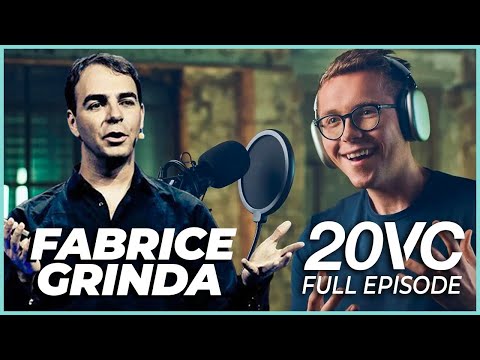
Fabrice Grinda: The First Person to Predict the Collapse of Credit Suisse? | 20VC #886
Harry Stebbings (host), Fabrice Grinda (guest), Narrator
In this episode of The Twenty Minute VC, featuring Harry Stebbings and Fabrice Grinda, Fabrice Grinda: The First Person to Predict the Collapse of Credit Suisse? | 20VC #886 explores fabrice Grinda Maps Three Futures For Tech Amid Global Uncertainty Fabrice Grinda recounts his evolution from marketplace founder to prolific early-stage investor and co‑founder of FJ Labs, explaining how investing sharpened his operating skills and market insight.
Fabrice Grinda Maps Three Futures For Tech Amid Global Uncertainty
Fabrice Grinda recounts his evolution from marketplace founder to prolific early-stage investor and co‑founder of FJ Labs, explaining how investing sharpened his operating skills and market insight.
He lays out a macro thesis he calls “The Great Unknown,” arguing that current conditions can plausibly lead to three very different outcomes: an optimistic soft‑landing, an inflationary stagnation, or a deep global crisis.
Across these scenarios, Grinda explains how interest rates, inflation, geopolitical shocks, and sovereign debt interact to drive asset prices, with particular implications for tech, crypto/Web3, and venture funding.
Despite high uncertainty, he remains strongly bullish on early-stage tech and Web3 over the next decade, while being more cautious on late-stage valuations, follow‑on capital, and LP behavior in the near term.
Key Takeaways
Use a simple, consistent investment framework and make fast decisions.
Grinda still relies on four core criteria—team, business quality, deal terms, and thesis fit—and structures his process to decide in one or two one‑hour meetings, forcing clarity and discipline.
Get the full analysis with uListen AI
Expect multiple macro paths and assign probabilities instead of certainties.
He frames the future as 20% odds of a benign soft-landing, 60% odds of an inflationary stagnation, and 20% odds of a severe crisis, and makes portfolio decisions based on this probabilistic view.
Get the full analysis with uListen AI
In high‑inflation, high‑uncertainty environments, tech still gains share.
Even in a “yucky” stagnation world, he argues that software and internet businesses retain pricing power and continue to take share from the rest of the economy, making early-stage tech relatively attractive.
Get the full analysis with uListen AI
Separate macro noise from long‑term startup building and early‑stage investing.
For seed and Series A investing, Grinda focuses on 7–10 year outcomes; short-term recessions and rate cycles matter mainly for follow‑on capital and valuation discipline, not whether to back great founders.
Get the full analysis with uListen AI
Raise and deploy capital cautiously, preserving dry powder for dislocations.
He advises VCs to slow check sizes, maintain reserves for existing portfolio companies, and build a “shopping list” of later‑stage leaders to buy in secondaries if valuations reset sharply.
Get the full analysis with uListen AI
Be intellectually honest about selling: rebalance when the risk/reward skews.
Grinda now uses rules of thumb—often selling ~50% at liquidity or frothy late-stage secondaries—to lock in gains and reallocate into higher‑return opportunities, instead of mindlessly holding or exiting entirely.
Get the full analysis with uListen AI
Bet on technology as the primary solution to structural global problems.
He believes climate change, inequality of opportunity, and well‑being crises will not be solved by politics or degrowth, but by tech-driven productivity and deflation in sectors like energy, education, and healthcare.
Get the full analysis with uListen AI
Notable Quotes
“History trumps macro. For 200 years, betting on technology has worked despite wars, depressions, and crashes.”
— Fabrice Grinda
“We’re in what I call ‘The Great Unknown’—I can make a good case for three radically different outcomes from here.”
— Fabrice Grinda
“It’s so hard to do one thing well in life, let alone two. In general, I would just say: focus.”
— Fabrice Grinda
“The degrowth movement is bullshit. No one wants to go back to being a farmer with a life expectancy of 29.”
— Fabrice Grinda
“When you start a memo with, ‘This is a generational company and I’ll regret passing,’ you are. Make the investment.”
— Fabrice Grinda
Questions Answered in This Episode
How should early-stage founders practically adjust their fundraising and burn plans under Grinda’s 60% ‘great stagnation’ scenario?
Fabrice Grinda recounts his evolution from marketplace founder to prolific early-stage investor and co‑founder of FJ Labs, explaining how investing sharpened his operating skills and market insight.
Get the full analysis with uListen AI
What concrete indicators would convince him we’re shifting from the optimistic to the crisis path—or vice versa?
He lays out a macro thesis he calls “The Great Unknown,” arguing that current conditions can plausibly lead to three very different outcomes: an optimistic soft‑landing, an inflationary stagnation, or a deep global crisis.
Get the full analysis with uListen AI
How can smaller funds and angels compete in a world dominated by mega‑funds like Insight and Tiger without overpaying?
Across these scenarios, Grinda explains how interest rates, inflation, geopolitical shocks, and sovereign debt interact to drive asset prices, with particular implications for tech, crypto/Web3, and venture funding.
Get the full analysis with uListen AI
Where does he see the most credible, near-term utility for Web3 beyond speculative NFTs and tokens?
Despite high uncertainty, he remains strongly bullish on early-stage tech and Web3 over the next decade, while being more cautious on late-stage valuations, follow‑on capital, and LP behavior in the near term.
Get the full analysis with uListen AI
How should investors weigh sovereign debt and banking‑system fragility (e.g., his Credit Suisse/Switzerland concerns) when building a long‑term tech portfolio?
Get the full analysis with uListen AI
Transcript Preview
Three, two, one, zero. You have now arrived at your destination.
Maurice, it has been seven years since our last show.
(laughs)
I cannot believe it. I said to you five. You co-correction me seven.
(laughs)
I am horrified. But thank you so much for joining me after all this time.
Thank you so much for having me.
Not at all. But I wanna start, and for those that missed our first episode, which to be fair, I'm sure many (laughs) did, uh, hit me. How did you make your foray into the world of investing, and how did you come to found FJ Labs most recently?
So I, I, I made my, my foray into the world of investing through being a tech founder. So by virtue of being a visible consumer internet-facing CEO, a lot of, like, other founders started approaching me. So when I built my first company, I was 23, back in '98, it was an eBay of Europe called, uh, Okland. And I was, like, one of the public faces in the internet revolution of France especially. And so all the other, like, young founders were looking up to me and was like, said, "Hey, can you invest?" And at that point in time, I thought long and hard, sh- is it a distraction from my core mandate as founder and CEO to be investing in other startups? And upon reflection, decided that if I can articulate lessons learned to others, uh, it means I've internalized them, making me a better founder. And at the same time, meeting all these other extraordinary founders to help their dreams come true kept my fingers on the pulse of the market, also made me a better founder. And so back in '98, when I first started out as a CEO founder of tech startups, I'm like, "Okay, I'm gonna be an angel investor at the same time." At that time, I had very little capital. Um, and that continued throughout my life, to the point that when I sold OLX in 2013 and, a- a- a- and left it, I'd already made over 150 investments. And so basically, I've always had the dual track founder, investor, of course focusing... And because I was so busy as a tech founder of like, "Okay, I need to only invest in things I understand innately," and I was building marketplaces and thinking about marketplace, so I'm like, "Only gonna do marketplaces." And because I could not be distracted, I, I set up back then the same heuristics I did to apply to my own companies I would pick to others, adding, of course, the, the variable of, um, the team evaluation and, uh, a- a- and deal terms. And so I created a setup for a process for deciding in a one-hour meeting if I would invest or not in a startup. And that's essentially one that we still use to this day, you know, with refinement over time. So I've basically been a, a tech investor since 1998.
Install uListen to search the full transcript and get AI-powered insights
Get Full TranscriptGet more from every podcast
AI summaries, searchable transcripts, and fact-checking. Free forever.
Add to Chrome