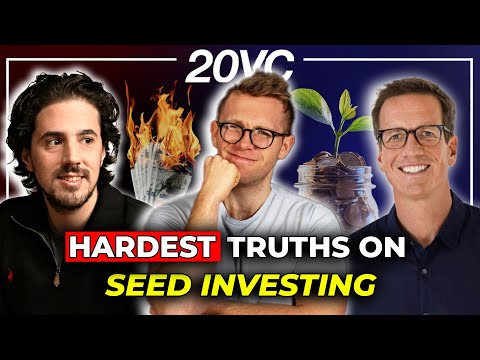
David Tisch & Terrence Rohan: Biggest Misconceptions & Hardest Truths About Seed Investing | E1112
David Tisch (guest), Terrence Rohan (guest), Harry Stebbings (host)
In this episode of The Twenty Minute VC, featuring David Tisch and Terrence Rohan, David Tisch & Terrence Rohan: Biggest Misconceptions & Hardest Truths About Seed Investing | E1112 explores seed Investing’s Messy Truth: Gut Decisions, Human Relationships, Not Spreadsheets David Tisch (BoxGroup) and Terrence Rohan (Otherwise) unpack how seed investing really works, arguing it’s fundamentally a human, intuition‑driven business rather than a data or “value‑add” arms race.
Seed Investing’s Messy Truth: Gut Decisions, Human Relationships, Not Spreadsheets
David Tisch (BoxGroup) and Terrence Rohan (Otherwise) unpack how seed investing really works, arguing it’s fundamentally a human, intuition‑driven business rather than a data or “value‑add” arms race.
They contend that most commonly touted VC advantages—platform services, content, coaching, rigid pricing rules—are largely commoditized or misleading, while what truly matters is early access, trust, and being a founder’s favorite long‑term partner.
Both describe seed as structurally random, power‑law driven, and permanently inefficient, with the real edge coming from seeing the right founders early and having the courage to say yes, even at unconventional prices or structures.
They also debate hot topics like multi‑stage funds at seed, signaling, reserves and secondaries, and how AI and brand will shape—but not fundamentally change—the seed market over the next decade.
Key Takeaways
At seed, gut and relationships matter more than models and ‘value‑add’.
Both investors insist early rounds are decided on instinct about people and nascent ideas, not spreadsheets or service menus; founders choose investors they like and trust for a decade‑long journey, not those who promise the fanciest platform.
Get the full analysis with uListen AI
Seed is structurally random and power‑law driven, so optimize for access and conviction, not rules.
Because outcomes are dominated by a tiny number of outliers and it takes 5–10 years to know if you were right, rigid rules on check size, valuation bands, or structures can shut you out of the rare $100B‑scale companies.
Get the full analysis with uListen AI
Group decision‑making and consensus are often harmful in seed investing.
They argue partnership voting and ‘grenade‑throwing’ in committees flatten edge cases and kill fragile, non‑obvious ideas; their firms empower individuals to say yes based on their own conviction without needing consensus.
Get the full analysis with uListen AI
Most VC ‘value‑add’ is commoditized; the real edge is being a founder’s favorite, not ‘best,’ investor.
Intros to customers, talent, and follow‑on investors can be replicated; what scales is consistency, low‑friction help, emotional support through failure, and a reputation that makes founders proactively recommend you.
Get the full analysis with uListen AI
Price is a secondary concern at true seed; the exit size matters far more.
They’ll back the right company at $5M or $50M pre‑money, arguing the rare winner’s eventual scale dominates returns; being ‘valuation‑sensitive’ can be more expensive than overpaying if it causes you to miss the actual outlier.
Get the full analysis with uListen AI
Reserves and secondaries are powerful but dangerous levers that must fit strategy.
Rohan avoids reserves and secondaries, believing they depress DPI and introduce adverse selection and relationship strain, while Tisch uses a follow‑on fund selectively, aiming to double down just before the market fully realizes a company’s quality.
Get the full analysis with uListen AI
Brand and founder networks are compounding advantages that shape who you see and win.
Top firms’ brands help with hiring, later‑stage capital, and even loss ratios; founder‑led networks (like Otherwise’s model) often see and win better at seed because peers seek them out and they invest in people and domains they deeply know.
Get the full analysis with uListen AI
Notable Quotes
“The space I have conviction that there will never be efficiency in is the seed market.”
— David Tisch
“Our job is to say yes, not to say no.”
— David Tisch
“The rare thing is not price. The rare thing is conviction in the company.”
— Terrence Rohan
“I don’t believe in the word coaching. I believe in relationship.”
— David Tisch
“The core of seed investing is this very human, very personal thing… and I don’t think that’s going to be replaced by AI.”
— Terrence Rohan
Questions Answered in This Episode
If you’re a first‑time founder, how can you practically assess whether an investor will be a ‘favorite’ partner rather than just another name on the cap table?
David Tisch (BoxGroup) and Terrence Rohan (Otherwise) unpack how seed investing really works, arguing it’s fundamentally a human, intuition‑driven business rather than a data or “value‑add” arms race.
Get the full analysis with uListen AI
How should seed‑stage founders think about valuation and structure (e.g., uncapped SAFEs) when great investors say price is secondary but downstream rounds still care?
They contend that most commonly touted VC advantages—platform services, content, coaching, rigid pricing rules—are largely commoditized or misleading, while what truly matters is early access, trust, and being a founder’s favorite long‑term partner.
Get the full analysis with uListen AI
For emerging managers, what concrete steps can you take to increase your ‘see’ advantage in such a fragmented, fast‑moving global seed market?
Both describe seed as structurally random, power‑law driven, and permanently inefficient, with the real edge coming from seeing the right founders early and having the courage to say yes, even at unconventional prices or structures.
Get the full analysis with uListen AI
How can founders protect themselves from ‘bad’ or intrusive VCs early on, given the asymmetry of experience and the pressure to close a round?
They also debate hot topics like multi‑stage funds at seed, signaling, reserves and secondaries, and how AI and brand will shape—but not fundamentally change—the seed market over the next decade.
Get the full analysis with uListen AI
If AI and better tooling make startups far more capital‑efficient, how should that change founders’ and investors’ attitudes toward raising follow‑on capital versus staying optional and profitable?
Get the full analysis with uListen AI
Transcript Preview
The space I have conviction that there will never be efficiency in is the seed market.
I believe, actually, a group decision is the wrong way to make a seed investment. A lot of this, um, the picking is instinctual, intuitive. But articulating that to a group is really hard.
I don't believe in the word coaching. I believe in relationship. Leadership, culture, those things can be helped from the outside. But I think the idea that the success of a company is dependent upon outsiders is nonsense.
Where's the seed market in 10 years, guys? What's the discussion then?
Maybe there's less (censored) , but more of it.
I am so excited for this. I've been looking forward to this one for a while. The, the Twitter shitposting, David, has been incredibly entertaining. I feel sorry for Terrance, having to put up with us for this conversation. But first, thank you so much for joining me today.
Thanks for having me back, Harry.
Thanks for having me. I'm excited to be here.
Now I wanna just start with some intros. So can you first just explain a little bit about who you are, what firm you founded, and then where you focus in particular? Let's start there. And, and Terrance, why don't we start with you, given the fact David's done this twice before? (laughs)
Sure. So hello, my name's Terrance. I'm a seed investor. Um, I've been fortunate over the past 10 to 15 years to back some incredible founders, um, at their earliest stages. Figma, Notion, Hugging Face, uh, Vanta, Robinhood, um, Patreon, Front, just, just to name a few. Started off my tech career originally at, at Google. I was there '05 to, to '10. I did various product development, product marketing roles. Um, and then started professionally investing in 2010. I, I joined, um, Index Ventures, actually joined over in London, and led and managed the seed practice for them for seven years. Incredible experience. Did that both in, um, both in, uh, in London for a short stint, and then in San Francisco. We did incredible work. Super proud of it. Um, and, you know, part of my role there, I was fortunate to give, you know, they gave me a lot of rope to innovate. And one of the, one of the things I innovated it on was actually giving capital to founders to invest. And so I incubated a fund, um, for them, um, which later was the genesis, um, for Otherwise. So Otherwise is the fund that I invest out of. The model is w- we give capital to, um, a, a network of top founders and they discreetly make multi-stage investments. Uh, actually venture investments, primarily it's seed. Don't publicly talk about the fund or the strategy, so I'm gonna hold to that. But I'm really happy to talk about my own, you know, investing experience and, and, and kinda journeys. Yeah, in terms of investing, I write two 150K checks. I do mostly, mostly seed, but I do some later stage investment. I'm sector agnostic, um, but do mostly applications and, um, yeah, really try to support, um, amazing founders.
Install uListen to search the full transcript and get AI-powered insights
Get Full TranscriptGet more from every podcast
AI summaries, searchable transcripts, and fact-checking. Free forever.
Add to Chrome