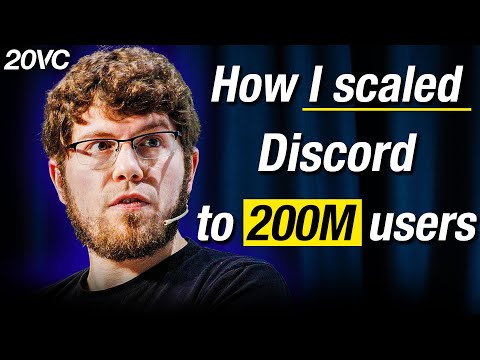
Jason Citron, Co-Founder/CEO @Discord: The Untold Story Behind Scaling to 200M Users | E1230
Jason Citron (guest), Harry Stebbings (host), Narrator
In this episode of The Twenty Minute VC, featuring Jason Citron and Harry Stebbings, Jason Citron, Co-Founder/CEO @Discord: The Untold Story Behind Scaling to 200M Users | E1230 explores discord’s Jason Citron On Founder Mode, Focus, And 200M Users Jason Citron, co-founder and CEO of Discord, walks through the journey from a failed mobile game to building a 200M+ user communication platform for gamers, highlighting the importance of stubborn vision but flexible execution. He explains why product-market fit was hard-won, why “build it and they will come” failed them, and how a scrappy Reddit playbook kickstarted growth.
Discord’s Jason Citron On Founder Mode, Focus, And 200M Users
Jason Citron, co-founder and CEO of Discord, walks through the journey from a failed mobile game to building a 200M+ user communication platform for gamers, highlighting the importance of stubborn vision but flexible execution. He explains why product-market fit was hard-won, why “build it and they will come” failed them, and how a scrappy Reddit playbook kickstarted growth.
A major focus is the painful hyper-scaling phase from 200 to 1,000 employees, where over-delegation to executives, obsession with “alignment,” and standard big-company best practices led to a slowdown in shipping great products. Citron contrasts his former ‘manager mode’ with his current ‘founder mode’ style: personally choosing key projects, tightly guiding problem selection, and using async video to give direct feedback.
He also reflects on turning down a $12B acquisition offer, fundraising lessons, hiring and integrating executives, and why he now trusts his intuition over external experts when context suggests otherwise. The conversation closes with his views on gaming’s AI-driven future, educational reform, and underappreciated technologies like nuclear power.
Key Takeaways
Growth mindset from gaming translates into entrepreneurship.
Citron argues games are ‘sandboxes of life’ where you repeatedly face challenges, fail, learn, and try again—building resilience, problem solving, and teamwork muscles that are directly applicable to running a company.
Get the full analysis with uListen AI
Vision can be stubborn, but tactics must be flexible.
Discord started as a game meant to bootstrap a chat network; the game underperformed, but the team pivoted to build the standalone chat product while keeping the original thesis about gaming communities and distribution.
Get the full analysis with uListen AI
“Build it and they will come” fails without deliberate distribution.
After launch, Discord stalled at ~20 DAUs until they actively seeded communities—like Final Fantasy XIV subreddits—by inviting players into a Discord server to test, give feedback, and spread word-of-mouth.
Get the full analysis with uListen AI
Over-delegation and generic ‘best practices’ can kill product quality.
During the 200-to-1,000 employee hyper-scale phase, Citron hired many executives, delegated strategy and project selection, and chased empowerment and alignment; the result was incoherent products, slower shipping, and a sense of fighting the organization instead of working with it.
Get the full analysis with uListen AI
Founders should own problem selection and key project choices.
Citron now sets explicit problem spaces, proposes solution directions, and personally picks projects, while letting teams own how to execute—arguing that problem selection and resource allocation at the top are crucial to coherent products.
Get the full analysis with uListen AI
Executive hiring success depends on deep reference checks and structured onboarding.
He emphasizes that senior candidates interview well by default; the real signal comes from exhaustive backchannel references and a deliberate 60–90 day learning period before they’re allowed to make big changes, to avoid context-free missteps and credibility loss.
Get the full analysis with uListen AI
Founder intuition, grounded in company context, often beats external expertise.
Citron recounts times he overrode his instincts to follow seasoned executives, only to see initiatives fail; he now uses his intuition as a gate on major decisions, while recognizing domains where his gut is weaker and discounting it accordingly.
Get the full analysis with uListen AI
Notable Quotes
“Games are such amazing little simulation sandboxes… microcosms of real life where you can learn these skills in safe places.”
— Jason Citron
“We were stubborn on the vision, but flexible on the details.”
— Jason Citron
“Words today that trigger me… are words like empowerment, alignment. I now say alignment is a four-letter word.”
— Jason Citron
“I pick all the projects now… I’m very top-down on what the strategy is and how we’re allocating resources.”
— Jason Citron
“I’ve changed pretty much everything that I’ve wanted to change over the last year. I really skip to work every day now.”
— Jason Citron
Questions Answered in This Episode
How can a founder practically distinguish between healthy delegation and harmful over-delegation before growth starts to stall?
Jason Citron, co-founder and CEO of Discord, walks through the journey from a failed mobile game to building a 200M+ user communication platform for gamers, highlighting the importance of stubborn vision but flexible execution. ...
Get the full analysis with uListen AI
In what kinds of decisions should a CEO explicitly trust their intuition over the advice of more experienced executives or investors?
A major focus is the painful hyper-scaling phase from 200 to 1,000 employees, where over-delegation to executives, obsession with “alignment,” and standard big-company best practices led to a slowdown in shipping great products. ...
Get the full analysis with uListen AI
How could Citron’s ‘async Loom feedback’ model be adapted in non-tech or non-product-centric organizations?
He also reflects on turning down a $12B acquisition offer, fundraising lessons, hiring and integrating executives, and why he now trusts his intuition over external experts when context suggests otherwise. ...
Get the full analysis with uListen AI
What are the early warning signs that a company has drifted away from its core user and needs to ‘refocus on gaming’–style course correction?
Get the full analysis with uListen AI
Given AI’s potential to massively lower creation costs, what new discovery and curation models might be needed so great games can still break through?
Get the full analysis with uListen AI
Transcript Preview
That period for us when we went from 200 to 1,000 in basically two and a half years was the moment in time when I think I made the most management mistakes at Discord. I hired a bunch of executives and, and set the vision and delegated that work to them, and everything ground to a halt. Words today that trigger me, which I think are shadows of this, are words like empowerment, alignment.
Ready to go? Jason, I am so excited for this, man. It is such a pleasure. I've heard so many good things from Danny Rimer at Index for many years, so thank you so much for joining me today.
Yeah. Thanks for having me, Harry. Great to be here.
Uh, not at all. But listen, I have interviewed 800 of the best CEOs of the last probably 10 years, and a commonality amongst many of them is they excelled at gaming, ironically, in the early years of their life. And I wanted to ask you, why do you think gaming is such good preparation for CEO-ship?
You know, game, games are like these little sandboxes of life, right? And you know, you think about what you're doing when you're playing games. You're, um, you're, you're encountering challenges. You're trying to figure out how to solve them. You're failing. You're thinking about what mistakes you made, how you could do it better. You do it again, and you keep doing this over and over until you, you have overcome your challenge. Like, that's growth mindset, right? Like, isn't that incredible? Like, we're... Like, kids are, are experiencing this, you know, just by playing games. Or you think about, um, playing games w- with your friends and against other people, and what do you need to do? You have to learn how to cooperate. How do you divide up tasks? Who steps into a leadership role? How do you be a good, a good follower? When do you trade those places? How do you learn how to be a good, you know, not a sore loser, not a sore winner? Like, these things all happen when you play Fortnite. (laughs) So like, games are such amazing, um, little simulation sandboxes to get to ex- to, to interact with these things that are basically like microcosms of real life, and you can learn these skills in safe places. And my guess is there's something to do with being able to, to do those things over and over and over and over and over again in a way where you don't even realize you're, you're learning those skills 'cause you're just having fun, that may translate to the kind of things you need to do to run a company. I, I don't know. I mean, c- certainly I did.
You mentioned levels there. Uh, in games you have levels, it gets harder, generally the way that games work. If we align that parallel to company building, which level of company building was the hardest? And what was the cheat code that you used to break it?
Install uListen to search the full transcript and get AI-powered insights
Get Full TranscriptGet more from every podcast
AI summaries, searchable transcripts, and fact-checking. Free forever.
Add to Chrome