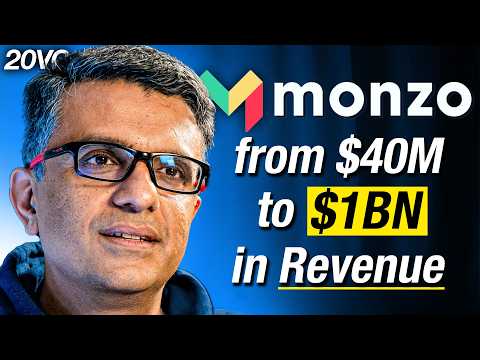
TS Anil, CEO @Monzo: From Layoffs, Downrounds and Low Employee NPS, To $1BN in Revenue | E1254
Harry Stebbings (host), TS Anil (guest)
In this episode of The Twenty Minute VC, featuring Harry Stebbings and TS Anil, TS Anil, CEO @Monzo: From Layoffs, Downrounds and Low Employee NPS, To $1BN in Revenue | E1254 explores monzo CEO TS Anil on Rebuilding, Mission, and Scaling to Profitability TS Anil explains how he took over Monzo during a crisis marked by a down round, regulatory pressure, low morale, and weak monetization, and helped turn it into a £1B+ revenue digital bank. He outlines Monzo’s diversified business model—roughly one-third transaction revenue, one-third lending, and one-third ‘good fees’ like subscriptions and marketplace income. A core theme is rejecting false binaries: tech vs bank, mission vs profit, values vs high ambition, and product vs regulation. The conversation also covers product velocity, international expansion (US and Europe), IPO considerations, and the cultural and personal aspects of leading through existential pressure.
Monzo CEO TS Anil on Rebuilding, Mission, and Scaling to Profitability
TS Anil explains how he took over Monzo during a crisis marked by a down round, regulatory pressure, low morale, and weak monetization, and helped turn it into a £1B+ revenue digital bank. He outlines Monzo’s diversified business model—roughly one-third transaction revenue, one-third lending, and one-third ‘good fees’ like subscriptions and marketplace income. A core theme is rejecting false binaries: tech vs bank, mission vs profit, values vs high ambition, and product vs regulation. The conversation also covers product velocity, international expansion (US and Europe), IPO considerations, and the cultural and personal aspects of leading through existential pressure.
Key Takeaways
Diversify revenue across transactions, lending, and ‘good fees’.
Monzo aims for a balanced mix: about one-third transaction revenue (interchange, FX), one-third unsecured lending (loans, overdrafts, BNPL/Flex), and one-third fees that don’t rely on customer mistakes (subscriptions, marketplace origination, savings margin). ...
Get the full analysis with uListen AI
Reject the ‘mission vs profit’ binary; design products that serve both.
Monzo deliberately avoids ‘gotcha’ products (e. ...
Get the full analysis with uListen AI
Solve interlocking problems simultaneously with structured, time-horizoned plans.
The turnaround required addressing capital, regulatory trust, product momentum, and talent at the same time, using tools like a 100‑day plan and a multi-horizon roadmap (quick 4–8 week wins plus 9‑month bets). ...
Get the full analysis with uListen AI
Invest early in regulatory ‘muscles’ and controls as a competitive moat.
By building a strong controls framework and embracing the realities of being a bank, Monzo earned regulator trust and created a barrier to rivals. ...
Get the full analysis with uListen AI
Use engagement and trust as the foundation of superior unit economics.
Monzo focuses on weekly transacting usage, not just balances, and has ARPUs of ~£145 retail and £500–£550 SME—comparable to high-street banks after risk/capital adjustment, achieved largely via word of mouth. ...
Get the full analysis with uListen AI
Sequence product expansion based on customer needs, education, and economics.
For investing, Monzo started with mutual funds, low minimums, and in‑app education to tackle two barriers: people think investing is for the rich and don’t understand it. ...
Get the full analysis with uListen AI
Treat international expansion as building full-scale businesses, not vanity flags.
In the US, Monzo will use partner banks rather than chase its own license and is exploring credit‑led entry points in a fragmented, CAC-driven market. ...
Get the full analysis with uListen AI
Notable Quotes
““I’ve never been shy to run towards the fire.””
— TS Anil
““A mission without a business plan is a bumper sticker.””
— TS Anil
““We’re 500 years late to banking. There’s nothing first about that.””
— TS Anil
““If we choose not to charge for value, I’m just doing charity at the cost of the VC.””
— TS Anil
““We’re building a consumer platform where engagement is measured in trust and love.””
— TS Anil
Questions Answered in This Episode
How far can a mission-led stance against products like mass-market crypto trading hold if competitors monetize aggressively and customers demand access?
TS Anil explains how he took over Monzo during a crisis marked by a down round, regulatory pressure, low morale, and weak monetization, and helped turn it into a £1B+ revenue digital bank. ...
Get the full analysis with uListen AI
What specific metrics or signals would tell Monzo it’s finally time to IPO, and how will it weigh London versus other exchanges when that decision can no longer be deferred?
Get the full analysis with uListen AI
In the US, how will Monzo differentiate itself from existing ‘thin-slice’ fintechs when it’s also reliant on partner banks rather than its own license?
Get the full analysis with uListen AI
What are the biggest cultural or organizational risks of scaling product velocity while also tightening regulatory controls and ‘controls debt’?
Get the full analysis with uListen AI
As Monzo consolidates more of a customer’s financial life, how will it guard against becoming the same kind of incumbent it originally set out to disrupt?
Get the full analysis with uListen AI
Transcript Preview
What does that look like in terms of how Monzo fundamentally makes money?
A third is transaction-based revenues, interchange FX and so on. A third is on-balance-sheet lending, when customers take out an unsecured borrowing product from us, a loan or an overdraft, or Monzo Flex. And then the last one-third is what I describe as good fees. And I say good fees because this is not stuff we make money when customers make mistakes. It's not gotcha fees. These are fees like subscriptions, when someone takes out a subscription product from us, or on the marketplace if they original mortgage in the future. It includes the interest margin that we make on the savings product.
Ready to go? TS, I'm so excited for this. Listen, I've spoken to most of your cap table in preparation for the show, so thank you so much for joining me.
Just waiting to be asked.
Ah.
Excited to be here, Harry.
Listen, we've had it in the calendar for a while. Now, I wanna start with, when you took over, it was, it was a tough time. There was a 40% down round, there was little runway, there was high engineering attrition, there was low employee NPS. It was tough. And also, you're in the US. Why did you decide to take on the challenge?
You know, to answer that, we're gonna have to back up a little bit, um, Harry, back up because, as you know, I've spent many years in different sorts of financial services companies and banks around the world. And through it all, I had this big unscratched itch of really thinking that someone needed to reinvent the sector, someone needed to reinvent how customers and money worked with each other. And in the bigger places I had worked, I'd tried to do it, right? But it was clear that the legacy players were never gonna fix it, right? For the, with the best of intent and the best of, of, uh, wanting to do it, it was never gonna get fixed by incumbents, right? And the, the history of incumbents transforming their industries is anyways very, very sketchy. And for all of the obvious reasons of legacy tech and legacy mindset and business models to protect, and this and that and the other. So it had been a thing for me for the longest time, so it wasn't an accident that I ended up in the conversation with Monzo in the first place, because I'd been seeking to do that thing, be a part of a team that was gonna change the sector for- uh, forever and ever. So that commitment and belief in the mission was very real for me. So encountering what Monzo was, um, when I started, of course, you've talked about all of the s- you know, all of the things, um, that were, were wrong or broken or difficult, but if I looked at the hand I had to play, there were some good cards in that hand. We had found a magical product market fit with our initial current account product. We'd found a brand and a tone of voice that had really resonated across the country. So in addition to that, all of those problems you talked about were real, right? We were running out of capital and there was, um, COVID on, our revenues had, had fallen off of a cliff, monetization was lagging the user growth. So every version of problem that you can think of, we certainly had that as well. But if I looked at the full hand, this was one I wanted to play. And I guess at a, at a deeper level, I've never been shy to run towards the fire. Never been one to sort of balk because it feels difficult. If anything, it feels more like, "Yeah, I'm gonna give this a swing," right? "And, uh, I'm gonna give everyth- give it everything I've got. And it won't fail because of something I did not do." That's it, there's a deep sense of like, "I'm gonna try and make this work."
Install uListen to search the full transcript and get AI-powered insights
Get Full TranscriptGet more from every podcast
AI summaries, searchable transcripts, and fact-checking. Free forever.
Add to Chrome