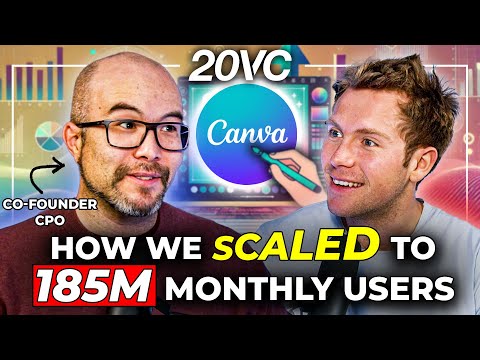
Cameron Adams: How Canva Builds Products: Lessons Learned, What Works? What Flopped? | E1179
Cameron Adams (guest), Harry Stebbings (host)
In this episode of The Twenty Minute VC, featuring Cameron Adams and Harry Stebbings, Cameron Adams: How Canva Builds Products: Lessons Learned, What Works? What Flopped? | E1179 explores inside Canva: Product Craft, AI Bets, And Delighting 190M Users Cameron Adams, Canva’s co-founder and Chief Product Officer, discusses how Canva was built around the vision of democratizing design and why that clear, long-term mission mattered more than Lean Startup-style rapid shipping. He explains Canva’s product philosophy: balance speed with quality, obsess over early user delight, keep the surface simple while hiding deep power for advanced users, and invest heavily in R&D and AI as core enablers rather than add‑on upsells.
Inside Canva: Product Craft, AI Bets, And Delighting 190M Users
Cameron Adams, Canva’s co-founder and Chief Product Officer, discusses how Canva was built around the vision of democratizing design and why that clear, long-term mission mattered more than Lean Startup-style rapid shipping. He explains Canva’s product philosophy: balance speed with quality, obsess over early user delight, keep the surface simple while hiding deep power for advanced users, and invest heavily in R&D and AI as core enablers rather than add‑on upsells.
Adams details how Canva creates fanatical users through crafted details, Easter eggs, thoughtful onboarding, and a fast path to an “I am a designer” aha moment. He also shares lessons from failed bets (like a social layer pushed by investors), the move into true enterprise, experimentation frameworks, and how they manage large, global rollouts like the new “Glow up” interface.
A substantial portion of the conversation covers AI: Canva’s early generative launches (like text‑to‑image), multi‑model strategy, how AI is changing product roadmapping and team structure, and why prompting will matter but UX for human–AI collaboration must evolve beyond chat boxes. Adams also reflects on competition with Adobe, the future LLM landscape, and the broader societal responsibilities of scaled companies, including his work on the “nature crisis” through Wedgetail.
Throughout, he emphasizes trusting founder intuition, resisting purely investor-driven feature requests, thinking of competition less as a zero‑sum fight and more as category creation, and recognizing the outsized impact leaders’ words and choices can have on teams, users, and the planet.
Key Takeaways
Balance speed with a high bar for delight, not just functionality.
Adams rejects a literalist Lean Startup approach; Canva ships fast but won’t launch until the product is good enough that people are excited to share it, because word‑of‑mouth has been their biggest growth driver.
Get the full analysis with uListen AI
Design for a fast “aha moment” where users feel newly capable.
Canva’s onboarding is built so first‑time users quickly create something that feels uniquely theirs and realize they can ‘be a designer,’ transforming initial curiosity into durable engagement.
Get the full analysis with uListen AI
Keep the surface simple, but hide meaningful depth for power users.
Canva applies an 80/20 rule: new users can access ~80% of the value with simple UX, while advanced capabilities gradually “unfurl” over time, enabling serious work without overwhelming beginners.
Get the full analysis with uListen AI
Use small crafted details and Easter eggs to create emotional affinity.
From playful landing page animations to a duck that appears every 100 uploads, these moments of delight signal craft and care, prompting users to talk about the product and deepening loyalty.
Get the full analysis with uListen AI
Let vision, not investor pressure, drive major product directions.
Their biggest early misstep—spending nine months on a social layer that flopped—came from chasing investor hype rather than their core mission; they now trust their instincts and stick closer to their DNA.
Get the full analysis with uListen AI
Treat AI as a core capability integrated into workflows, not a bolt‑on upsell.
Canva rolled out text‑to‑image in six weeks, now weaves AI into nearly every touchpoint, and includes it within existing subscriptions to maximize value and adoption, anticipating AI will soon be commoditized.
Get the full analysis with uListen AI
Manage big UX changes with gradual rollout and explicit “change boarding.”
For major updates like the “Glow up” interface, Canva rolls out in percentage cohorts, explains the value inside the product, user‑tests the transition, and even offers a skip button for critical moments.
Get the full analysis with uListen AI
Notable Quotes
“You can't take five years to launch a product, but it also needs to reach a certain level where people get excited about it.”
— Cameron Adams
“If you don't have a strong vision to start out with, your heart won't be in it, and it won't get you through those dark moments over the next 20 years of building a business.”
— Cameron Adams
“When you present people with a blank page, they just freeze up. And at the moment, AI is just like that.”
— Cameron Adams
“If, in five years’ time, the way that we interact with AI is purely just through prompts, I think it will have displayed a total lack of imagination from us as product builders.”
— Cameron Adams
“We really consider ourselves to be in a totally different category. When we started, design was something that 1% of the world could do, and we wanted to bring it to the other 99%.”
— Cameron Adams
Questions Answered in This Episode
How do you decide when a product is ‘delightful enough’ to ship versus needing more iteration, especially under time pressure?
Cameron Adams, Canva’s co-founder and Chief Product Officer, discusses how Canva was built around the vision of democratizing design and why that clear, long-term mission mattered more than Lean Startup-style rapid shipping. ...
Get the full analysis with uListen AI
What concrete signals tell you an advanced feature is ready to be surfaced to more users without overwhelming newcomers?
Adams details how Canva creates fanatical users through crafted details, Easter eggs, thoughtful onboarding, and a fast path to an “I am a designer” aha moment. ...
Get the full analysis with uListen AI
How do you prioritize which AI capabilities to integrate next when the model landscape and capabilities are changing so quickly?
A substantial portion of the conversation covers AI: Canva’s early generative launches (like text‑to‑image), multi‑model strategy, how AI is changing product roadmapping and team structure, and why prompting will matter but UX for human–AI collaboration must evolve beyond chat boxes. ...
Get the full analysis with uListen AI
Looking back, what early product decisions would you change now that Canva serves 190 million users and large enterprises?
Throughout, he emphasizes trusting founder intuition, resisting purely investor-driven feature requests, thinking of competition less as a zero‑sum fight and more as category creation, and recognizing the outsized impact leaders’ words and choices can have on teams, users, and the planet.
Get the full analysis with uListen AI
How should founders balance the desire to build a category‑defining mission‑driven company with the need to experiment and potentially pivot?
Get the full analysis with uListen AI
Transcript Preview
Speed is definitely important. Like, you can't take five years to launch a product. It also needs to reach a certain level where people get excited about it. You don't just wanna launch something that people feel like it just gets the job done, but they're not that crazy excited about it. Launching something at Canva that people will spread, they will tell others about, has been the biggest growth driver for us.
Ready to go? (instrumental music plays) Cam, I am so excited for this. I was just chatting to Cliff beforehand, and I was like, "Where do I take this conversation?" He's like... I'm not gonna do the accent 'cause you just ridiculed me for it.
(laughs)
I was actually gonna do it before, but he said, "You've gotta ask him, how did he come to meet me and Mel?" And he said there was a little bit of confusion on your end about-
(laughs)
... why you were there as an advisor or actually a hire. Talk to me about that.
Well, firstly, don't ask Cliff about content.
(laughs)
But secondly, um, I got intro'd to Mel and Cliff through my old boss at Google, Lars Rasmussen. So, he was one of the founders of Google Maps, and I worked with him on a project called Google Wave, and we did that for, like, four and a half years. I left Google to do this other startup with a couple of other, um, engineers from Google, and we were going very happily doing that. We were in the process of fundraising and Lars said, "Go talk to these people about some tech that they need." And I went and talked to them, they'd just moved to Sydney over from Perth at the time, and they had a school yearbook business. So, they were running this thing in Adobe Flash, it helped schools make their yearbooks, and they kinda wanted to take it to the next level, but they weren't gonna do that with Flash. So, I knew a bit about JavaScript and HTML, so I went to chat to them about that. Walked into their office, Mel was sitting at their conference table, trying to look very professional 'cause they had, like, five staff at the time, and I walked in and she's like, "Oh, are you here for the PHP developer role?" And I'm like, "No, I'm here to tell you, like, how to actually run the tech side of your business." So, we sat down, we chatted a bit about the latest tech at the time, what browsers were capable of, and particularly in the scheme of creating design, so how can you do visual design inside a browser, which was quite tricky at the time.
Mm-hmm.
Um, we explored it a bit. We went for coffee afterwards. Mel told me about her bigger vision beyond yearbooks, and it was democratizing design. It was bringing design to people who hadn't been able to access it before, which was really intriguing to me because my background is a graphic designer and also computer scientist, so merging design with democratizing technology was perfect for me. But me and my co-founders in my other startup, called Fluent, were, like, very happy, we were gonna take over the world, and we were just about to land $5 million in funding. Little did we know that we weren't just about to land $5 million in funding, but that's beside the point. So, I kind of put it in the back of my mind, of what Mel and Cliff were doing, and went off to do what I wanted to do. And a few months later, after our, um, startup had kind of created a little bit, um, that idea of democratizing design really came back to me. So, my wife, uh, her- she- we were looking at possibly moving to San Francisco 'cause there wasn't much happening in Australia at the time. My wife wasn't that keen to move to San Francisco, neither was I, so she said, "Why don't you go hit up Mel and Cliff again and see how they're going with trying to democratize design?" Uh, so I did, and they hadn't got funding or anything so far, they hadn't, uh, found a tech co-founder that could help them build the product, so we decided to join forces, and that was 2012.
Install uListen to search the full transcript and get AI-powered insights
Get Full TranscriptGet more from every podcast
AI summaries, searchable transcripts, and fact-checking. Free forever.
Add to Chrome