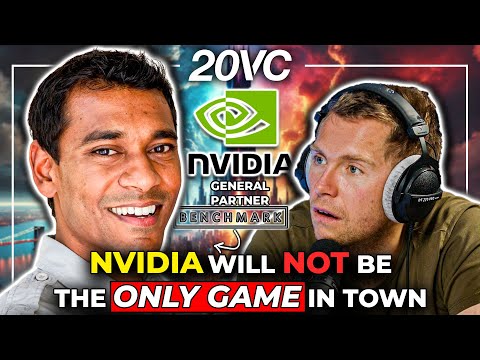
Eric Vishria: Where is the Value in AI - Chips, Models or Apps? | E1206
Eric Vishria (guest), Harry Stebbings (host), Narrator
In this episode of The Twenty Minute VC, featuring Eric Vishria and Harry Stebbings, Eric Vishria: Where is the Value in AI - Chips, Models or Apps? | E1206 explores eric Vishria on AI Value, Venture Discipline, and Founder Insight Eric Vishria, Benchmark general partner and former founder, discusses where value will accrue in the AI stack, arguing that foundational models are rapidly depreciating assets while infrastructure and applications with real insight offer better long-term opportunity.
Eric Vishria on AI Value, Venture Discipline, and Founder Insight
Eric Vishria, Benchmark general partner and former founder, discusses where value will accrue in the AI stack, arguing that foundational models are rapidly depreciating assets while infrastructure and applications with real insight offer better long-term opportunity.
He explains Benchmark’s philosophy: small, equal partnership, no sector specialization, concentrated high-conviction bets, and a heavy focus on backing exceptional, learning-oriented entrepreneurs over spreadsheets or sector theses.
Vishria contrasts career investors and ex-operators, critiques spreadsheet-driven SaaS-era venture, and outlines how he evaluates distribution, market creation, and insight in a world of hyper-competitive AI categories.
He also explores internal partnership dynamics at Benchmark, their voting and deal process, how partners save each other from mistakes, and why he believes NVIDIA won’t be the only winner in AI infrastructure.
Key Takeaways
Foundational models are rapidly commoditizing; durable value likely shifts to infrastructure and apps.
Vishria calls foundational models “the fastest depreciating asset in human history,” suggesting that while model providers push the state of the art, lasting value will favor infrastructure (chips, inference platforms) and applications with deep domain insight.
Get the full analysis with uListen AI
Exceptional entrepreneurs with authentic, unique insights matter more than sector specialization.
Benchmark deliberately avoids sector specialists; instead, they assess whether a founder is extraordinary, has a non-obvious but cogent insight, and is attacking a market that can support a large company, especially important in crowded AI spaces.
Get the full analysis with uListen AI
Distribution and incumbents’ moats can overwhelm product quality in AI markets.
Using AI medical scribes as an example, Vishria notes that marginally better products may still lose to incumbents like Microsoft/Nuance, whose distribution and bundling power can ‘crush’ startups despite superior tech.
Get the full analysis with uListen AI
Early AI revenue can be a “sugar high” and should be interpreted carefully.
Zero-to-millions in ARR in months mostly proves strong demand and a sense of “magic”/ROI, but doesn’t guarantee sustainable advantage; investors must still judge defensibility, differentiation, and whether the product can maintain an edge as competition intensifies.
Get the full analysis with uListen AI
Spreadsheet-driven, bankery SaaS investing will struggle in the AI era.
Vishria argues early-stage metrics like gross margin and NDR are often irrelevant and falsely precise; AI’s uncertainty and speed require judgment about people, insight, and markets, not template-based financial modeling.
Get the full analysis with uListen AI
Great partnerships help both encourage bold bets and prevent bad ones.
He describes how partners like Peter Fenton first tried to talk him out of Cerebras, then pushed him to “call the vote” once convinced, and how Sara Tavel stopped him from backing a business with fatally weak unit economics—illustrating high-trust, high-candor decision-making.
Get the full analysis with uListen AI
NVIDIA’s dominance is unlikely to be permanent in AI infrastructure.
Contrary to consensus that all AI ROI flows to NVIDIA, Vishria believes other infrastructure players (including companies like Cerebras) will capture meaningful value as the market matures and alternatives prove themselves.
Get the full analysis with uListen AI
Notable Quotes
““Foundational models are the fastest depreciating asset in human history.””
— Eric Vishria
““I don’t think NVIDIA is going to be the only game in town on the infrastructure layer.””
— Eric Vishria
““Startups are really hard… good teams with an interesting idea are not necessarily enough.””
— Eric Vishria
““Spreadsheet investors are gonna get wiped out or have a really hard time in this era.””
— Eric Vishria
““Finding great companies is hard enough—let’s not over-constrain it.””
— Eric Vishria, paraphrasing Charlie Munger’s idea
Questions Answered in This Episode
If foundational models are depreciating so quickly, how should startups decide whether to build on, fine-tune, or attempt to own models themselves?
Eric Vishria, Benchmark general partner and former founder, discusses where value will accrue in the AI stack, arguing that foundational models are rapidly depreciating assets while infrastructure and applications with real insight offer better long-term opportunity.
Get the full analysis with uListen AI
What specific signals distinguish a truly ‘learning’ founder from one who appears flexible but will struggle with a major platform shift like AI?
He explains Benchmark’s philosophy: small, equal partnership, no sector specialization, concentrated high-conviction bets, and a heavy focus on backing exceptional, learning-oriented entrepreneurs over spreadsheets or sector theses.
Get the full analysis with uListen AI
How can early-stage AI startups realistically build defensible distribution against incumbents with massive existing channels and bundling power?
Vishria contrasts career investors and ex-operators, critiques spreadsheet-driven SaaS-era venture, and outlines how he evaluates distribution, market creation, and insight in a world of hyper-competitive AI categories.
Get the full analysis with uListen AI
What new monetization models for AI (beyond per-seat pricing and simple API calls) does Vishria expect to emerge over the next five years?
He also explores internal partnership dynamics at Benchmark, their voting and deal process, how partners save each other from mistakes, and why he believes NVIDIA won’t be the only winner in AI infrastructure.
Get the full analysis with uListen AI
Given Benchmark’s dismissal of portfolio-construction constraints, are there hidden risks in relying so heavily on partner judgment and high-concentration bets in such a volatile AI landscape?
Get the full analysis with uListen AI
Transcript Preview
Foundational models are the fastest depreciating asset in human history. I don't believe NVIDIA's gonna be the only game in town on infrastructure layer. We have a major, major shift in AI, which is, could be bigger than any of these other shifts, um, maybe combined. It's simultaneously the most exciting and most disorienting time in my 25 years in technology. There's a lot of uncertainty, but we've been more active than we've been since 2010 and 2011.
Ready to go? Eric, I am so excited for this, man. We've been waiting like, so, I think it was like five or six years since our last one at least.
Wow. It's been a while.
So thank you so much for joining me today.
You look older, Harry.
I- it happens, dude.
(laughs)
It's- it's called Ben Show, Hey.
Well, I- I do too.
You know, the Botox isn't working. Um, but I was-
Dude.
... I was just listening to you on a- another show, actually, not nearly as good as mine, by the way. Uh, but you (laughs) , you said that as a CEO you felt you fell short, and they didn't really go anywhere from there in that conversation. And I just wanted to un-
That was back in my startup.
Yeah. And I wanted to understand why, as a CEO, you think you fell short as specifically as possible.
You know, I- I'm trying to re- I'm trying to remember the interview, but w- what I would say, like, when I reflect on Rockmelt, which was- which is the startup I founded and was CEO of, my- my reflection is that we fell short, like far short of my hopes and dreams for the company. Like w- my expectation for the company and my hopes and what I- what- what I thought we could accomplish, we fell really, really far short of it. You know, and I think there's a few ways to think about it, and- and I think one of the reflections and it's been really useful now as a venture capitalist is, you know, good teams with an interesting idea, like even, i- i- it's not necessarily enough. The real lesson from it for me is like, hey, you can put it together a great team, and I think we did, um, you can have an interesting or provocative idea, we were rethinking the browser, um, and this is circa 2010, but I think we had some of the right ideas in there. We had, uh, some of the right, um, execution even, um, and a great team. But, you know, distribution for- for a browser, brutal. Um, and- and so it- it just didn't work. And i- but m- the big takeaway, the big lesson from that actually I think is just that, you know, startups are really hard and I think it makes you really empathetic, it makes me really empathetic as a venture capitalist now when I meet entrepreneurs and you kind of, you understand like, well, you know what? This stuff is really hard and there's a whole bunch of stuff you can do, and there's a whole bunch of stuff you can't.
Install uListen to search the full transcript and get AI-powered insights
Get Full TranscriptGet more from every podcast
AI summaries, searchable transcripts, and fact-checking. Free forever.
Add to Chrome