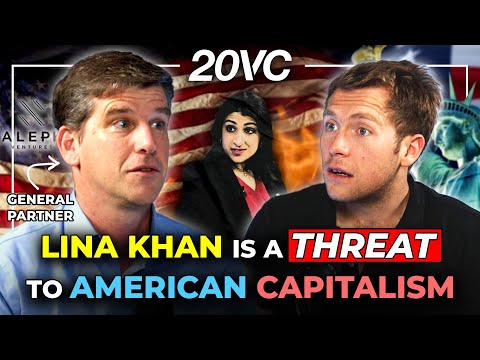
Michael Eisenberg: How China Could Overtake the US in the AI Race | E1167
Michael Eisenberg (guest), Harry Stebbings (host)
In this episode of The Twenty Minute VC, featuring Michael Eisenberg and Harry Stebbings, Michael Eisenberg: How China Could Overtake the US in the AI Race | E1167 explores aI Bubbles, Regulation, and Why Most VCs Won’t Get Liquidity Michael Eisenberg argues that AI—especially LLMs—is the most transformational technology of his lifetime, yet today’s frenzy is a classic bubble where most investors will lose money while a few foundational winners and critical infrastructure are created.
AI Bubbles, Regulation, and Why Most VCs Won’t Get Liquidity
Michael Eisenberg argues that AI—especially LLMs—is the most transformational technology of his lifetime, yet today’s frenzy is a classic bubble where most investors will lose money while a few foundational winners and critical infrastructure are created.
He challenges conventional venture thinking on foundation models, SaaS, exits, and pro‑rata, stressing moats, uniqueness, and early IPOs over waiting for perfect conditions or private equity bailouts.
Eisenberg is deeply skeptical of European-style regulation, current US antitrust policy, and overhyped PE and defense enthusiasm, positioning AI as a national power vector where the US, China, and Israel will dominate.
He emphasizes applied AI, hard tech, and “labless” synthetic biology, and is candid about venture realities: most companies never get liquid, many funds will die, and board meetings and VC behavior often destroy more value than competition itself.
Key Takeaways
Expect both massive AI value creation and massive capital destruction.
Eisenberg insists you must hold two truths at once: AI/LLMs will be epoch-defining, but today’s rush is a bubble where many investors—especially LPs overexposed to the same logos—will lose large amounts of money.
Get the full analysis with uListen AI
Moats and uniqueness matter more than chasing hot AI or SaaS categories.
He prefers non-obvious, less competitive markets where a company can become the only way to play a major trend (e. ...
Get the full analysis with uListen AI
Foundation model bets will be winner-take-few; most will fail for VCs.
He sees perhaps one or two foundation-model companies generating strong venture returns, with cloud giants likely acquiring smaller model players and OpenAI/Anthropic battling at the top, leaving many VCs and LPs underwater.
Get the full analysis with uListen AI
SaaS is over-saturated; AI will erode many horizontal software markets.
Eisenberg believes we’ve hit “peak SaaS,” with slowing growth, heavy competition, price erosion, and AI enabling enterprises either to build more in-house or rely on consultants/tools instead of buying shelf SaaS.
Get the full analysis with uListen AI
Regulation and geopolitics will shape AI winners, disadvantaging Europe.
He expects Europe’s heavy-handed regulation to cripple its AI competitiveness relative to the US, China, and Israel, and considers AI a national power akin to nuclear capability, making over-regulation in the US strategically dangerous.
Get the full analysis with uListen AI
Liquidity is rarer than founders and VCs admit; IPOs are available but at humbler prices.
Most startups and funds will never see meaningful liquidity; he argues the IPO window is actually open if companies accept lower valuations, go public earlier, and build as public companies instead of waiting for perfect conditions or PE rescues.
Get the full analysis with uListen AI
Venture success requires conviction, early ownership, and decisive selling.
He argues you should buy your ownership in the first round, rarely rely on pro rata, and be willing to sell 100% when your information advantage says the risk/reward has flipped—rather than averaging out like in public markets.
Get the full analysis with uListen AI
Notable Quotes
“Foundation models are the fastest appreciating asset in history.”
— Michael Eisenberg (citing Gavin Baker)
“Why invest in a business where the assets walk out at night?”
— Michael Eisenberg (quoting Bill Gates’ father)
“If I'm in Europe and I'm starting a company, I would get out.”
— Michael Eisenberg
“Lina Khan, I think, openly is a threat to American capitalism.”
— Michael Eisenberg
“If something is not hard, it doesn’t matter.”
— Michael Eisenberg
Questions Answered in This Episode
How should founders in crowded AI or SaaS categories rethink their strategies to build true moats rather than just features?
Michael Eisenberg argues that AI—especially LLMs—is the most transformational technology of his lifetime, yet today’s frenzy is a classic bubble where most investors will lose money while a few foundational winners and critical infrastructure are created.
Get the full analysis with uListen AI
What practical signals can investors use to distinguish between foundational AI companies and those that are just riding the bubble?
He challenges conventional venture thinking on foundation models, SaaS, exits, and pro‑rata, stressing moats, uniqueness, and early IPOs over waiting for perfect conditions or private equity bailouts.
Get the full analysis with uListen AI
If IPOs are in fact open but at lower prices, how should boards and founders reset their psychological and financial expectations?
Eisenberg is deeply skeptical of European-style regulation, current US antitrust policy, and overhyped PE and defense enthusiasm, positioning AI as a national power vector where the US, China, and Israel will dominate.
Get the full analysis with uListen AI
How can legacy enterprises realistically reorganize their data and processes to become true “AI companies” instead of being left behind?
He emphasizes applied AI, hard tech, and “labless” synthetic biology, and is candid about venture realities: most companies never get liquid, many funds will die, and board meetings and VC behavior often destroy more value than competition itself.
Get the full analysis with uListen AI
Given the geopolitical importance of AI, what balance should democracies strike between open innovation and national security-driven controls?
Get the full analysis with uListen AI
Transcript Preview
Foundation models are the fastest appreciating asset in history. Why invest in a business where the assets walk out at night? If I'm in Europe and I'm starting a company, I would get out. Lina Khanos, I think, openly is, I think, a threat to American capitalism. Whether Biden or Trump gets elected, she needs to go. I don't buy that the IPO window is closed. The IPO window is wide open. The question is, what's the price you're willing to take?
Ready to go? Michael, I'm so excited. Dude, we've been friends for years, and this is the first time that we get to do this in person. So, thank you for joining me.
Thank you for having me. The first time we get to do the podcast in person, but not the first time we meet in person.
Uh, no, no, no, no, no. The first time podcast in person. But, you know, it's so funny. I'm sure you find this actually, but I was saying the other day on Twitter that actually it makes such a difference doing, um, in-person shows.
I totally agree with you.
Really, for me, it's a game-changer. N-
Thank you for having me.
Not at all. But I want to dive straight in, because it seems like we're in this kind of bizarre AI bubble now, and we have one side of the table that says, "No, this is the most transformational technology that we've seen in 20 years," and we have another side of the table that says, "This is completely nuts. The valuations are crazy. The amount of cash that's being burnt is crazy. This is peak." How do you just think about that from a starting point, before we do a comparison?
One of the hardest things to do in the venture business is hold ... And in life, by the way, is to hold two truths in your head at the same time. I think both of those things are true. This is the most transformational technology I think I will ever see in my lifetime. Um, and at the same time, uh, there is, like happens with many transformational technologies, just an incredible gold rush that brings in a lot of people. Both these things are true. You know, when the internet came on, uh, and I was starting my venture career, this is in 1995, it was, it was incredible. I mentioned to you before we came on air, the first deal I did was called Picture Vision, and it was an online photo sharing, when there were still cameras with film and negatives. You had to actually scan the negatives, uh, in order to send the pictures. You'd upload them. It looked like paint drying, uh, to put- upload, uh, upload the pictures. And then there was pets.com and pets.com.com and pets.com.com.com, because it was an incredible gold rush. But the internet, eBay, Amazon, et cetera, turned out to be incredible companies. And I think the same will be true about AI, which is, by the way, a giant bucket that we need to kind of break apart. And then, you know, right after the dot-com thing, people have forgotten, but there was like a fiber optic craze. Everyone's forgotten it, 'cause it's called the dot-com crash. But there was a fiber ac- uh, optic equipment and infrastructure craze. And we laid a ton of fiber optic cables, and it was a bubble, and the stocks went crazy. But we live off that infrastructure today. And that's what's made the current moment possible. Same thing happened, you know, uh, Cisco bought, um, blank on the name of the company for $6 billion in the fiber optic routing space in, I think, 2001. Then that bob- bubble burst, and, you know, it took a bunch of years to kind of find our footing again. So yes, AI is the most transformational technology I think I'll ever see in my lifetime. True. It's also true that there's a massive financial gold rush going on in what turns into a bubble. True. What's also true is those bubbles create the infrastructure that we need going forward, and that's also true. So, a lot of people are gonna lose a lot of money during this, like a lot of money. Um, and some foundational companies and technologies will be built.
Install uListen to search the full transcript and get AI-powered insights
Get Full TranscriptGet more from every podcast
AI summaries, searchable transcripts, and fact-checking. Free forever.
Add to Chrome