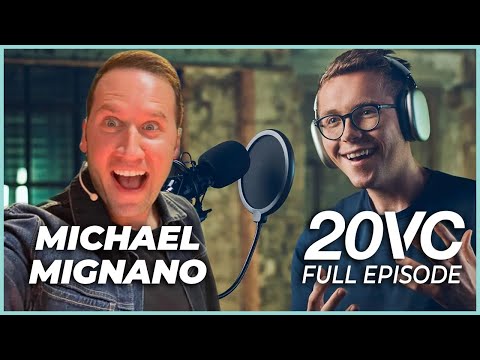
Michael Mignano: How I Founded Anchor; Why TikTok could be a $2 TRILLION Company | 20VC #923
Harry Stebbings (host), Michael (Mike) Mignano (guest)
In this episode of The Twenty Minute VC, featuring Harry Stebbings and Michael (Mike) Mignano, Michael Mignano: How I Founded Anchor; Why TikTok could be a $2 TRILLION Company | 20VC #923 explores from Anchor to Lightspeed: Mike Mignano on Social, TikTok, VC Michael Mignano, co‑founder of Anchor and former Spotify exec, joins Lightspeed as a consumer partner, bringing a zero‑to‑one product and angel investing background into institutional venture. He argues venture needs far more direct, transparent communication with founders and shares how his own hype cycle with Anchor reshaped his views on markets, pivots, and founder psychology.
From Anchor to Lightspeed: Mike Mignano on Social, TikTok, VC
Michael Mignano, co‑founder of Anchor and former Spotify exec, joins Lightspeed as a consumer partner, bringing a zero‑to‑one product and angel investing background into institutional venture. He argues venture needs far more direct, transparent communication with founders and shares how his own hype cycle with Anchor reshaped his views on markets, pivots, and founder psychology.
The conversation dives deep into the evolution of social media from social graphs to recommendation engines, why TikTok and Meta are locked in a critical two‑year battle, and what it really takes for a new social platform to be defensible against incumbent copycats. Mignano critiques live‑only formats like Clubhouse, explains why creator tools matter but the current creator economy is structurally skewed, and explores NFTs/Web3 primarily as infrastructure and creator monetization, not social flex.
He also outlines his angel investing philosophy—portfolio construction, consistent check sizes, and mission‑driven founders—while reflecting on misses like OpenSea and mistakes like backing “spreadsheet startups.” Personal segments touch on parenting, relationships, and why encryption and privacy‑centric consumer products (e.g., in women’s health) are gaining importance amid institutional mistrust.
Key Takeaways
Venture needs radically more direct, honest communication with founders.
Mignano criticizes investors for vague passes and relationship‑milking; he argues VCs should clearly state when they don’t believe in the company or even the founder, explain partnership dynamics, and remove ambiguity so founders can improve and plan realistically.
Get the full analysis with uListen AI
The social graph is now commoditized; recommendation media is the real moat.
With any new app able to reconstruct a social graph via contacts, incumbents like Meta are shifting to algorithmic content distribution that maximizes engagement and moderation efficiency—following TikTok’s model—creating room for new, truly social experiences to emerge.
Get the full analysis with uListen AI
New social giants must invent defensible formats, not just features incumbents can copy.
He sees BeReal and Clubhouse as instructive: BeReal’s historical “album” and Clubhouse’s live audio format had some defensibility, but sustainable winners need tool‑driven, hard‑to‑transpose formats (as TikTok did with short‑form video tools and a new consumption pattern).
Get the full analysis with uListen AI
Live‑only content is structurally weak compared to asynchronous media.
Clubhouse’s reliance on synchronous presence created a “math problem” and often low‑quality, meandering content; on‑demand audio and video (Spotify, YouTube, podcasts) win because they fit any schedule and can be edited for a much better word‑to‑value ratio.
Get the full analysis with uListen AI
Successful creator tools must either make creators money or give them distribution.
Mignano and Stebbings agree that tools that don’t materially improve monetization or audience growth are non‑starters; he sees most revenue accruing to the top 1% of creators and argues the real opportunity is tooling and platforms that help millions in the long tail earn their first dollar and find an audience.
Get the full analysis with uListen AI
For angels, consistent check sizes and portfolio breadth beat conviction‑sizing at seed.
Because every early‑stage deal is highly risky, Mignano chose to write the same small check into ~50 companies, avoid over‑indexing on conviction, and not waste time or money renegotiating standard docs—reserving selectivity for founder quality and mission‑alignment.
Get the full analysis with uListen AI
Founders must align with what the market actually wants, not just their original vision.
Reflecting on Anchor’s pivot from “social audio” hype to podcast tooling, he emphasizes that enduring companies stop trying to force the world to want their first idea and instead use their unique assets to serve real, emerging demand.
Get the full analysis with uListen AI
Notable Quotes
“I think investors would be more respected by founders if they said, ‘Right now, I don’t think you have what it takes—but you can prove me wrong.’”
— Michael Mignano
“All of the biggest markets were never as big as they were until the defining companies made them that way.”
— Michael Mignano
“The social graph used to be defensible; now it’s completely commoditized.”
— Michael Mignano
“Live on the internet is kind of a flawed format—if it’s only live and not asynchronous, it becomes a really challenging math problem.”
— Michael Mignano
“At a certain point you have to stop trying to get the world to want what you want it to want, and give it what it needs and what you’re uniquely positioned to give it.”
— Michael Mignano
Questions Answered in This Episode
How realistic is it to expect VCs to be brutally honest with founders when optionality and reputation are at stake?
Michael Mignano, co‑founder of Anchor and former Spotify exec, joins Lightspeed as a consumer partner, bringing a zero‑to‑one product and angel investing background into institutional venture. ...
Get the full analysis with uListen AI
If social graphs are commoditized, what specific product patterns could power the next great truly social platform?
The conversation dives deep into the evolution of social media from social graphs to recommendation engines, why TikTok and Meta are locked in a critical two‑year battle, and what it really takes for a new social platform to be defensible against incumbent copycats. ...
Get the full analysis with uListen AI
What metrics or signals would you use to decide whether a new live or synchronous format is worth backing despite its structural challenges?
He also outlines his angel investing philosophy—portfolio construction, consistent check sizes, and mission‑driven founders—while reflecting on misses like OpenSea and mistakes like backing “spreadsheet startups. ...
Get the full analysis with uListen AI
How can a creator‑tool startup practically design for the long tail—so that non‑elite creators actually earn money and distribution?
Get the full analysis with uListen AI
In a post‑hype NFT and Web3 environment, what kinds of infrastructure companies still have the potential to become enduring, venture‑scale businesses?
Get the full analysis with uListen AI
Transcript Preview
Mike, this is such a joy to do. I've been looking forward to this one for a long time. It's been a long time since our last episode, but thank you so much for joining me today.
Thank you for having me, Harry. Yes, I remember that first interview we did. It was probably, it was probably about seven years ago, six years ago.
I-
I don't even know. (laughs)
I, I, I know. I feel like Dorian Gray. I was young and good-looking-
(laughs)
... back in those days. But I, I wanna start, and we have some very exciting news today, so I'm just gonna hand over to you, uh, and say tell me, what is this wonderful and exciting news that you have for me today?
Yes, thank you. So today we're announcing that I'm actually joining Lightspeed as a partner on the consumer team, and I will be based here in New York City. And also as a fund, uh, my partner Justin Overdorf announced today that Lightspeed is gonna be planting a flag here in New York City and opening a brand new office. So that's the news, and thank you for letting me share it on 20VC.
Not at all. I find it so much nicer to have like a podcast episode. It really brings stories to life. But tell me, you know, you've had an amazing career so far with Anchor and with Spotify. You could've chosen many funds to go and work at. Why did you choose Lightspeed?
So I've been angel investing for about three years now, and while I've really enjoyed angel investing, it's been a blast, I definitely wanted to kind of take my investing to the next level and join one of the world's best and most storied venture platforms. And you know, in talking to a lot of them and, you know, partners that I knew at different funds and talking to a number of different funds throughout this process, I really felt like Lightspeed was unique in that we are, number one, truly global, and we have been for more than 15 years. You know, the past decade has obviously been, uh, in a big way, uh, about the US and the companies coming out of the US, but I really believe that the future is global, so it was really important to me to join a global platform. Uh, I wanted to join a, a fund that had really deep domain expertise across a number of different, uh, areas. Uh, I'll tell you that when I was building Anchor, I always appreciated investors (laughs) who actually had real-world experience and they weren't just check writers, so that was very important to me. I also wanted, um, a fund that was really strong on partnerships and not egos. Uh, a thing that we did in Anchor was we were really focused on building a culture around a mission, uh, not about individuals. We had this thing, missionaries not mercenaries, and it was very clear to me that Lightspeed was similar. And then lastly, you know, sort of as we were, as we were going into... uh, as I was going into this new role and looking at the landscape and the market, um, and obviously, you know, we're in a, we're in a period of uncertainty in the market right here, I felt it was really important to join a fund, uh, that could support teams at every single stage, full stack support. Uh, Lightspeed invests in every stage, and so that was really important. So between all those things and, you know, the, the amazing conversations, uh, I've had with everyone at the fund and the relationships I've built there with Alex and Nicole and, and Paul Murphy, who, who actually hired me at Aviary at my first startup job, you know, uh, 10 years ago, who's now at Lightspeed as well, it just made, it just made so much sense for a number of reasons. So yeah, I'm really excited.
Install uListen to search the full transcript and get AI-powered insights
Get Full TranscriptGet more from every podcast
AI summaries, searchable transcripts, and fact-checking. Free forever.
Add to Chrome