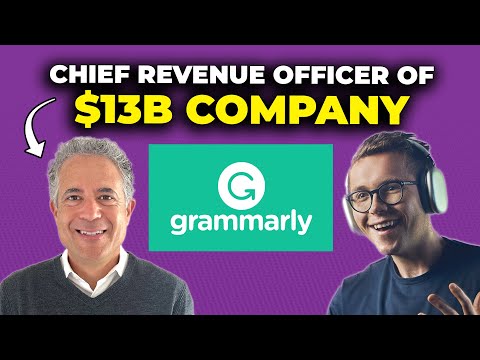
Matt Rosenberg: Why You Should Not Hire Sales Leaders From Big Companies | E1068
Matt Rosenberg (guest), Harry Stebbings (host), Narrator, Narrator
In this episode of The Twenty Minute VC, featuring Matt Rosenberg and Harry Stebbings, Matt Rosenberg: Why You Should Not Hire Sales Leaders From Big Companies | E1068 explores why Big-Company Sales Leaders Fail Startups, And Who To Hire Instead Matt Rosenberg, CRO of Grammarly, shares how his unconventional path from law to early-stage startups shaped his views on sales leadership, playbooks, and hiring. He argues that most founders overvalue big-company pedigrees and pre-baked playbooks, and undervalue analytical generalists who can actively listen, learn markets, and build from zero. Rosenberg emphasizes flexible, data-driven sales processes, deep discovery, and tight collaboration in the earliest sales hires to create momentum and real product–market fit. He also breaks down how to move from PLG to enterprise, where to place incentives, and why more women (especially parents) should be in sales leadership.
Why Big-Company Sales Leaders Fail Startups, And Who To Hire Instead
Matt Rosenberg, CRO of Grammarly, shares how his unconventional path from law to early-stage startups shaped his views on sales leadership, playbooks, and hiring. He argues that most founders overvalue big-company pedigrees and pre-baked playbooks, and undervalue analytical generalists who can actively listen, learn markets, and build from zero. Rosenberg emphasizes flexible, data-driven sales processes, deep discovery, and tight collaboration in the earliest sales hires to create momentum and real product–market fit. He also breaks down how to move from PLG to enterprise, where to place incentives, and why more women (especially parents) should be in sales leadership.
Key Takeaways
Don’t import rigid playbooks; build the critical 20% in-market.
Rosenberg argues that while 80% of sales process is transferable, the winning 20% is company- and market-specific, discovered only after you’re “punched in the face” by real customers and iterating in the field.
Get the full analysis with uListen AI
Hire flexible, analytical first sales leaders—not ex-Google logos.
He cautions founders against over-indexing on big-brand pedigrees and instead recommends ex-bankers, consultants, or lawyers who are strong active listeners, pattern-finders, and critical thinkers able to define ICP, messaging, and motion from scratch.
Get the full analysis with uListen AI
Start with a sales leader plus rev ops, then hire in collaborative pairs.
Rosenberg prefers starting with a senior seller who can scale and pairing them quickly with strong sales/rev ops to codify process, then hiring two reps at a time to maximize shared learning, not internal competition.
Get the full analysis with uListen AI
Great discovery wins deals fast; bad discovery leads to slow losses.
Effective discovery begins with research, then explores priorities, success metrics, what’s working, what’s not, and—crucially—the impact of solving those problems, which later powers urgency, pricing discipline, and shorter cycles.
Get the full analysis with uListen AI
Create urgency by quantifying economic impact, not by gimmicks.
If you can tie your solution to hard financial outcomes and agree on the value of delay, you can frame slippage as real cost and move customers (and CFOs) to act, especially for painkiller products.
Get the full analysis with uListen AI
Let data drive coaching, process design, and targeted prospecting.
Rosenberg uses detailed performance data (win rates by stage, time-to-close, discounting, etc. ...
Get the full analysis with uListen AI
PLG-to-enterprise shifts require treating enterprise as a different business.
He stresses that moving from consumer/PLG to enterprise demands new messaging, pricing, security, staffing, and incentives, while carefully avoiding cannibalization and intelligently leveraging PLG usage data inside large accounts.
Get the full analysis with uListen AI
Notable Quotes
“Deals are won and lost in discovery. Bad discovery leads to very long losses; good discovery leads to very quick wins.”
— Matt Rosenberg
“Don’t hire anybody that says on their LinkedIn, ex-Google, ex-Amazon, ex-Facebook.”
— Matt Rosenberg
“Everybody has a plan until they get punched in the face. When you get into the market and start to get punched, you then develop your playbook.”
— Matt Rosenberg
“If you really want to find a great sales executive, hire a mom.”
— Matt Rosenberg
“Founders have superpowers in lots of areas, but my point of view is building a playbook ain’t one of them.”
— Matt Rosenberg
Questions Answered in This Episode
How can an early-stage founder practically distinguish between a big-company sales leader who truly built something versus one who just coasted on brand momentum?
Matt Rosenberg, CRO of Grammarly, shares how his unconventional path from law to early-stage startups shaped his views on sales leadership, playbooks, and hiring. ...
Get the full analysis with uListen AI
What concrete signals should tell a startup it’s ready to invest seriously in an enterprise motion on top of its PLG base?
Get the full analysis with uListen AI
How can sales teams rigorously quantify the economic impact of solving a customer’s problem when the value is indirect or spread across departments?
Get the full analysis with uListen AI
What are the most effective ways to structurally encourage collaboration—not competition—between the first two sales hires?
Get the full analysis with uListen AI
How should compensation and ownership be split between PLG, sales, and CS when an enterprise deal grows from a small self-serve footprint into a broad ELA?
Get the full analysis with uListen AI
Transcript Preview
If you want to find efficiency, find a mom. They will be the most efficient people on the planet. Find a parent, particularly a parent of young children. More stuff will get done in an eight-hour block than you could imagine. (instrumental music plays)
Matt, I am so excited for this. As I said to you just now, I heard so many great things from many mutual friends. So first, thank you so much for joining me today.
Well, thank you, Harry, I really appreciate you having me on. It's, it's an honor.
Now, I would love to start with a little bit of context. I want to start on entry into sales. How did you make your way into sales in the first place? Let's start there.
Yeah. So I am a little bit of an accidental sales leader. You see, um, after graduating college, I didn't know what to do, so I went and backpacked through South America. And along the way, I decided to go to law school because I figured you could always make a living as a lawyer. That is a very bad reason to go to law school, it turns out. So after graduating law school, I became a lawyer, and not a very good one at that. And it was there that I said, "I need to do something else with my life. I need to actually have impact." And so this was the late 1990s, the first dot-com boom was happening out in California. I was a lawyer in Chicago sitting in a very large office building wearing a suit in a very large, um, office, and I was lonely and my soul was dying, and I thought to myself, "Boy, if I just move out to California and join a startup, everything will take care of itself." So I remember telling my parents, "I'm moving to California. I'm gonna take a pay cut of about two-thirds, and I'm gonna join a startup." And they said, "Are you out of your mind?" And that's what I did. I moved to California, I joined a startup as the second employee, and along the way, um, you know, I joined them as their head of business development. They were raising money, I knew how to fundraise, I knew how to structure contracts, I knew how to structure core partnerships. So they hired me to be their head of BD, and along the way, we had multiple pivots. The business, like most startups, failed a number of times, and we kept pivoting our way into a new market, and I was the one that helped the company figure it out and sell the first big solution. And then I fell in love with sales. The, uh, intellectual aspect of it, the emotional aspect of it, all of it. And that's how I ended up in, in sales and as a sales leader.
Can I ask you a really personal question? I didn't expect to go here, actually. I, I actually did law as well, because I thought you could always earn a living as a, a lawyer. And I, I always wanted that security. I wanted something to fall back on. Um, I saw my grandparents lose all of our money when I was younger, and it really just instilled this fear of having nothing, and so I wanted that security of I could always have that. Why do you think you had that need for safety of, "Oh, I can always make money as a lawyer"?
Install uListen to search the full transcript and get AI-powered insights
Get Full TranscriptGet more from every podcast
AI summaries, searchable transcripts, and fact-checking. Free forever.
Add to Chrome