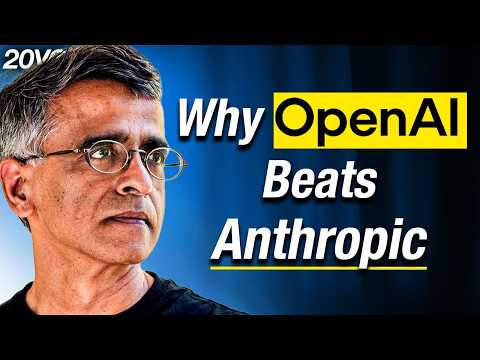
Sridhar Ramaswamy, CEO @Snowflake: Deepseek is Not a Threat to OpenAI & OpenAI Beats Anthropic|E1258
Sridhar Ramaswamy (guest), Harry Stebbings (host)
In this episode of The Twenty Minute VC, featuring Sridhar Ramaswamy and Harry Stebbings, Sridhar Ramaswamy, CEO @Snowflake: Deepseek is Not a Threat to OpenAI & OpenAI Beats Anthropic|E1258 explores snowflake CEO on AI moats, OpenAI’s dominance, and relentless leadership Sridhar Ramaswamy, CEO of Snowflake and former Google Ads chief, discusses how AI is reshaping careers, startups, and large incumbents, while explaining Snowflake’s strategy in a crowded data and AI landscape. He argues that sustainable AI value will accrue to products with deep customer relationships, not just to model creators, and that OpenAI’s real moat is ChatGPT as a consumer product rather than its models. Ramaswamy shares candid views on the risks of building on top of OpenAI, the Databricks rivalry, and how public-market constraints sharpen Snowflake’s innovation. He also reflects on leadership: intensity, hard conversations, demotions, and the importance of presence in parenting and in building enduring teams.
Snowflake CEO on AI moats, OpenAI’s dominance, and relentless leadership
Sridhar Ramaswamy, CEO of Snowflake and former Google Ads chief, discusses how AI is reshaping careers, startups, and large incumbents, while explaining Snowflake’s strategy in a crowded data and AI landscape. He argues that sustainable AI value will accrue to products with deep customer relationships, not just to model creators, and that OpenAI’s real moat is ChatGPT as a consumer product rather than its models. Ramaswamy shares candid views on the risks of building on top of OpenAI, the Databricks rivalry, and how public-market constraints sharpen Snowflake’s innovation. He also reflects on leadership: intensity, hard conversations, demotions, and the importance of presence in parenting and in building enduring teams.
Key Takeaways
Build your career at the intersection of passion and societal value.
Ramaswamy advises young people to choose fields where they both care deeply and where society demonstrably pays, then stay nimble and open to change as AI reshapes knowledge work rather than trying to avoid it.
Get the full analysis with uListen AI
Embrace AI as a universal “translation layer” for knowledge work.
He expects all knowledge professions, including software engineering, to be heavily impacted by AI’s ability to understand and transform structured and unstructured information, but sees this as creating new opportunities rather than eliminating entire professions overnight.
Get the full analysis with uListen AI
Product and distribution, not just models, will determine AI winners.
OpenAI’s advantage is not only model quality but ChatGPT’s half-billion users and rich product features (images, uploads, code execution); DeepSeek and others can improve models, but replicating that product and user base is far harder.
Get the full analysis with uListen AI
It’s risky to be a startup purely built on top of OpenAI.
Because the line between infrastructure and applications is blurry, players like OpenAI, Anthropic, Microsoft, and Google can quickly move into any attractive application category (coding assistants, legal tools, etc. ...
Get the full analysis with uListen AI
Sustainable AI value in enterprise will flow to incumbents who self-disrupt fast.
Ramaswamy argues that platforms with deep data and customer relationships (e. ...
Get the full analysis with uListen AI
Hard conversations and calibrated demotions are core to real leadership.
He openly demotes or reshapes roles when scope outgrows a person, framing it as creating the right context for them to succeed, and stresses that avoiding tough conversations harms both the business and the individual.
Get the full analysis with uListen AI
Public-market constraints can sharpen focus and innovation.
Operating as a public company forces Snowflake to prioritize free cash flow, avoid unfocused spending, and ‘show its work’ to the market; Ramaswamy sees this discipline as ultimately healthy, even if it limits the “blank check” approach of some private rivals.
Get the full analysis with uListen AI
Notable Quotes
“Find something that you're passionate about that society values.”
— Sridhar Ramaswamy
“AI is this incredible translation layer between all kinds of knowledge.”
— Sridhar Ramaswamy
“You're not going to switch from ChatGPT to DeepSeek. It's a product, it's not a model.”
— Sridhar Ramaswamy
“I think it is terrifying to be a startup building on top of OpenAI.”
— Sridhar Ramaswamy
“Money doesn't buy you amazing foundation models, doesn't buy you Snowflake.”
— Sridhar Ramaswamy
Questions Answered in This Episode
If OpenAI’s primary moat is product and distribution, what realistic strategies can startups use to build defensible AI products without being steamrolled by foundation model providers?
Sridhar Ramaswamy, CEO of Snowflake and former Google Ads chief, discusses how AI is reshaping careers, startups, and large incumbents, while explaining Snowflake’s strategy in a crowded data and AI landscape. ...
Get the full analysis with uListen AI
How should a young software engineer or analyst practically adapt their skill set over the next five years to stay on the right side of AI-driven change?
Get the full analysis with uListen AI
Where exactly is the line between being a responsible public-company CEO and taking the big bets necessary to win a fast-moving AI market?
Get the full analysis with uListen AI
How can leaders distinguish between an employee who can grow into a larger role with coaching versus someone who truly needs their scope reduced or changed?
Get the full analysis with uListen AI
In the AI ‘arms race,’ how can investors and founders tell the difference between infrastructure spending that will look like the 1990s fiber build-out and spending that will end up as a Webvan-style write-off?
Get the full analysis with uListen AI
Transcript Preview
I think it is terrifying to be a startup building on top of OpenAI. The line between an infrastructure provider and an application provider today is super blurry. There's basically no guarantee that OpenAI or Anthropic or Microsoft or Google are not going to go creative. You're not going to switch from ChatGPT to DeepSeek. It's a product, it's not a model. There's a big difference, Harry. There's a reason why Anthropic hasn't done as well, because it operates sort of at the model level. It's all of the additional things that go into ChatGPT that I think has staying power.
Ready to go? Sridhar, I'm so excited to have you on the show, man. It has been so long since we saw each other last as well, so thank you for doing this with me.
(laughs) Thank you, Harry. Amazing to be here, um, and, uh, 20VC is absolutely one of the iconic names, uh, in investing. Excited for this.
Dude, you're very, very kind. Listen, I spoke to Margot before the show, and she said, like, "You'd be really missing a trick with Sridhar if you went straight to AI and straight to actually, like, CEO-ship." And so she was like, "You gotta just get a little bit more personal." And so I was like, "Okay, Margot, tell me more." And she said, "Start with, as your younger self in college or in your first job, did you ever imagine yourself becoming a CEO, and why?"
(laughs) No, I did not. Certainly not when I was getting a bachelor's, certainly not when I was getting a PhD. In fact, I think when I was getting a PhD, becoming a professor, um, sounded more like the ideal. But at some point, I, you know, was not that excited about doing research, um, and, uh, that's when I switched over to software engineering. Uh, and even in software engineering, it's very much of aspire big, uh, but take little steps. Um, and yo- when you're at the right place at the right time, great things, uh, happen.
I totally agree with you in terms of being right place, right time, uh, says the man with a fondness on a podcast. Um, my, my question to you is, when you look at, bluntly, graduates coming out today and entering the workforce... I know you also have two boys-
That's right.
... who Margot told me about. What would you advise 20, 21-year-olds coming into today's workforce-
(laughs)
... who are bluntly scared in some ways, looking at AI, going, "Where is there gonna be long-term jobs? Where is there not?" What would you advise a 20, 21-year-old entering the workforce?
My kids and I used to talk a lot, they're 25 and 23, um, about what they should work on. Roughly, my advice to them was, "Find something that you're passionate about that society values." Um, I was like, "Yeah, don't pick these noble professions that we all pretend we value, but in fact we don't." I was like, "Being a teacher is really hard." Like, God bless them, but you know, um... And so hopefully by the time you have graduated, you have skills and passion in something that society values. Obviously everything is undergoing a lot of change. The best advice I have for navigating the, um, environment, um, is be open, be nimble about where change is coming, embrace change. Don't be one of those people that's like, "Yeah, the internet is never gonna be a thing." It is. AI is. And so embracing the change, seeing what is, uh, seeing what is possible, and you know, putting in the time, putting in the dedication, uh, to both excel at the job but be thinking about where things can go. Um, I think that core formula, um, of drive and malleability is the advice that I give to a 21-year-old. Honestly, it's the thing that I look for when I am trying to hire, uh, you know, take your pick, a senior exec into Snowflake.
Install uListen to search the full transcript and get AI-powered insights
Get Full TranscriptGet more from every podcast
AI summaries, searchable transcripts, and fact-checking. Free forever.
Add to Chrome