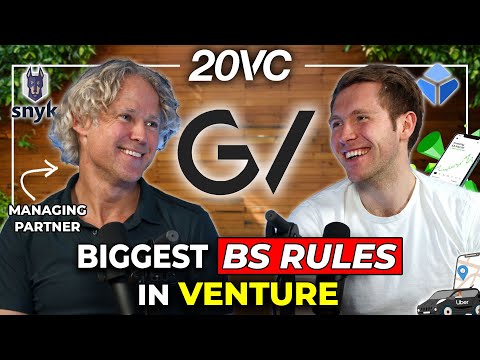
Tom Hulme: Lessons from a 24x Angel Track Record, 275x on Robinhood & Making Billions on Uber |E1150
Tom Hulme (guest), Harry Stebbings (host), Narrator, Narrator
In this episode of The Twenty Minute VC, featuring Tom Hulme and Harry Stebbings, Tom Hulme: Lessons from a 24x Angel Track Record, 275x on Robinhood & Making Billions on Uber |E1150 explores tom Hulme Dissects Venture Craft, Founder Psychology, and AI Hype Cycles Tom Hulme, GV general partner and prolific angel, unpacks how his early experiences, angel track record, and operating background shape his investing philosophy across sourcing, selection, and founder support.
Tom Hulme Dissects Venture Craft, Founder Psychology, and AI Hype Cycles
Tom Hulme, GV general partner and prolific angel, unpacks how his early experiences, angel track record, and operating background shape his investing philosophy across sourcing, selection, and founder support.
He contrasts “smart-smart” versus passive and dangerous investors, critiques overstructured and overcapitalized deals, and explains why angel follow-ons often destroy returns given our poor ability to predict winners.
Hulme dives deep into portfolio construction, reserves, liquidity, fund-returner dogma, and the psychological traps of fear-driven investing, while emphasizing long-term compounding, honest pre‑mortems, and founder empathy.
He also offers a skeptical but nuanced view on AI and foundation models, arguing most capital there will be lost, and closes with lessons on culture debt, remote work, clock speed, and how parenting reshaped his view of founders.
Key Takeaways
Avoid “dangerous” investors who are meddling but not truly value-add.
Hulme classifies investors as smart-active, passive, and dangerous (passive or dumb but convinced they’re smart). ...
Get the full analysis with uListen AI
As an angel, following on can materially worsen your returns.
His pre‑2015 angel portfolio (~27 companies) returned ~4. ...
Get the full analysis with uListen AI
Overcapitalization and aggressive structure often hurt companies more than “bad” investors.
He argues that foie‑gras‑style funding (too much too soon) drives premature scaling, higher burn, lower adaptability, and misalignment via complex preferences and notes that founders should optimize for options and terms, not just headline price.
Get the full analysis with uListen AI
VC edge is in fundamentals and compounding, not “hot” seeds.
Hulme’s biggest winners (e. ...
Get the full analysis with uListen AI
Most investors vastly overestimate their ability to predict winners and size outcomes.
He admits he would have mis‑ranked his own portfolio and uses this to argue against overconfident reserves models and fund-returner dogma, preferring diversified, consistent check sizing and scenario planning that emphasizes option value rather than precise forecasts.
Get the full analysis with uListen AI
GenAI economics are brutal; value will accrue largely to incumbents and infra.
Hulme likens foundation models to rapidly depreciating power stations, sees fast commoditization (especially with open-source models like LLaMA), and believes 90% of foundation-model dollars and ~70% of app‑layer dollars will be lost, while incumbents like Microsoft capture much of the real value.
Get the full analysis with uListen AI
Execution speed, paid feedback, and culture discipline matter more than clever ideas.
He insists ideas are cheap and backs founders on unfair advantage, clock speed, and willingness to charge early customers (because “free kills feedback”), while warning that cultural debt from bloated, misaligned, or remote‑only setups is far harder to fix than technical debt.
Get the full analysis with uListen AI
Notable Quotes
“Venture capital is like being a founder on antidepressants. You basically have all of the highs, just not as high, all of the lows, just not as low.”
— Tom Hulme
“There are basically three types of investors… You need to avoid investors that are passive, or sometimes even dumb, but think they're smart and actually gonna kind of interfere.”
— Tom Hulme
“Being too early is tantamount to being wrong, unless you can survive long enough for the market to come to you.”
— Tom Hulme
“Ideas are cheap, execution is everything. I cannot invest based on an idea.”
— Tom Hulme
“Free kills feedback. You don't know if it's valued, and people don't value what they don't pay for.”
— Tom Hulme
Questions Answered in This Episode
How should a first-time founder realistically assess whether an investor will be smart-active, genuinely passive, or dangerously meddling before taking their money?
Tom Hulme, GV general partner and prolific angel, unpacks how his early experiences, angel track record, and operating background shape his investing philosophy across sourcing, selection, and founder support.
Get the full analysis with uListen AI
Given Hulme’s skepticism of foundation-model economics, what would a truly defensible AI company need to look like over the next decade?
He contrasts “smart-smart” versus passive and dangerous investors, critiques overstructured and overcapitalized deals, and explains why angel follow-ons often destroy returns given our poor ability to predict winners.
Get the full analysis with uListen AI
How can angels and emerging managers design reserves strategies that acknowledge our poor ability to predict outliers without under-supporting clear breakouts?
Hulme dives deep into portfolio construction, reserves, liquidity, fund-returner dogma, and the psychological traps of fear-driven investing, while emphasizing long-term compounding, honest pre‑mortems, and founder empathy.
Get the full analysis with uListen AI
What practical steps can founders take to avoid culture debt during rapid headcount growth, especially in hybrid or remote setups?
He also offers a skeptical but nuanced view on AI and foundation models, arguing most capital there will be lost, and closes with lessons on culture debt, remote work, clock speed, and how parenting reshaped his view of founders.
Get the full analysis with uListen AI
In a world where incumbents increasingly capture AI value, where are the most attractive niches for new startups to build durable, venture-scale businesses?
Get the full analysis with uListen AI
Transcript Preview
Venture capital is like being a founder on antidepressants. You basically have all of the highs, just not as high, all of the lows, just not as low. And so with a portfolio of 20 companies, every day is a rollercoaster. (rollercoaster ride rumbling) There are basically three types of investors. You've got smart investors that know they're smart and they're gonna add value, then you've got passive investors that are gonna stay passive and they're not gonna get in the way. Both of those are absolutely fine. You need to avoid investors that are passive, or sometimes even dumb, but think they're smart and actually gonna kind of interfere.
Ready to go? (upbeat music) Tom, I am so excited for this. Dude, we have been friends for so many years. It's taken, what, seven or eight for me to convince you to do this. But thank you for joining me.
It's a, it's a total pleasure. I feel like you, we've probably been for close to a hundred walks together, and you told me this would be just like another walk.
(laughs)
Now I have a microphone thrust in my face.
Do you know, I really wanna do, like, Carpool Karaoke, but walks around the park. Uh, I think it'd be hard to do. Listen, I think we're all shaped by our childhoods in many ways, and so I wanna start with your childhood. We've chatted about it before, but talk to me a little bit about your childhood and how it shaped a little bit of your mindset today.
Yeah. Look, overall it was a great childhood. I grew up in North London, but I think the thing you, you and I have spoken about before is I had a few years where I was bullied at school. It was utterly miserable. It took all my kind of grit and perseverance to actually make it into school each day. So it taught me that. I think maybe some would say it gave me a little bit of a chip on my shoulder. But it also taught me empathy. I will never assume anything about how someone feels. I will never actually expect others to do something that I wouldn't do myself. So, look, I'm a post-rationalizer. In this industry, most of us are optimists, so I can tell you why it was probably good for me. But it was a really rough few years that actually I wouldn't wish on anyone.
Aha, the thing I found is that I had the same, but actually it means that I just desperately want people to like me, and that can actually lead to me avoiding conflict in a lot of cases, which actually can be quite a negative trait too.
I think so. I think... Look, I've had that feedback before because I want others to be happy. I want to be liked in the same way. But I think over time, I've learned actually the best thing for others, if you truly are empathic towards them, you kind of wanna give them honest, direct feedback, help them grow. And interestingly, they are very grateful for it in the long run.
Install uListen to search the full transcript and get AI-powered insights
Get Full TranscriptGet more from every podcast
AI summaries, searchable transcripts, and fact-checking. Free forever.
Add to Chrome