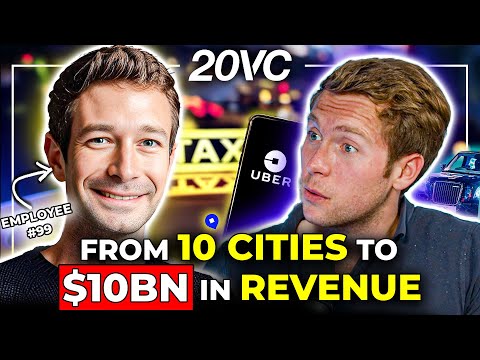
Scott Gorlick: How Uber Acquired 1M Drivers & The Uber’s Expansion Playbook | E1196
Scott Gorlick (guest), Harry Stebbings (host)
In this episode of The Twenty Minute VC, featuring Scott Gorlick and Harry Stebbings, Scott Gorlick: How Uber Acquired 1M Drivers & The Uber’s Expansion Playbook | E1196 explores inside Uber’s Playbook: Cold Starts, City Launches, and Relentless Hustle Scott Gorlick, Uber’s 99th employee, walks through how Uber scaled from city zero to millions of drivers, focusing heavily on driver acquisition, marketplace liquidity, and on-the-ground operations.
Inside Uber’s Playbook: Cold Starts, City Launches, and Relentless Hustle
Scott Gorlick, Uber’s 99th employee, walks through how Uber scaled from city zero to millions of drivers, focusing heavily on driver acquisition, marketplace liquidity, and on-the-ground operations.
He explains the early Atlanta launch, tactics to solve the supply-demand cold start problem, and the largely manual processes that powered the first million drivers.
The conversation compares Uber’s approach with Lyft, explores regulatory battles, free UberX launches, and why Uber beat Lyft in rides but lost U.S. food delivery leadership to DoorDash.
Gorlick also reflects on Travis Kalanick’s leadership, what Uber got wrong strategically and culturally, and distills broader lessons on growth metrics, competition, and founder-led companies.
Key Takeaways
Solve the supply side first in marketplaces, then let demand follow.
Uber focused obsessively on driver acquisition—cold calling fleets, in-person onboarding, and guarantees—because once cars were reliably available, rider demand naturally surged and stayed.
Get the full analysis with uListen AI
Do unscalable things far longer than feels comfortable to win early.
The first ~1M drivers were largely acquired via manual processes: cold calls, hotel conference-room onboarding, airport parking-lot canvassing, and in-person hustle instead of heavy paid performance marketing.
Get the full analysis with uListen AI
Use guarantees and smart positioning to bridge marketplace cold starts.
Uber paid hourly guarantees to idle drivers and placed them near known demand centers (e. ...
Get the full analysis with uListen AI
Referrals inside tight communities can scale supply faster and cheaper.
Driver referral bonuses, initially small but later very large, tapped into existing driver networks, turning each community into a growth engine as drivers recruited peers to buy more cars and expand fleets.
Get the full analysis with uListen AI
Brand, proximity, and local teams can trump remote, centralized operations.
Uber’s on-the-ground city teams, deep driver relationships, and existing black-car brand gave it a durable edge over Lyft’s SF-centric, fly-in launcher model when both were competing head-to-head.
Get the full analysis with uListen AI
Aggressive subsidies can win share but wreck short-term economics.
To counter SoftBank-funded rivals, Uber escalated driver acquisition bounties to as high as $2,000 per driver in some markets and ran free UberX weeks, trading near-term margins for long-term network effects.
Get the full analysis with uListen AI
Clarity on a few core metrics beats “death by a thousand dashboards.”
Gorlick emphasizes aligning teams on a small set of input/output metrics (e. ...
Get the full analysis with uListen AI
Notable Quotes
“When you're starting a marketplace, you really need to do two things. You need to get supply and you need to get demand. For Uber, the hardest thing was the driver's side.”
— Scott Gorlick
“Within a 10-minute span, we went from two out of 10 cars utilized to all 10 cars utilized and 100 people opening the app. From that point forward, we just needed more cars.”
— Scott Gorlick
“For probably the first million drivers that we onboarded, a lot of our processes were manual… it was really the operational teams going out and finding drivers.”
— Scott Gorlick
“The best founders build cults and they’re cult leaders… we were all kind of going to war together every day on this mission.”
— Scott Gorlick
“Fear is the disease. Hustle is the antidote.”
— Travis Kalanick (quoted by Scott Gorlick)
Questions Answered in This Episode
How would Uber’s playbook for solving the cold start problem change if it were launching today, with modern tools and competition levels?
Scott Gorlick, Uber’s 99th employee, walks through how Uber scaled from city zero to millions of drivers, focusing heavily on driver acquisition, marketplace liquidity, and on-the-ground operations.
Get the full analysis with uListen AI
Where is the line between necessary market subsidies and unsustainably burning capital in a marketplace war like Uber vs. Lyft?
He explains the early Atlanta launch, tactics to solve the supply-demand cold start problem, and the largely manual processes that powered the first million drivers.
Get the full analysis with uListen AI
Could Uber have both maintained Travis Kalanick’s founder edge and still successfully matured its regulatory and media posture?
The conversation compares Uber’s approach with Lyft, explores regulatory battles, free UberX launches, and why Uber beat Lyft in rides but lost U. ...
Get the full analysis with uListen AI
What specific tactics should Uber Eats have used to counter DoorDash’s suburban focus and win U.S. food-delivery leadership?
Gorlick also reflects on Travis Kalanick’s leadership, what Uber got wrong strategically and culturally, and distills broader lessons on growth metrics, competition, and founder-led companies.
Get the full analysis with uListen AI
How should platforms like Uber balance bold, futuristic bets (e.g., Elevate, AVs) against staying ruthlessly focused on their core businesses?
Get the full analysis with uListen AI
Transcript Preview
When I got back to Atlanta to launch Uber, it was really about building the operation from scratch. You know, while most drivers hadn't heard of Uber and were a little bit skeptical, they were willing to give us a shot because it didn't cost them anything to join. And for the first two or three weeks of the city, dude, I was nervous. Zero out of 10 cars utilized, one out of 10, two out of 10. And then one Friday night, I was out. You know, I'm sitting next to some other guys that are in different cities and they're like, "It's gonna happen. It's gonna happen." And within, like, 10-minute span, we went from, like, two out of 10 cars utilized to, like, all 10 cars utilized and, like, 100 people opening the app. And it just totally flipped. And from that point forward, we just needed more cars.
Ready to go? (upbeat music plays) Scott, man, I am so excited for this. They- I said to you before, I'm a fanboy of your Twitter threads. I think they are fantastic. So first, thank you so much for joining me today, man.
Thanks, Harry. Excited to be here.
Now, I would love to start just with a little bit of context before we dive into the incredible stories that are coming. Uh, tell me, how did you make your way into the world of growth to join Uber, I believe, as employee number 99?
Harry, it's a crazy story. So I finished up school in 2011 and when I finished up school, there were really only two things that people did. They either went to investment banking or they went to consulting. I chose consulting. And very early on, I realized that it wasn't for me. Um, probably on like week three. But the silver lining of the experience was on the weekends, I could go out and fly to San Francisco, as long I was back- as long as I was back at the client site on Monday morning. So this was 2011, 2012 and, you know, I was going out and meeting companies like Airbnb and Square fairly early, along with like 50 other companies, but nothing really clicked, um, until I was in Chicago one night. I was trying to get to a work dinner and I was trying to find a taxi. It was raining. And I had heard about this app where if you press the button, you could get a ride. So I download the app and two minutes later, my first Uber showed up. It was an Escalade and I was immediately in love. Absolutely magical experience. So that night, uh, I was working on a deck pretty late at night, probably wrapped around midnight or 1:00 AM, and had this Jerry Maguire moment where I was like, "Huh, I need to be a part of this Uber thing. What's the most, like, simple thing to do?" So I decided to email travis@uber.com, not thinking that I would hear anything. And I got an email back and, you know, over the next few weeks, uh, I got to know the team. Eventually, uh, took an analytics test, took a creative test, and then flew out to meet the team probably a couple of weeks later. And because I was so young when I got in the room, I said, "Don't worry guys, I'm old enough." They seemed to think that was really funny. I was 23 and didn't know a- anything. But they sent me back to Atlanta to launch Uber's, uh, roughly 10th city as employee number 99.
Install uListen to search the full transcript and get AI-powered insights
Get Full TranscriptGet more from every podcast
AI summaries, searchable transcripts, and fact-checking. Free forever.
Add to Chrome