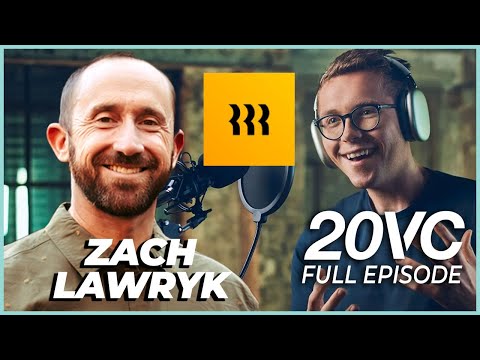
Zach Lawryk: The Ultimate Guide to Sales Engineering | E980
Zach Lawryk (guest), Harry Stebbings (host)
In this episode of The Twenty Minute VC, featuring Zach Lawryk and Harry Stebbings, Zach Lawryk: The Ultimate Guide to Sales Engineering | E980 explores sales Engineering Redefined: Buyer-Led Journeys, Sense-Making, and Scale Zach Lawryk, veteran sales engineering leader at companies like Salesforce, Slack, Box, and Rippling, explains how modern sales must shift from seller-centric control to true buyer enablement and “sense-making.”
Sales Engineering Redefined: Buyer-Led Journeys, Sense-Making, and Scale
Zach Lawryk, veteran sales engineering leader at companies like Salesforce, Slack, Box, and Rippling, explains how modern sales must shift from seller-centric control to true buyer enablement and “sense-making.”
He outlines why solutions engineers (SEs) are critical in complex, technical sales cycles, how their role is evolving earlier in the funnel, and how to scale their impact through content and collaboration with marketing.
For founders, he demystifies early sales and product-market fit by stressing deep customer empathy, value mapping, and concrete ROI—especially when multiple stakeholders like CFOs are involved.
He also offers practical guidance on when to hire the first SE, how to interview and onboard them, how to structure comp and responsibilities with AEs, and what red flags to watch in the first 3–6 months.
Key Takeaways
Modern sales must prioritize buyer enablement over seller control.
Most orgs still sell as if they control the process, but buyers now drive the journey. ...
Get the full analysis with uListen
Use “sense-making” to guide complex deals rather than pure persuasion.
Borrowing Forrester’s concept, Zach frames sales as helping buyers interpret options and tradeoffs; reps and SEs win by clarifying, contextualizing, and simplifying decisions for time-poor customers.
Get the full analysis with uListen
Scale SE expertise by productizing it into content, not just calls.
Because SEs are scarce, their knowledge should be converted into short videos, demo vignettes, and reusable assets that marketing and AEs can deploy earlier in the funnel.
Get the full analysis with uListen
Technical founders overcomplicate sales by ignoring basic customer empathy.
Zach advises founders to explicitly map who the buyer is, their pains and desired gains, and how the product ties to their outcomes—using tools like value canvases—before obsessing over features or investors.
Get the full analysis with uListen
Tie value to proportional business outcomes and hard ROI, especially for CFOs.
Founders and sales teams must show that the business impact justifies the spend; soft or localized value isn’t enough when CFOs scrutinize every purchase against a stack of other tools.
Get the full analysis with uListen
Hire your first SE around 5–7 AEs, biasing for domain credibility early.
At that stage, AEs are stretched across demos and technical depth; Zach recommends adding an SE who brings market credibility and can build demos, decks, and process, even if ACV experience is lighter.
Get the full analysis with uListen
Evaluate SEs on solution wins and collaboration, not just closed revenue.
SE success is partly reflected in higher close rates, but also in qualifying out bad deals, achieving “solution wins” (technical validation), and effectively partnering with AEs without friction.
Get the full analysis with uListen
Notable Quotes
“Most technology sales organizations are selling the same way they were 20 years ago.”
— Zach Lawryk
“The buyer is in control of the process, and it's more about buyer enablement than it's about selling anymore.”
— Zach Lawryk
“Your job is not to sell something to somebody. Your job is to help your buyer make sense of a really increasingly complex world.”
— Zach Lawryk
“If you don't feel like you're learning from the people that you're surrounded with, then you're in the wrong spot.”
— Zach Lawryk
“Our job as solutions consultants is to ensure the technology aligns to what the customer is trying to accomplish from a business perspective.”
— Zach Lawryk
Questions Answered in This Episode
How can a small, resource-constrained startup practically implement buyer enablement and sense-making from day one?
Zach Lawryk, veteran sales engineering leader at companies like Salesforce, Slack, Box, and Rippling, explains how modern sales must shift from seller-centric control to true buyer enablement and “sense-making.”
Get the full analysis with uListen AI
What specific formats and channels work best for turning SE expertise into scalable, ‘TikTok-style’ sales content?
He outlines why solutions engineers (SEs) are critical in complex, technical sales cycles, how their role is evolving earlier in the funnel, and how to scale their impact through content and collaboration with marketing.
Get the full analysis with uListen AI
How should founders adapt their value story when selling to multiple personas (end user, business owner, CFO) in the same deal?
For founders, he demystifies early sales and product-market fit by stressing deep customer empathy, value mapping, and concrete ROI—especially when multiple stakeholders like CFOs are involved.
Get the full analysis with uListen AI
What early warning signs suggest your AE–SE pairing or culture is discouraging true collaboration and team selling?
He also offers practical guidance on when to hire the first SE, how to interview and onboard them, how to structure comp and responsibilities with AEs, and what red flags to watch in the first 3–6 months.
Get the full analysis with uListen AI
If your product has grown from a PLG wedge, how do you retrofit a robust value-selling motion without breaking what already works?
Get the full analysis with uListen AI
Transcript Preview
... what has changed and, uh, what is sort of broken about most sales organizations today is they're still trying to sell like they're in control of that process, when the truth is they're not. The buyer is in control of the process, and it's more about buyer enablement than it's about selling anymore.
Zach, I have heard many great things from Maggie, wonderful, wonderful person. But thank you so much for joining me today first.
Yeah. Well, I'm happy to be here, humbled to be included, and, uh, it's an honor.
Not at all. This is a very special 20 Sales episode, and I wanna start with a little bit of context. So tell me, how did you make your way into the world of sales, how did you make your way into the world of solutions engineering, and most recently, you know, end up at the wonder that is Rippling?
Sure. So long story short, I started, uh, university with the idea that, uh, I was gonna complete a computer science degree, uh, because it was around, it was 1999, right before the bubble burst, and, uh, that was the best way or the best path to making great money. Halfway through it, I realized I didn't wanna spend all my time in a lab, because that was most of the, you know, initial coursework for the computer science degree. I pivoted and said, "I'm gonna be a lawyer." So I did political science instead, but it never got away from technology, and I always loved the intersection of business and technology. And frankly, I sort of stumbled into technology sales. I started a company in college. I'd had no idea what I was doing but was sort of on, like, the business and technology side. I worked for a company that got me to San Francisco. I luckily got a job at Salesforce. I knew nothing about the company, knew nothing about the job, was just happy to get paid a little bit more than what I was paid previously. And, uh, again, long story short, I'm in a training room. I started my job at Salesforce. I was, like, a premier support person basically, so I had a set of accounts. I was the Salesforce expert, helped them set up their Salesforce instance and manage it. On one h- one side of the room, there were the technical support people, like myself. On the other side of the room, their sales engineers. The sales engineer side of the room was having a lot more fun than I was, and I looked across the room, and I said, "I wonder what that job is about? It looks like they're having a lot more fun than we are. We're taking this so seriously." Uh, and lo and behold, it's true. It was a much more fun and, uh, and rewarding career, and I never looked back. And so that was, like, around 2006. I, I interviewed for my first SE job. I didn't get it the first time. I demoed. They said, "Uh, y- n- you're gonna need to do that again. That was pretty bad." The second time around, they said, "That was okay. Come on aboard." And, uh, I've never been more excited about getting a job.
Install uListen to search the full transcript and get AI-powered insights
Get Full TranscriptGet more from every podcast
AI summaries, searchable transcripts, and fact-checking. Free forever.
Add to Chrome