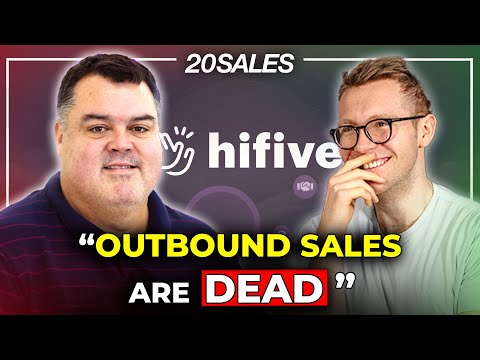
Brendon Cassidy: Why You Should Never Hire Someone You Do Not Know in Your First Five Hires | E1124
Brendon Cassidy (guest), Harry Stebbings (host)
In this episode of The Twenty Minute VC, featuring Brendon Cassidy and Harry Stebbings, Brendon Cassidy: Why You Should Never Hire Someone You Do Not Know in Your First Five Hires | E1124 explores brendon Cassidy Redefines Early-Stage Sales Hiring And Go-To-Market Models Brendon Cassidy argues that most of the traditional SaaS outbound/SDR-heavy go-to-market model is broken, especially in today’s crowded, capital-disciplined market. He believes AI will push SDR and outbound demand generation back under marketing, while great VPs of sales will refuse roles dependent on outbound-led growth. For early-stage startups, he insists that founders must sell first, design the initial playbook, and only make their first 3–5 sales hires through trusted networks, not open-market recruiting. Throughout, he emphasizes deeply understanding buyer psychology, minimizing bloated discovery, running tight monthly sales processes, and hiring for proven grit and coachability over brand-name resumes.
Brendon Cassidy Redefines Early-Stage Sales Hiring And Go-To-Market Models
Brendon Cassidy argues that most of the traditional SaaS outbound/SDR-heavy go-to-market model is broken, especially in today’s crowded, capital-disciplined market. He believes AI will push SDR and outbound demand generation back under marketing, while great VPs of sales will refuse roles dependent on outbound-led growth. For early-stage startups, he insists that founders must sell first, design the initial playbook, and only make their first 3–5 sales hires through trusted networks, not open-market recruiting. Throughout, he emphasizes deeply understanding buyer psychology, minimizing bloated discovery, running tight monthly sales processes, and hiring for proven grit and coachability over brand-name resumes.
Key Takeaways
Do not use outbound-dependent models as your core GTM in 2025.
Cassidy states the traditional outbound SDR model has effectively collapsed due to channel glut and buyer fatigue; companies that rely on it as their primary growth engine will struggle to attract good VPs of sales and are unlikely to succeed.
Get the full analysis with uListen AI
Return SDR/demand gen ownership to marketing, especially with AI.
He predicts AI will automate much of what SDRs do, making it logical for outbound and demand generation to sit under marketing again instead of sales, reversing a decade-long shift.
Get the full analysis with uListen AI
For the first five sales hires, only hire through trusted networks.
Early sales hires are foundational; Cassidy will not hire anyone ‘off the street’ for these roles, insisting they must either have worked with him before or be strongly vouched for by someone he deeply trusts, to avoid extremely high failure risk.
Get the full analysis with uListen AI
Founders must own early sales and sketch the first playbook.
He argues great SaaS companies have founders actively selling, mapping customer personas and pains, and creating a rough playbook that a future VP of sales can formalize, rather than outsourcing sales learning too early.
Get the full analysis with uListen AI
Build playbooks around buyer psychology, not company-centric process.
Effective playbooks start from what specific personas fear and want personally; he advocates selling to a person, not a company, and says reps should know 3–4 common pain paths so well that discovery should take about five minutes, not hours.
Get the full analysis with uListen AI
Evaluate sales hires via live pitches on what they sell today.
His key hiring filter is a panel-reviewed mock sales call where candidates pitch their current product; if they can’t make their own product compelling after years, he assumes they won’t make yours compelling either.
Get the full analysis with uListen AI
Run tight monthly forecasts and watch communication gaps as red flags.
Cassidy runs monthly commit/best-case pipelines and treats multi-day communication gaps with ‘committed’ prospects as a near-certain signal a deal will slip or die, using this to discipline reps and avoid fantasy pipelines.
Get the full analysis with uListen AI
Notable Quotes
“For my first five sales hires, I would never hire somebody out of network, ever.”
— Brendon Cassidy
“The entire outbound go-to-market SDR model has collapsed in the last three to five years.”
— Brendon Cassidy
“No great VP of sales is ever gonna take a job with a company that's dependent on an outbound go-to-market model.”
— Brendon Cassidy
“If you need to get on a call and spend two and a half hours doing discovery on your own behalf, then you shouldn't be on my sales team.”
— Brendon Cassidy
“The odds that you're gonna hire someone off the street better than the people who’ve already proven it in your system are almost zero point fucking zero.”
— Brendon Cassidy
Questions Answered in This Episode
If outbound SDR-led models are ‘over,’ what concrete, scalable alternatives should early-stage founders prioritize instead?
Brendon Cassidy argues that most of the traditional SaaS outbound/SDR-heavy go-to-market model is broken, especially in today’s crowded, capital-disciplined market. ...
Get the full analysis with uListen AI
How can a founder with a weak network practically build the trusted relationships needed to source those critical first five sales hires?
Get the full analysis with uListen AI
In a world of AI-assisted prospecting, what does a high-impact human salesperson uniquely do that cannot be automated?
Get the full analysis with uListen AI
How can teams balance Cassidy’s ‘five-minute discovery’ philosophy with complex enterprise deals that may have hidden stakeholders and nuanced requirements?
Get the full analysis with uListen AI
What are the early warning signals that your GTM motion is still too dependent on broken outbound assumptions, and how do you pivot without stalling growth?
Get the full analysis with uListen AI
Transcript Preview
Ultimately, what AI does is probably get- put the SDR function back under marketing. For my first five sales hires, I would never hire somebody out of network. I can tell you, no great VP of sales is ever gonna take a job with a company that's dependent on an outbound go-to-market model. That's just... nope. (upbeat music)
Brandon, I am so excited for this. I've wanted to make it happen for a while. It's been a while since we last chatted, so thank you so much for joining me today.
Also, uh, great to be here. Yeah, I think it was, uh... Last time we saw each other was maybe in Napa, like, some years ago, I think, um, f- for, like, a SaaStr retreat. So yeah, it's great to see you.
Brandon, I was young back then, but I wanna start with a little on you, just a context check.
You still, you still look good. Trust me. So... (laughs)
Dude, I, I look like fricking Benjamin Button. But tell me, how did, how did you first make your way into the world of sales, and when did you realize you loved sales?
I was sort of coming into the tech world, uh, around, like, ni- 1999, 2000, was the beginning of my career, which is hard to believe I've actually been around that long. I started my career as a recruiter. So this is before the dot-com bubble burst, which there's not a lot of people that have that as a reference point today. I was a recruiter. We worked with venture-backed companies, sort of around sort of helping them build their leadership and management teams. That was really my first job out of college. Came in at sort of the height of it, and then the entire market collapsed. And then recruiting became literally the first thing, you know... That's the first... Oh, recruiting fees? Yeah, that's just... Yeah, that's not e- There's not... That's a five-second discussion. And so that became, like, you know, an incredible career experience because it was like, "Survive. Okay, how do we survive doing this?" Because no one needs it. Certainly, nobody wants to pay for it. Everyone's firing people. No one's hiring people. Um, what now? Um, and so that forced all of us... We were all really young, and a lot of people, um, sort of didn't make it. Uh, but the- those of us that did, um, it's, you know... I d- I can't ima- You know, it's so foundational in my career, um, that it's... You know, I can't imagine not having gone through it.
What did you take away from it, that really shit hard time? How did it impact your mindset?
Yeah, I mean, we, we didn't really... We weren't really that experienced, so we had to... I mean, this might sound bad. We had to basically invent versions of ourselves that were real, and we had to convince people that those were real, that we had a level of experience and knowledge and expertise that we didn't really have, but we had to convince everyone that we did have. And that, that's a pretty good primer to get into sales, right, where it's like, you know, like, um, y- you are constantly having to kind of reinvent yourself. You have to be able to be, uh, very adaptable to who, whoever you're talking to, whomever the customer is. And that's something that we had no choice but to, to l- to learn to be that. It was be that or be gone. And so, you know, we were these 24, 25-year-old kids, you know, a lot of them from New York. I was from here, in the Bay Area, but, um, convincing people with, you know, 20, 25 years of experience that we had... We knew things that were, um, uncommon. Um, and, you know, that's... Yeah. It was pretty great experience. And every single one of the people that were there, they've all gone on to, like, incredible success, because nothing will ever be harder than that.
Install uListen to search the full transcript and get AI-powered insights
Get Full TranscriptGet more from every podcast
AI summaries, searchable transcripts, and fact-checking. Free forever.
Add to Chrome