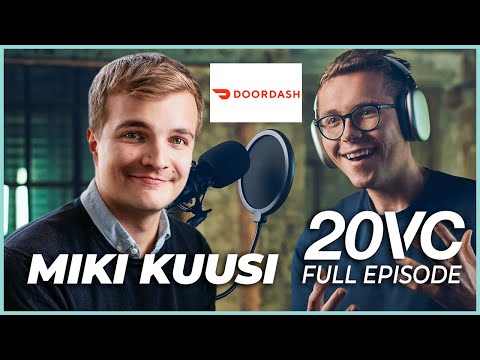
Miki Kuusi: How I Scaled Wolt to $8B; Why I Sold to DoorDash | 20VC #953
Harry Stebbings (host), Miki Kuusi (guest), Narrator, Narrator
In this episode of The Twenty Minute VC, featuring Harry Stebbings and Miki Kuusi, Miki Kuusi: How I Scaled Wolt to $8B; Why I Sold to DoorDash | 20VC #953 explores miki Kuusi on ruthless focus, Wolt’s near-death, and $8B exit Miki Kuusi, founder and CEO of Wolt, walks through Wolt’s evolution from a broad ‘everything local’ vision to a tightly focused restaurant delivery business that ultimately sold to DoorDash for $8B.
Miki Kuusi on ruthless focus, Wolt’s near-death, and $8B exit
Miki Kuusi, founder and CEO of Wolt, walks through Wolt’s evolution from a broad ‘everything local’ vision to a tightly focused restaurant delivery business that ultimately sold to DoorDash for $8B.
He explains how real product‑market fit only arrived when Wolt shifted from digital ordering to full-stack logistics—bringing restaurants to customers rather than customers to restaurants.
A major portion of the conversation centers on leadership: extreme focus, hiring for potential over logos, building high‑performance cultures grounded in ownership and trust (but not job safety), and learning to delegate big problems despite inevitable mistakes.
Kuusi also reflects on personal tradeoffs, his identity as a founder, why he sold to DoorDash, and his long-term belief that local commerce will compress into near-instant logistics powered from the smartphone ‘remote control’ in everyone’s pocket.
Key Takeaways
Relentless focus beats early diversification.
Wolt began with a broad ‘everything local’ vision but only took off when it focused almost exclusively on restaurant delivery for its first five years, cutting other categories until the core worked with strong unit economics.
Get the full analysis with uListen AI
Product-market fit is obvious when you truly have it.
Kuusi notes that if you’re unsure whether you have product‑market fit, you don’t; with delivery, demand, retention, and customer pull became unmistakable compared to the earlier pickup-only product.
Get the full analysis with uListen AI
Ownership culture requires both equity and real responsibility.
He argues that if you want people to act like owners, you must make them owners (stock/options for everyone, even support) and give them end‑to‑end responsibility over meaningful areas, not just small delegated tasks.
Get the full analysis with uListen AI
Trust employees deeply, but be ruthless about the team’s performance bar.
Trust means fairness, transparency, and supporting people through tough times—not guaranteeing safety or lifetime employment. ...
Get the full analysis with uListen AI
Hire for trajectory and potential, not logos and ‘done it before’.
Kuusi cites Case from Booking. ...
Get the full analysis with uListen AI
Great companies execute the really hard, painful decisions.
His most difficult day was laying off one-third of Wolt in 2017 when funding dried up; he did every conversation 1:1 and frames it as an example of how good companies know what to do, but great ones actually do the painful things.
Get the full analysis with uListen AI
Secondary liquidity can reduce fear-driven exits and extend ambition.
He advises founders to use secondary in later rounds to take pressure off personal finances, so they’re not tempted to sell too early out of fear of losing hard‑won momentum.
Get the full analysis with uListen AI
Notable Quotes
“If you don’t know that you have product‑market fit, you don’t have product‑market fit.”
— Miki Kuusi
“Focus means making difficult decisions to put all of your effort in the smallest possible subset of things.”
— Miki Kuusi
“The easiest way to make someone act like an owner is to make them an owner.”
— Miki Kuusi
“Your biggest KPI as a CEO is: if you die tomorrow, is the company still going to succeed?”
— Miki Kuusi
“The difference between good and great companies is that both know what needs to be done, but only the great ones execute on the truly difficult things.”
— Miki Kuusi (quoting advice from Ilkka Paananen)
Questions Answered in This Episode
How do you practically decide which promising opportunities to cut in order to maintain extreme focus, especially when investors or team members are excited about them?
Miki Kuusi, founder and CEO of Wolt, walks through Wolt’s evolution from a broad ‘everything local’ vision to a tightly focused restaurant delivery business that ultimately sold to DoorDash for $8B.
Get the full analysis with uListen AI
What specific signals or metrics did you see that convinced you Wolt had finally hit product‑market fit with delivery, versus just modest traction?
He explains how real product‑market fit only arrived when Wolt shifted from digital ordering to full-stack logistics—bringing restaurants to customers rather than customers to restaurants.
Get the full analysis with uListen AI
How can early‑stage founders create a genuine ownership culture if they have limited equity to distribute or are in ecosystems where options are uncommon?
A major portion of the conversation centers on leadership: extreme focus, hiring for potential over logos, building high‑performance cultures grounded in ownership and trust (but not job safety), and learning to delegate big problems despite inevitable mistakes.
Get the full analysis with uListen AI
Where is the line, in your view, between healthy high‑performance culture and a toxic environment that burns people out or makes them feel disposable?
Kuusi also reflects on personal tradeoffs, his identity as a founder, why he sold to DoorDash, and his long-term belief that local commerce will compress into near-instant logistics powered from the smartphone ‘remote control’ in everyone’s pocket.
Get the full analysis with uListen AI
Looking ahead 5–10 years, what new categories or behaviors do you expect to be transformed once ‘10–30 minute logistics’ becomes standard in most cities?
Get the full analysis with uListen AI
Transcript Preview
Mikki, I'm so excited for this. (upbeat music) I obviously saw you speak before, and I thought it was fantastic. But I thought that I had to be the one interviewing you this time. So thank you so much for joining me today.
Awesome to be here, Harry. Thank you for inviting me.
Not at all. But I want to start with a little bit on you. So we see Wolt today, this incredible household name. But what was that a-ha starting moment for you with the founding?
(inhales deeply) Hmm. There wasn't really s- like a single a-ha moment. Um, but, like, I started in university in 2009 right at the financial crisis. And, uh, in hindsight, it was a really good time to start in university. I, I think it's kind of like starting university today because when the world looks, you know, as fucked it is right now, that's a really good place to be starting something new. Um-
W- w- well, s- sorry, sorry, can I just... Why?
Because, uh, there's gonna be a lot of things that get cleaned up from the economy. Uh, you know, l- right now, you can see, like, a lot of tech c- tech companies, for instance, like, you know, laying off people after, you know, a decade of fervent fighting for talent, which means that it's a really great time to start a new company. There's a lot of people that are willing to take risks, uh, that are available in the labor market and so forth. So it's still like this, like, renewing phase, uh, of economy. And if you start to work on something new, you benefit out of whatever may come next.
Mm-hmm.
So hindsight was a very lucky time after 2008 financial crisis. And, uh, I ran into this group of people, and I r- like, you know, uh, they were talking about startups and TechCrunch and Facebook and Twitter in 2009, when, like, in Europe, no one knew what any of those things were.
Yeah, yeah, yeah.
Um, and I just got hooked. Like, you know, this was a world that was talking about building stuff. This is a world where, you know, people were talking about how the world is changing when I was a little bit afraid starting in uni that, like, the world is ready. Like, it's already been defined, we only get to live in it. And then you realize that, like, hell, it's like this inter- internet revolution. Everything is going online, a world of opportunity. It's at the start. So it kind of got me hooked, and, uh, and I went with it. And, uh, over those years, uh, of, like, you know, I did many things in those years. But, like, I just realized that, you know, we're living through this almost, like, industrial revolution. The world is going online. Every industry is being redefined. Every service, like, every part of the world being thought of in a new way because you can organize things more efficiently, differently, um, because of the internet. And for me, the a-ha moment was kind of realizing that, you know, the phone, the smartphone in everyone's pockets, like, iPhone came out in 2008, uh, it's gonna become a remote controller. It's gonna become a remote controller for everything we have in life. And I was like, "You know, I want to be a part of defining what's gonna... what that remote controller is gonna do." And Wolt was... The hypothesis was, what is the button for food going to look like and ultimately for local services and everything in the city?
Install uListen to search the full transcript and get AI-powered insights
Get Full TranscriptGet more from every podcast
AI summaries, searchable transcripts, and fact-checking. Free forever.
Add to Chrome