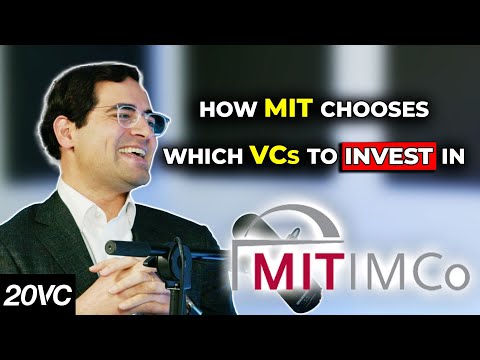
Ryan Akkina: How MIT Builds Their Venture Fund Portfolio & How MIT Approach Direct Investing | E1109
Harry Stebbings (host), Ryan Akkina (guest)
In this episode of The Twenty Minute VC, featuring Harry Stebbings and Ryan Akkina, Ryan Akkina: How MIT Builds Their Venture Fund Portfolio & How MIT Approach Direct Investing | E1109 explores inside MIT’s Endowment: How Ryan Akkina Selects and Backs VCs Ryan Akkina of the MIT Investment Management Company explains how MIT builds and manages its venture fund and direct co‑investment portfolio in a much more competitive, complex venture landscape. He outlines their evaluation framework for managers (“see, pick, win, serve”), the challenges of sizing commitments, staying loyal while funds scale, and deciding when to pare back or stop re‑upping. Akkina also details MIT’s growing use of direct co‑investments, the importance of structure and price discipline, and the incentive misalignments within traditional endowment models. Throughout, he reflects on mistakes (errors of omission like OpenAI, and bad direct bets), the half‑life of all venture firms, and what it now takes for emerging managers to successfully raise from top LPs.
Inside MIT’s Endowment: How Ryan Akkina Selects and Backs VCs
Ryan Akkina of the MIT Investment Management Company explains how MIT builds and manages its venture fund and direct co‑investment portfolio in a much more competitive, complex venture landscape. He outlines their evaluation framework for managers (“see, pick, win, serve”), the challenges of sizing commitments, staying loyal while funds scale, and deciding when to pare back or stop re‑upping. Akkina also details MIT’s growing use of direct co‑investments, the importance of structure and price discipline, and the incentive misalignments within traditional endowment models. Throughout, he reflects on mistakes (errors of omission like OpenAI, and bad direct bets), the half‑life of all venture firms, and what it now takes for emerging managers to successfully raise from top LPs.
Key Takeaways
Top LPs now evaluate VCs on ‘see, pick, win, and serve,’ with winning and servicing increasingly decisive.
Many GPs can access deal flow and make good picks, but sustained access to iconic companies requires repeatedly winning allocations and being a strong, referenceable partner to founders.
Get the full analysis with uListen AI
Fund size and growth speed can quietly destroy a previously great firm’s edge.
When managers raise too much, too fast, they’re pushed out of their historical sweet spot; combined with success‑driven arrogance or fading motivation, this often causes once‑excellent firms to go sideways.
Get the full analysis with uListen AI
Track record matters less for emerging managers than qualitative factors and founder references.
For new funds, MIT emphasizes likability, founder fit, work ethic, and early angel track records over backward‑looking fund metrics, because early performance data is sparse and noisy.
Get the full analysis with uListen AI
Direct co‑investments are attractive when MIT already knows the company and can secure protective structures.
Deals like Coupang and Rippling worked for MIT because they had a ‘prepared mind,’ trusted the lead GP, and invested via senior or otherwise well‑structured instruments that limited downside while preserving upside.
Get the full analysis with uListen AI
Endowment incentive structures are poorly aligned with taking smart risk, especially in directs.
Akkina openly notes that traditional endowment compensation gives staff little economic upside from big wins, so only strong culture and leadership can motivate people to pursue higher‑effort, higher‑impact co‑investments.
Get the full analysis with uListen AI
Errors of omission—passing on outliers like OpenAI—can be more painful than visible losses.
MIT skipped OpenAI due to structure and perceived technical risk; Akkina now thinks they should have made a small, option‑like bet given their trust in Sam Altman and the magnitude of the idea.
Get the full analysis with uListen AI
Emerging managers must treat fundraising as an enterprise sales process and time LP engagement carefully.
He suggests building a funnel, cultivating ‘lines not dots,’ and avoiding full evaluation by large institutions too early, because a premature “no” can effectively sideline you for years.
Get the full analysis with uListen AI
Notable Quotes
“When things are going well, you're never as smart as you think you are, and when things are going poorly, you're never as dumb as you think you are.”
— Ryan Akkina
“Every firm, no matter how great, has a half-life. No firm is gonna be great forever.”
— Ryan Akkina
“Frankly, if people have a spell of success, sometimes they become arrogant. They start to make worse decisions and treat people worse.”
— Ryan Akkina
“Our scarcest resource is our time. Figuring out how you allocate that is really the first constraint; everything else flows from that.”
— Ryan Akkina
“Honestly, I think the answer is no. The traditional endowment or foundation doesn’t have an incentive to be good at this stuff.”
— Ryan Akkina (on whether endowment incentives are ‘right’)
Questions Answered in This Episode
How can an emerging manager concretely demonstrate ‘win’ and ‘service’ capabilities to an LP before having a long track record?
Ryan Akkina of the MIT Investment Management Company explains how MIT builds and manages its venture fund and direct co‑investment portfolio in a much more competitive, complex venture landscape. ...
Get the full analysis with uListen AI
What early signs should LPs watch for that a once‑great venture firm is starting to grow beyond its optimal fund size or lose its edge?
Get the full analysis with uListen AI
How might endowments redesign compensation and governance to better align staff incentives with taking intelligent, long‑term risks?
Get the full analysis with uListen AI
In hindsight, what practical framework could have helped MIT justify a small, speculative bet on OpenAI despite its unusual structure?
Get the full analysis with uListen AI
What are the main pitfalls LPs face when ramping up direct co‑investing, and how can they avoid ending up in the ‘messy middle’ of shallow underwriting?
Get the full analysis with uListen AI
Transcript Preview
Is it harder than ever before in terms of investing in venture funds?
It's gotten a lot more difficult, for a lot of reasons.
This is Ryan O'Keene. He is a member of the global investment team at the MIT Investment Management Company with an AUM of over $30 billion. For the funds which are working really well, what are the reasons that they go sideways?
Frankly, if people have a spell of success, sometimes they become arrogant, right? They start to make worse decisions and treat people worse. When things are going well, you're never as smart as you think you are, and when things are going poorly, you're never as dumb as you think you are.
For managers who are contemplating raising today, what would be your biggest piece of advice?
I think you have to treat the process like...
Ryan, I am so excited for this. I love, love that you're here. So thank you so much for joining me today.
My pleasure. The tables are turned now.
The tables are turned now, so this is gonna be fun. Uh, the LP world is an interesting one. How did you make your way into the world of fund investing and being an LP and come to be at MIT?
Well, it's definitely not a job that you, uh, you think of as a kid or something and say, "I wanna be an LP," right?
(laughs)
I mean, I didn't even know the job existed probably till my early 20s. Uh, you know, not to be too meandering, but maybe to explain a little why I got interested in technology as well, um, you know, originally I thought I would be an engineer, and I was lucky I had this interesting job in high school where I worked at HP and Intel working on microchip design on this project called the Itanium processor. And so I- I assumed when I went to college, I'd probably do double E and, uh, you know, be an engineer after that, but I wound up at Stanford and, uh, started in double E, and about four summers into my internship at HP and Intel working on this processor, I decided I didn't really like working as a individual contributor engineer in a cubicle somewhere and wanted to do something different, so I switched to something at Stanford called Management Science and Engineering. In, in retrospect, maybe what I should've concluded is I just didn't like working at a big company, uh, but anyway, I did that, and I was also part of a lot of entrepreneurship activity at Stanford, if you will. There was this club called BASES that helped organize the career fairs and speaker series and things like that. So I got to meet a lot of interesting VCs and entrepreneurs through that, um, got to work with some interesting firms as well. This was back before YC was so well-known, for instance, and I remember one spring, I think, we helped, uh, organize a YC startup school event on the Stanford campus, so I got to see that from pretty early days. So, you know, I actually, when I was graduating, I thought, "Well, maybe I'd like to become a venture capitalist." And I also started a, a company with some friends my senior year that, uh, a few months in, I decided it was unlikely to work out, so I didn't stick with it. They actually went on with it for four or five years, I think, and went through YC and made a go of it. Uh, but anyway, I actually thought about becoming a, a venture capitalist after school, and I had an offer at a firm, but I ended up deciding, uh, you know, I don't really have a right to win there, right? I'd seen by that time that the returns were pretty concentrated in just the, the top people, right? And not having been an entrepreneur or even a, you know, a senior executive or somebody in tech, I might have just said, "Well, you know, is this really the best thing for me to start off at 22 and just carry someone's bag and probably not be very much value add?" So, but then inexplicably, I decided to be a management consultant instead.
Install uListen to search the full transcript and get AI-powered insights
Get Full TranscriptGet more from every podcast
AI summaries, searchable transcripts, and fact-checking. Free forever.
Add to Chrome