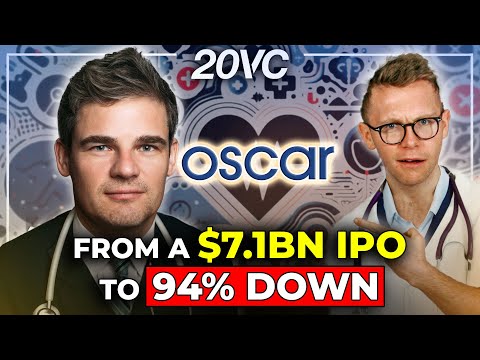
Mario Schlosser: "How to Deal with a 94% Decline in Market Cap" | E1136
Mario Schlosser (guest), Harry Stebbings (host)
In this episode of The Twenty Minute VC, featuring Mario Schlosser and Harry Stebbings, Mario Schlosser: "How to Deal with a 94% Decline in Market Cap" | E1136 explores founder Survives 94% Stock Crash, Redefines Leadership, Money, Resilience Mario Schlosser, co‑founder of health insurer Oscar, recounts taking the company public, enduring a 94% stock price collapse, and navigating the psychological and operational fallout. He explains why healthcare is so hard to disrupt, how markets mispriced Oscar, and what he learned about communicating with Wall Street. Schlosser also reflects on stepping down as CEO, his evolving relationship with money and status, and the emotional toll of leading through crisis, including depression and medication. Throughout, he challenges common Silicon Valley myths about hero founders, visions, and success, emphasizing humility, low expectations, and designing companies around one’s own operating style.
Founder Survives 94% Stock Crash, Redefines Leadership, Money, Resilience
Mario Schlosser, co‑founder of health insurer Oscar, recounts taking the company public, enduring a 94% stock price collapse, and navigating the psychological and operational fallout. He explains why healthcare is so hard to disrupt, how markets mispriced Oscar, and what he learned about communicating with Wall Street. Schlosser also reflects on stepping down as CEO, his evolving relationship with money and status, and the emotional toll of leading through crisis, including depression and medication. Throughout, he challenges common Silicon Valley myths about hero founders, visions, and success, emphasizing humility, low expectations, and designing companies around one’s own operating style.
Key Takeaways
Design your company around how you actually work, not generic ‘best practices’.
Schlosser argues that founders often over‑adopt professional managers’ playbooks; instead, they should build meeting rhythms, decision processes, and org structures that fit their own cognitive strengths and preferred ways of thinking.
Get the full analysis with uListen AI
In healthcare and other regulated markets, great tech is useless without deep domain understanding.
Most healthtech startups either have good technology or understand healthcare’s incentives and workflows—but rarely both; success requires explicitly adding domain expertise rather than relying solely on outsider creativity.
Get the full analysis with uListen AI
Communicating with public markets requires brutal simplicity, not detailed nuance.
Oscar tried to explain its economics via complex operational detail, but investors with limited attention mainly saw massive losses; Schlosser learned that public markets respond to clear, high‑level narratives and visible profitability paths.
Get the full analysis with uListen AI
Founders must proactively manage their mental health during extreme volatility.
After the IPO disappointment and prolonged decline, Schlosser experienced serious depression, sought professional help, took antidepressants, and tracked his mood—framing chemistry and therapy as essential tools, not weaknesses.
Get the full analysis with uListen AI
Stepping aside as CEO can be an act of protection for the company, not failure.
Fearing he’d exhausted his “bag of tricks” for future crises, Schlosser deliberately recruited an experienced operator as CEO and fully ceded authority, emphasizing that partial handovers and shadow leadership are what truly damage startups.
Get the full analysis with uListen AI
Low expectations can fuel resilience and a sense of wonder.
Coming from a small German town with modest ambitions, Schlosser found that low initial expectations made later access to Silicon Valley and elite networks feel magical, and reduced entitlement while increasing staying power.
Get the full analysis with uListen AI
Money mainly buys freedom of focus, not lasting happiness.
Becoming financially secure felt like relief and validation, but also raised the stakes; Schlosser values money most as the ability to pursue intellectually interesting, often inefficient projects without needing anyone’s permission.
Get the full analysis with uListen AI
Notable Quotes
“The world doesn’t end that often.”
— Mario Schlosser
“Public markets don’t care about your red button versus blue button when you’re losing $400 million a year.”
— Mario Schlosser
“If you step down as CEO, you have to do it wholeheartedly. You can’t still be the shadow decision‑maker.”
— Mario Schlosser
“You might as well build organizations the way you like it, not the way that a book or advisor tells you.”
— Mario Schlosser
“There’s always a room you’re not in. Even for Zuckerberg, there’s a room he doesn’t get invited to.”
— Mario Schlosser
Questions Answered in This Episode
How should a founder decide when it’s time to bring in an external CEO versus pushing to grow into the next stage themselves?
Mario Schlosser, co‑founder of health insurer Oscar, recounts taking the company public, enduring a 94% stock price collapse, and navigating the psychological and operational fallout. ...
Get the full analysis with uListen AI
What concrete frameworks can help founders assess whether their business model truly aligns with the incentive structures in healthcare or other complex markets?
Get the full analysis with uListen AI
How can public‑company CEOs better balance the need for simple narratives with the reality of complex underlying businesses?
Get the full analysis with uListen AI
What are effective, practical ways for founders to monitor and protect their mental health before crises become overwhelming?
Get the full analysis with uListen AI
If visions can unintentionally limit potential, how should ambitious people set goals without capping their upside?
Get the full analysis with uListen AI
Transcript Preview
We went public, right, I think it was March 3rd or whatever, 2021. It was Josh and I ringing the bell. We're like, "Fuck yeah, this is gonna be great," and then we open and the thing falls. It opens low right away and it falls right away. The world doesn't end that often, and that is actually one of the things you do realize. Step outside of yourself and observe yourself and say, "You've done this before. It is gonna be fine." Sometimes the rhetoric in Silicon Valley of like, oh my god, life and death, whatever, is also just fucking stupid.
Ready to go? Mario, I'm so excited for this. I cannot believe it has been so long since we did our last one. Hopefully I've improved as an interviewer. Christ, I needed to. But I so appreciate you joining me today.
I hope I've improved as a interviewee as an entrepreneur. We were both just starting out, I feel like, when we, when we last talked, so it's great to be-
I, I-
... back on.
It is astonishing how time flies. But I just want to go back to a little bit, actually, in childhood. I believe the best entrepreneurs are shaped early. When you think about your childhood, how would your parents and teachers have described the young Mario?
They would say I always had a high degree of totally intrinsic motivation and just not really caring what others told me to do or what others thought about what I was doing. And so, um, I got a, a Sinclair ZX81, which had, I think, one kilobyte of RAM, relatively early on from not my parents on ... My father's a middle school teacher. Mother's a nurse. And so they had really no mathematical or computer science inclinations whatsoever, but a friend of my father gave me that little computer, and so I would type in listings and whatever, learn all that stuff, and so just get sucked into that and, and to do whatever I wanted there, really. Um, I don't think I was always that smart in, in going about learning it. I remember actually a summer where I kept trying to figure out how to have the computer draw lines, and I would just on, you know, square paper draw lots and lots and lots of lines and see how would you have to place the pixels to draw a line. And, um, the guys who invented Doom, for example, would have probably figured out a clever algorithm there. I couldn't figure it out, and eventually I realized, okay, floating point numbers, that's the thing you need there, but it took me way too long, okay? So the persistence and the intrinsic motivation and then the sort of not caring what others think about it's probably the biggest ingredients.
So I have this theory that the best entrepreneurs show early signs of exceptionalism always. It could be in sport. It could be in business they start very, very young. It could be in designing websites for local, uh, businesses. But there's always a sign of exceptionalism early. Do you agree with that as an investing thesis, almost, or not?
Install uListen to search the full transcript and get AI-powered insights
Get Full TranscriptGet more from every podcast
AI summaries, searchable transcripts, and fact-checking. Free forever.
Add to Chrome