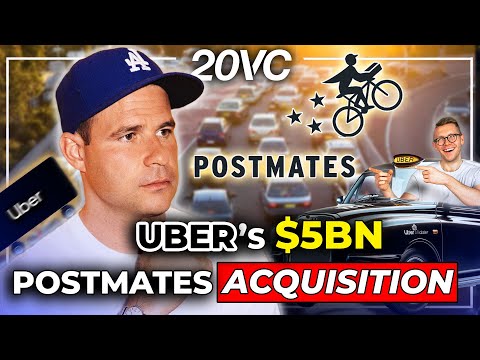
Bastian Lehmann: How the Uber Deal Went Down and How a $2.65BN Deal Turned into $5BN | E1137
Bastian Lehmann (guest), Harry Stebbings (host)
In this episode of The Twenty Minute VC, featuring Bastian Lehmann and Harry Stebbings, Bastian Lehmann: How the Uber Deal Went Down and How a $2.65BN Deal Turned into $5BN | E1137 explores from Hacking Dial-Up to Postmates’ $5B Uber Deal and Beyond Bastian Lehmann recounts his journey from a modest childhood in Germany, early computer obsession, and grit shaped by his mother’s sacrifices to founding and scaling Postmates over a decade of “wartime” competition.
From Hacking Dial-Up to Postmates’ $5B Uber Deal and Beyond
Bastian Lehmann recounts his journey from a modest childhood in Germany, early computer obsession, and grit shaped by his mother’s sacrifices to founding and scaling Postmates over a decade of “wartime” competition.
He details Postmates’ path through brutal fundraising, intense capital battles with DoorDash and Uber, and ultimately negotiating a strategically structured, no‑collar acquisition by Uber that grew from $2.65B to nearly $5B as Uber’s stock rose.
Lehmann shares nuanced views on venture capital—why most VCs are “sheep,” how to choose investors, and why great VCs accept they can’t change outcomes—along with practical lessons on board management and founder endurance.
He also discusses his second company TipTop, the advantages and mindset shifts of being a wealthy repeat founder, and offers contrarian takes on AI, personal inference hardware, the future of phones, Big Tech incumbents, and OpenAI’s role.
Key Takeaways
Relentless persistence beats timing and capital in most startup outcomes.
Lehmann argues most companies fail because founders give up; Postmates survived a decade of brutal competition and funding gaps fundamentally through refusal to quit and deep team loyalty.
Get the full analysis with uListen AI
In hyper‑competitive markets, large funding rounds make sense only after unit economics are proven.
He notes that once Postmates and peers had clear paths to profitability and scalable unit economics, capital became primarily a weapon for customer acquisition and share capture, justifying aggressive fundraising.
Get the full analysis with uListen AI
Acquisition structure can matter more than headline price.
By negotiating no breakup provisions and no collar on Uber’s stock, Postmates turned an announced $2. ...
Get the full analysis with uListen AI
Choose investors who already believe; don’t burn cycles “educating” skeptics.
Lehmann advises that if you must repeatedly convince a VC about your space or drill endlessly into unit economics, they’re likely benchmarking you against competitors and will be painful board members later.
Get the full analysis with uListen AI
Great VCs are humble about their ability to influence company outcomes.
He praises investors who see writing the check and staying out of the way as their main value, emphasizing that operators—not board members—ultimately determine success.
Get the full analysis with uListen AI
Board meetings work best when tension is diffused before you enter the room.
His evolved cadence: send a deck in advance, host a candid board dinner to surface issues, then run a short, focused formal meeting where real disagreements have already been mostly resolved.
Get the full analysis with uListen AI
Second‑time, financially secure founders must consciously preserve urgency and humility.
With TipTop, Lehmann avoids a salary, focuses on rapid hypothesis testing, and tries to ignore his wealth and past success so the team doesn’t drift into complacency despite plenty of capital.
Get the full analysis with uListen AI
Notable Quotes
“Most companies fail because the founders give up, and we refused to give up.”
— Bastian Lehmann
“We negotiated the deal so well, there was no collar on the deal. By the time the deal closed, it was almost $5 billion.”
— Bastian Lehmann
“A good signal can’t save a bad company.”
— Bastian Lehmann
“The greatest VCs that I have met are the people that know there is very little you can do to actually move the needle other than writing the check.”
— Bastian Lehmann
“Not developing AI fast enough is what will kill us, not the other way around.”
— Bastian Lehmann
Questions Answered in This Episode
How would Lehmann’s acquisition playbook change for today’s lower‑liquidity, higher‑rate environment versus the Uber deal era?
Bastian Lehmann recounts his journey from a modest childhood in Germany, early computer obsession, and grit shaped by his mother’s sacrifices to founding and scaling Postmates over a decade of “wartime” competition.
Get the full analysis with uListen AI
What concrete criteria would he use to decide whether to keep pushing TipTop or pivot fully into a different problem space?
He details Postmates’ path through brutal fundraising, intense capital battles with DoorDash and Uber, and ultimately negotiating a strategically structured, no‑collar acquisition by Uber that grew from $2. ...
Get the full analysis with uListen AI
How can first‑time founders practically distinguish between ‘sheep’ VCs and the rare partners who add genuine value without oversteering?
Lehmann shares nuanced views on venture capital—why most VCs are “sheep,” how to choose investors, and why great VCs accept they can’t change outcomes—along with practical lessons on board management and founder endurance.
Get the full analysis with uListen AI
If personal inference computers at home are the future, what are the most promising first use cases that could achieve mainstream adoption?
He also discusses his second company TipTop, the advantages and mindset shifts of being a wealthy repeat founder, and offers contrarian takes on AI, personal inference hardware, the future of phones, Big Tech incumbents, and OpenAI’s role.
Get the full analysis with uListen AI
Given his view that incumbents will crack from the inside, where does he see the earliest visible signs of that happening in Big Tech today?
Get the full analysis with uListen AI
Transcript Preview
Here is another thing that I think people don't fully understand. We negotiated the deal so well, there was no collar on the deal. By the time the deal closed, it was almost $5 billion. (cash register dings) We had just under $100 million left in cash, and our negative gross profit margin was, I think, single digits. Two or three quarters later, we, we were profitable as a company. Most companies fail because the founders give up, and we refused to give up.
Ready to go? (upbeat music) Bastian, I've wanted to do this one for a long time, my friend. So first, thank you so much for joining me today.
Yeah. You know what? Uh, same here. I think we had some, some, some scheduling bugs, but we figured it out.
We figured it out-
(laughs)
... in the end and we made it happen. I wanna go back to your childhood. I think great entrepreneurs are shaped early. Take me to your parents and your teachers. If they were to describe a young Bastian in Germany, what would they have said about you and how you were?
Well, first of all, y- you know, in 19- 1977, that's when I was born, 1980 in Germany, you have to understand, everything was still black and white, right? So, (laughs) you know, what, what, what... Um, wait. No. I mean, like, it was, it was sort of, it was sort of a different environment than, than we have today. But what would they say? Eh, probably a very curious child, you know. I liked to play a lot. Um, uh, I think I was always onto something. As a matter of fact, I think I was out of the house most of the time. Uh, I think as soon as I could get out of the house, I would just, I would just be somewhere. Uh, play in the forest or run around, you know. I had a group of friends. We did exhibitions and then, you know, that sort of stuff.
Can I ask you? I- I'm always struck with the question of skill versus luck in life. How do you think about the importance of skill versus luck in life?
I- I don't really believe in luck much, um, uh, but I also don't have a definite answer. I, I think I believe in determination and grit and, uh, and hard work.
I totally agree with you. I- I think the best is you make your own luck. Um, I- if we, like, isolate a point in your life that was a needle-moving moment for your career, when you reflect, what do you think the most needle-moving moment was? Was it the move to the US? Was it selling Postmates? What was that, "Ah, that was the big move"?
Uh, you know, definitely moving to the US, um, was, was a, was a huge part. And I think it's important to understand, I wanted to be in the US almost all my entire life. I remember very vividly, um ... This is actually a great story. So, um, what, what happened is that I was obsessed with computers, um, pretty much, uh, pretty much as long as I can remember. And I loved the idea that I can just, I can just hack things and something, you know, something co- something, something comes back f- from the screen. When we first got internet access, I, I incurred these, these bills of, like, ridiculous amounts of money. And, and I grew up, uh, in a fairly modest house and my, my, my mom had sometimes three jobs, so we didn't have a lot of money. And back then, if you- if you remember, it's a dial-up, so you pay, um, uh, you pay per minute or you pay per hour depending on your plan. And the, the closest internet provider was sort of a, sort of like a regional call, so it was not quite long distance but it was, it was quite something. And I don't ... I- I can't even tell you what I did online, to be honest, um, because back then, somebody just told you about a website, you would discover it and... Anyway, I- after a while, I decided that I could run a- a, you know, a- a BBS, like, uh, a little software that allowed other people to connect to, to connect to my computer. And obviously, that was a very boring affair because only one other person could connect to your computer, right? So you run this, this bulletin board, um, and- and you designed it and, yeah, I don't even know what you had on there. You had, you had probably photos of Claudia Schiffer. To that extent, content was available. And, and this, this person, um, his name was Annie Mello. He came online, or that was his name, and, um, we started talking. He's like, "Well, what's your setup?" And he had ... I'm like, "Well, you know, just ..." I think I had a 14.4K modem and, and, and I said like, you know, "I- I don't really know much about, about the internet or anything, and I also can't be connected to the internet because it costs a lot of money." And he said, "Why, you, you, you don't know how to surf in the internet for free?" And I'm like, "No. I- I don't know." And he said, "Well, uh, you need to get, you need to get a US calling card. You need to get a calling card from the US." 'Cause how it works, he said, in the US, they have like AT&T or they have MCI, WorldCom. For long distance calls and collect calls or calls abroad, in the US, they punch in this calling card number and a PIN code, and then they can use, uh, as, uh, uh, you know, a, a telephone booth for free or they can, they can call when they're abroad and it gets charged to their account. I'm like, "Wait a minute. I don't understand all of this." And he said, "I'm gonna come by." So a- a week later, he wanted to come by and obviously, I never, I never met this person. So he, he, he ... Uh, literally, back in the days, you just w- drove somewhere. And so he came by and- and it turns out he was like 40-something, and my mom was very, very skeptical of, of this person. She's like, "You leave the door open." And then, and- and- and she, she ... But, but this guy was a, was a complete nerd and- and he taught me literally what I had to do is I had to get a phone book from the US somehow. And then I had to call people in the US and had to tell them that I would be a, you know, service agent from MCI or from AT&T, and that there was a problem with their account, you know. I needed to verify their, uh, calling card number and their, and their, um, their- their PIN code. Thi- this is a true story. So, um, at some point, my parents were divorced and- and I think, uh, here- here's the one good thing my dad did for me. He got me a phone book as ... A phone book from San Francisco, a Pacific Bell phone book from San Francisco. And me and a friend of mine, we would hit the phone and we would call people in San Francisco and, uh, practice our American accent to sound like, uh, we're from MCI, WorldCom, or from AT&T, depending on the phone number. We would ask for their calling card number-... and I, I, at some point, after weeks of effort, someone also gave us the PIN code without, without being too, uh, suspicious. So then what we would do, we would have that calling card number and the PIN code. We would call our dial-up provider. We would... so, so you, you would call a toll-free number from, from AT&T in, uh, in Germany. You would punch in the calling card number. You would punch in the PIN code. You would then unplug the phone, plug in the modem, uh, dial the number from your internet provider, and, and, and you would surf. Um, so in, in a way, my career probably has started with embezzling, um, AT&T or MCI, uh, uh, in San Francisco.
Install uListen to search the full transcript and get AI-powered insights
Get Full TranscriptGet more from every podcast
AI summaries, searchable transcripts, and fact-checking. Free forever.
Add to Chrome