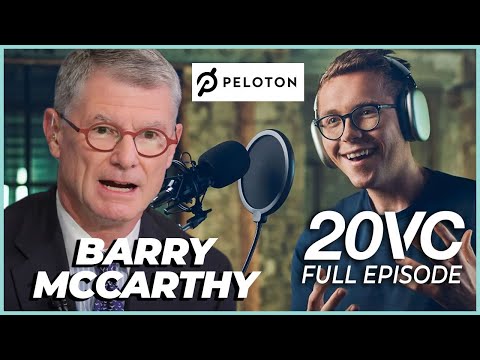
Barry McCarthy: From Netflix CFO to Peloton CEO; How Netflix Beat Blockbuster | 20VC #962
Harry Stebbings (host), Barry McCarthy (guest), Narrator
In this episode of The Twenty Minute VC, featuring Harry Stebbings and Barry McCarthy, Barry McCarthy: From Netflix CFO to Peloton CEO; How Netflix Beat Blockbuster | 20VC #962 explores barry McCarthy on Winning Markets, Turnarounds, and Talent Density Barry McCarthy traces his path from venture investor to operating executive, detailing formative leadership experiences at Netflix, Spotify, and now as Peloton’s turnaround CEO.
Barry McCarthy on Winning Markets, Turnarounds, and Talent Density
Barry McCarthy traces his path from venture investor to operating executive, detailing formative leadership experiences at Netflix, Spotify, and now as Peloton’s turnaround CEO.
He explains how business model design, control of demand creation, and talent density underpin durable competitive advantage, using Netflix’s catalog strategy and Spotify’s direct listing as case studies.
McCarthy explores the emotional resilience required in crisis leadership, decision-making frameworks, board dynamics, and his own strengths (pattern recognition) and weaknesses (EQ and impatience with BS).
Throughout, he contrasts founder-led and professional-CEO environments, and unpacks how Peloton’s brand, product-market fit, and COVID-era scale give it a path to sustainable recovery.
Key Takeaways
Business model quality is the primary driver of sustained advantage.
McCarthy argues that without the right business model, execution alone cannot win; at Netflix and Spotify, rethinking the model (e. ...
Get the full analysis with uListen AI
Owning demand creation lets platforms control gross margins.
By understanding individual preferences and steering users among similar content (e. ...
Get the full analysis with uListen AI
Talent density matters more than loyalty or ‘family’ culture.
He views companies as professional sports teams, not families; leaders must hire exceptional people, ruthlessly swap out underperformers, and create an environment where top performers want to play.
Get the full analysis with uListen AI
Turnaround CEOs must cultivate exceptional emotional resilience.
In crisis, almost nothing works and all problems escalate to the CEO; leaders must solve complex issues while staying emotionally stable and motivating teams, or risk burnout and attrition.
Get the full analysis with uListen AI
Use the ‘one-way vs. two-way door’ framework for decision speed.
Irreversible decisions demand slower, more analytical processes, while reversible ones (like new distribution partnerships) should be made quickly, with clear upfront success metrics and exit criteria.
Get the full analysis with uListen AI
Effective disagreement requires clarity on decision ownership and rationale.
McCarthy stresses that everyone should be heard, but a clear owner must make the call, be held accountable, and explicitly explain why a decision was taken so others can commit even if they disagreed.
Get the full analysis with uListen AI
Board value is proportional to the context and transparency CEOs provide.
Because directors never fully see inside a company, CEOs that proactively share context and seek help get more strategic, anticipatory input; secretive or defensive CEOs get less value from their boards.
Get the full analysis with uListen AI
Notable Quotes
“Whoever owns demand creation owns the gross margin.”
— Barry McCarthy
“We are not a family. We are a professional sports team.”
— Barry McCarthy
“The brand is golden and the user experience is platinum.”
— Barry McCarthy on Peloton
“People don’t come to you when things are working well, and in a turnaround almost nothing’s working well.”
— Barry McCarthy
“I have more IQ than I have EQ, and I would be a better manager if I had more EQ.”
— Barry McCarthy
Questions Answered in This Episode
How can early-stage startups practically apply ‘demand creation theory’ before they have massive data scale?
Barry McCarthy traces his path from venture investor to operating executive, detailing formative leadership experiences at Netflix, Spotify, and now as Peloton’s turnaround CEO.
Get the full analysis with uListen AI
What concrete steps can a CEO take to build emotional resilience during a prolonged downturn or turnaround?
He explains how business model design, control of demand creation, and talent density underpin durable competitive advantage, using Netflix’s catalog strategy and Spotify’s direct listing as case studies.
Get the full analysis with uListen AI
Where is the line between healthy ‘professional sports team’ culture and creating an environment that feels too transactional?
McCarthy explores the emotional resilience required in crisis leadership, decision-making frameworks, board dynamics, and his own strengths (pattern recognition) and weaknesses (EQ and impatience with BS).
Get the full analysis with uListen AI
In today’s capital markets, what innovations might replace or complement direct listings for companies that don’t need to raise money?
Throughout, he contrasts founder-led and professional-CEO environments, and unpacks how Peloton’s brand, product-market fit, and COVID-era scale give it a path to sustainable recovery.
Get the full analysis with uListen AI
How should a non-founder CEO build trust and authority with a founder-heavy board while still challenging their assumptions?
Get the full analysis with uListen AI
Transcript Preview
Barry, this is such a joy to do. As we just said, I've stalked you for- for many, many weeks now with- with-
(laughs)
... references from Gustav, from Daniel, from so many others. So thank you so much for joining me today.
Oh, it's a absolute pleasure.
Now, I would love to start with a little bit of context. We look at the incredible journey you've had. And I'm gonna skip a few steps in between. But I'd love to know, how did you make your way into the world of startups first? And then, how did you come to be CEO of Peloton most recently?
Well, I got involved in startups in the- in the 19... (laughs) not to date myself, in the 1980s when I was at First Boston, uh, and they pulled together an investment pool, um, and were investing in startups, and I was invited to participate in that group, uh, as a venture capital investor, and I spent seven years doing it. And I made just about every mistake you could possibly make. And then, along the way, I realized that I wanted to be an operating guy, and then it took me quite a while to get my, convince someone to hire me in my first operating role. Uh, eventually, that led me to- to Reed Hastings' doorstep in 1999, when Netflix was quite small. I think I was the 40th employee. Um, and then, you know, the rest is sort of history. And then with respect to Peloton, I was k- comfortably (laughs) retired, uh, and, uh, uh, and an avid Peloton fan, user. And, uh, and, uh, had- had many, um, years of successful association with TCV, both co-investors in Netflix and co-investors in Spotify. And, um, and read about some of the difficulties in the business and thought it was particularly relevant, coincidentally, with things I'd done in my career that led me, gave me some insights into, um, maybe some of the challenges they were facing and possibly some of the fixes. And I was anxious to play another big game with an iconic brand, which Peloton is, and, um, fortunately, I was able to convince them to give me a shot at- at, uh, jumping in and turning it around.
I'm sure that was a tough decision for them looking at your incredible journey. (laughs)
(laughs)
Um, but- but, uh, I- I do, I- I just-
Well, I'm not everybody's cup of tea, let me put it that way. (laughs)
T- we'll get to it. (laughs)
(laughs)
I heard some weaknesses too. I just, I'm fascinated. And I'm sure Ben told you I go off schedule a little bit. What was Reed like back in 1999? We see this incredible leader today. What was Reed like back then in 1999?
Well, his- his original vision was to be retired and to run the company and be its chairman. And the performance kind of got sideways and he came in off the sidelines and replaced Marc Randolph as the CEO, and then the very first thing he did was to bring in Patty McCord and rebuild the entire team. And, uh, so I came in as part of the rebuilding and it was then an a la carte business. Now, he had been very successful building a company called Pure Software, which he ended up selling and had been taken public by Morgan Stanley, and I think was maybe the second most successful IPO of all time if I'm recalling correctly. A little bit out of my depth there. Um, and in hindsight, I think he wished that he had had the opportunity to build it in a slightly different way. He had been a first time CEO at Pure, uh, and this was his- this was his do-over, in effect. Um, and so he was, um, he was quite deliberate in the way that he- he built the culture, um, and measured performance. And, um, and then eventually we found product market fit. It's a sub- subscription model as it turned out, not as an a la carte business. And once we stumbled into, uh, into the subscription model, the- the business literally started doubling each year and for, gosh, five or six years just kept doubling.
Install uListen to search the full transcript and get AI-powered insights
Get Full TranscriptGet more from every podcast
AI summaries, searchable transcripts, and fact-checking. Free forever.
Add to Chrome