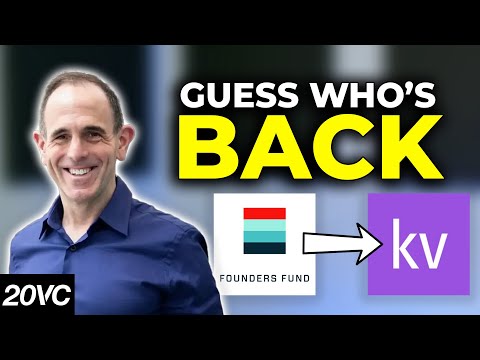
Keith Rabois on Rejoining Khosla Ventures | E1102
Harry Stebbings (host), Keith Rabois (guest), Narrator
In this episode of The Twenty Minute VC, featuring Harry Stebbings and Keith Rabois, Keith Rabois on Rejoining Khosla Ventures | E1102 explores keith Rabois Explains Return to Khosla, Seed Strategy, And Venture Edges Keith Rabois discusses why he left Founders Fund to rejoin Khosla Ventures, emphasizing long-standing relationships with partners, the intellectually rigorous Monday partner meetings, and Khosla’s deep-tech learning environment.
Keith Rabois Explains Return to Khosla, Seed Strategy, And Venture Edges
Keith Rabois discusses why he left Founders Fund to rejoin Khosla Ventures, emphasizing long-standing relationships with partners, the intellectually rigorous Monday partner meetings, and Khosla’s deep-tech learning environment.
He contrasts Khosla’s structured, debate-heavy culture with Founders Fund’s more autonomous, PM-style model, and explains how each sharpened different aspects of his investing—especially around growth and pro-rata decisions.
A large portion of the conversation explores seed vs. Series A vs. growth investing, price discipline, reserves, and how to think about conviction, social capital inside a firm, and fund sizing.
Rabois also touches on founder–investor fit, operator-turned-investor pitfalls, his views on Bitcoin, IPOs, and parenting, and why he cares more about impact on people’s lives than additional wealth.
Key Takeaways
Intense partner debate can materially improve investment judgment.
Khosla’s long, unstructured Monday partner meetings—with Vinod, Sameer, and David rigorously challenging each deal—forced Rabois to think more sharply, often strengthening or correcting his conviction while still leaving final decisions to him.
Get the full analysis with uListen AI
Price sensitivity at seed is often a proxy for weak conviction.
Citing Peter Fenton’s “price is always a trap” idea, Rabois argues that walking away from a strong seed or Series A deal primarily on valuation usually reflects insufficient belief in the opportunity; for true outliers, early entry price matters far less than being in.
Get the full analysis with uListen AI
Seed is where differentiated investors can gain an edge over top-tier A funds.
Rabois prefers leading seed rounds—often just a team and a deck—because fewer investors are comfortable at that stage, competition with elite Series A firms is lower, and he can shape the “liquid concrete” of culture and strategy before it hardens.
Get the full analysis with uListen AI
Reserves are more art than science; ad hoc can beat rigid allocation.
He contrasts Khosla’s more top-down reserve planning with Founders Fund’s deal-by-deal approach, suggesting that while structured reserves look elegant, opportunistically re-underwriting each follow-on often leads to better capital allocation.
Get the full analysis with uListen AI
Comparative advantage should drive both investments and fund strategy.
Rabois insists on asking “Why me? ...
Get the full analysis with uListen AI
Fund size must match stage focus, team capacity, and strategy.
Defending Khosla’s new ~$3B vehicle, he breaks it into seed, venture, and growth buckets and maps each to the number of true lead investors and portfolio size, arguing that when decomposed by stage, the headline number can be rational.
Get the full analysis with uListen AI
Founder–investor fit is a key determinant of startup success.
He frames choosing investors as matchmaking: highly opinionated, culture-driven founders like Mike at Traba or design-obsessed founders like Jack Dorsey need backers whose philosophies align enough to avoid constant thrash yet still provide challenge and frameworks.
Get the full analysis with uListen AI
Notable Quotes
“I always take very seriously the question, ‘Do I have a comparative advantage?’ If I don’t, I probably shouldn’t be in the deal.”
— Keith Rabois
“At seed or Series A, when you’re walking away on price, it’s really a lack of conviction. Price is usually just an excuse.”
— Keith Rabois
“I don’t believe there are shortcuts to success. The traits that lead to irrational success in any field are shockingly common—mostly pure input.”
— Keith Rabois
“I will definitely not be chilling, and I will not do my own fund.”
— Keith Rabois
“What I want people to say at my eulogy is: ‘I can’t imagine my life without Keith in it.’”
— Keith Rabois
Questions Answered in This Episode
How should a founder practically evaluate whether an investor truly has a comparative advantage for their specific company?
Keith Rabois discusses why he left Founders Fund to rejoin Khosla Ventures, emphasizing long-standing relationships with partners, the intellectually rigorous Monday partner meetings, and Khosla’s deep-tech learning environment.
Get the full analysis with uListen AI
Given his emphasis on conviction over price at seed, in what rare cases does Rabois believe walking away on valuation is actually rational?
He contrasts Khosla’s structured, debate-heavy culture with Founders Fund’s more autonomous, PM-style model, and explains how each sharpened different aspects of his investing—especially around growth and pro-rata decisions.
Get the full analysis with uListen AI
How could venture firms systematically improve the hardest step Rabois mentions—deciding which first meetings to take—without diluting partner time?
A large portion of the conversation explores seed vs. ...
Get the full analysis with uListen AI
What specific features of Founders Fund’s growth-valuation rigor could or should be imported into earlier-stage investing at other firms?
Rabois also touches on founder–investor fit, operator-turned-investor pitfalls, his views on Bitcoin, IPOs, and parenting, and why he cares more about impact on people’s lives than additional wealth.
Get the full analysis with uListen AI
How might Rabois’ views on early public listings change if the IPO market remains structurally tighter or more conservative over the next decade?
Get the full analysis with uListen AI
Transcript Preview
On Wednesday, Keith Raboy broke some groundbreaking news. (computer trilling) He would be leaving Founders Fund (graphic whooshing) to rejoin Khosla Ventures. Today, we have the exclusive of why Keith decided to move back to Khosla and the plans ahead. Talk to me, Keith. Moving back to Khosla. (screen whooshing)
There's certain things about, you know, KB that I kinda miss, (computer trilling) and then there's (censored) . And so the combination made a lot of sense.
Ten years out, is Keith at KV then? Is Keith doing his own fund?
I think the two most obvious components to answer are... (screen whooshing)
Keith, I am so excited for this. My word, you decided to save some of the biggest VC news for the start of the year. So thank you so much for joining me today first.
It's a pleasure to be with you again.
So, uh, (laughs) talk to me, Keith, moving back to Khosla, um, I- I guess the first question is, why did you decide to make the move back from Founders Fund to Khosla again?
Well, you know, in some ways, so I spent six years, just so everybody has some context, I spent six years from 2013 to 2019 as an MD at Khosla Ventures, and we had a really successful run together. Uh, KB4, KB5, and KB6 were the funds I was a partner in. And we produced, you know, really stellar returns working as a collaboration team between Vinod, Sameer, Kool, David Weiden, and Sven. And, um, I never really left in some senses, because after I left, I stayed in really significant contacts with Vinod, Sameer, and David particularly. We co-invested almost every quarter together. So Sameer invested and led a financing round in the company I run as CEO named OpenStor. Sameer led the series A for a company that you're familiar with, Trauma. Um, you know, he led the series A for Mike's company. So we worked together, we worked, we worked together there. Uh, I led a growth round for one of Sameer's favorite companies called, uh, Ultima, Ultima Genomics. Um, so, you know, it, it's a company I learned a lot about, a founder I knew really well from my days at KB. Sameer also led, you know, an investment round in Varda, uh, Delian's company. I worked very closely with David Weiden on a bunch of companies, including Fair, Bungalow, um, so I felt like I was actually seeing more of Sameer and David than I did when I was at KB for six years and the last five years at Founders Fund. I, because in, in basically when I was at KB, I would see them every Monday for hours at a time, but I didn't really see them Tuesday, Wednesday, Thursday, Friday 'cause we were all go- going meeting with founders, doing one-on-one with founders, attending board meetings, you know, uh, taking pitches, et cetera. Um, whereas over the last five years, actually I was working with Sameer and David basically every single week. Um, and so in some ways, you know, the bridging and bonding got stronger, um, over the last five years than the six years where we were just debating at partner meetings. There's certain things about, you know, KB that led to that successful track record, uh, at, uh, in KB4, 5, and 6 that I kinda missed. And then there's several personal things that just were more appealing to me as a human, you know, a- aside from my professional aspirations and goals and ambitions. And so the combination made a lot of sense, the recombination made a lot of sense. Um, I even spoke at the KB CEO summit, you know, last May, um, so, you know, I- I've stayed in quite close contact with all of the partners at KB. I even helped recruit Nikita originally to KB, so I'm extremely excited to be able to work with them.
Install uListen to search the full transcript and get AI-powered insights
Get Full TranscriptGet more from every podcast
AI summaries, searchable transcripts, and fact-checking. Free forever.
Add to Chrome