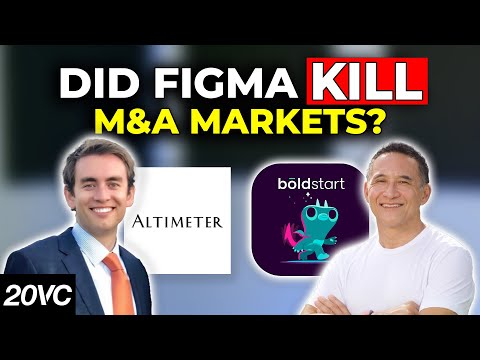
Ed Sim & Jamin Ball: Did Figma Kill M&A Markets & 3 Requirements to IPO in 2024 | E1101
Harry Stebbings (host), Ed Sim (guest), Jamin Ball (guest)
In this episode of The Twenty Minute VC, featuring Harry Stebbings and Ed Sim, Ed Sim & Jamin Ball: Did Figma Kill M&A Markets & 3 Requirements to IPO in 2024 | E1101 explores venture Reset: Overfunded Startups, Broken M&A, and Tougher IPO Bar The discussion examines how the 2020–2022 funding boom created an overhang of overvalued, underperforming startups now facing hard choices on M&A, recapitalizations, or eventual shutdowns. Ed Sim and Jamin Ball argue 2024 is when boards must confront reality, regardless of runway, by asking if businesses can ever grow into 2021-era valuations. They explore why large-scale M&A is structurally constrained by regulation, how private-to-private deals and mid-size exits will become more important, and what it will realistically take to IPO in this environment. Throughout, they stress capital discipline, honest board-founder conversations, and why current vintages—despite pain—may be among the best in a decade.
Venture Reset: Overfunded Startups, Broken M&A, and Tougher IPO Bar
The discussion examines how the 2020–2022 funding boom created an overhang of overvalued, underperforming startups now facing hard choices on M&A, recapitalizations, or eventual shutdowns. Ed Sim and Jamin Ball argue 2024 is when boards must confront reality, regardless of runway, by asking if businesses can ever grow into 2021-era valuations. They explore why large-scale M&A is structurally constrained by regulation, how private-to-private deals and mid-size exits will become more important, and what it will realistically take to IPO in this environment. Throughout, they stress capital discipline, honest board-founder conversations, and why current vintages—despite pain—may be among the best in a decade.
Key Takeaways
Runway is not the same as having a viable business.
Many companies have 24–36 months of cash but are growing too slowly or are too overvalued to justify continuing as-is; boards must ask if the company can ever grow into its last round valuation, not just whether it can survive.
Get the full analysis with uListen AI
Hard, early conversations between boards and founders are now mandatory.
Investors should push founders on their energy and conviction, realistic endgame, and whether selling, merging, or even returning capital might create a better outcome than grinding toward an unreachable valuation.
Get the full analysis with uListen AI
Overpriced 2021 rounds made many cap tables a structural risk.
Huge late-stage rounds built massive preference stacks and 100x ARR entry valuations, making it mathematically difficult for many companies to ever exceed their last private valuation, especially as public multiples normalize around 7–10x revenue.
Get the full analysis with uListen AI
Large-scale M&A is constrained; mid-size and private-to-private deals will matter more.
Regulatory scrutiny (e. ...
Get the full analysis with uListen AI
To IPO in this market, companies must be financially fit and realistic on valuation.
Expectations are for ~30%+ growth, cash-flow break-even or close, and trending toward Rule of 40–50; many IPOs will be down-rounds versus 2021 private marks, but going public can reset cap tables and create currency for hiring and M&A.
Get the full analysis with uListen AI
Founders should avoid making the cap table a risk by over-optimizing price.
Taking the highest possible valuation—especially in hot AI markets—can limit future exit options and force impossible growth expectations; more modest, milestone-based rounds preserve strategic flexibility and founder/employee upside in mid-size exits.
Get the full analysis with uListen AI
Despite current pain, 2024–2025 could be exceptional venture vintages.
Valuations have reset toward pre-ZIRP norms, founders are more disciplined, and a major AI-driven platform shift is underway; firms deploying thoughtfully now, especially in data, AI infrastructure, and security, may see outsized long-term returns.
Get the full analysis with uListen AI
Notable Quotes
“This shit is really fucking hard, and it takes a long time, so you gotta be patient.”
— Ed Sim
“Companies who raised those big mega rounds are pretty much all in this overvalued and underperforming bucket.”
— Jamin Ball
“Just because you have 24 or 36 months of cash doesn’t mean that you have a business.”
— Ed Sim
“Don’t make the cap table a risk to your business.”
— Jamin Ball
“The firms that are making capital calls in 2024…this is gonna be a fucking incredible vintage five years from now.”
— Ed Sim
Questions Answered in This Episode
If you’re a founder sitting on a large 2021 round with slow growth, how do you objectively decide between pushing on or proactively seeking an exit or recap?
The discussion examines how the 2020–2022 funding boom created an overhang of overvalued, underperforming startups now facing hard choices on M&A, recapitalizations, or eventual shutdowns. ...
Get the full analysis with uListen AI
As an employee at a heavily marked-up late-stage startup, what signals should you watch to gauge whether your equity is likely to be worth anything?
Get the full analysis with uListen AI
Given regulatory headwinds, how should startups strategically position themselves to be among the few that do get acquired by major platforms like Palo Alto or Snowflake?
Get the full analysis with uListen AI
For an AI startup today receiving 2021-style term sheets, what specific constraints or protections could be negotiated to avoid making the cap table an existential risk?
Get the full analysis with uListen AI
How should LPs and GPs rethink fund strategies, recycling, and manager selection in a world where mega-outcomes are rarer and mid-size exits matter more for overall returns?
Get the full analysis with uListen AI
Transcript Preview
What's the best investment advice (cash register chime) you've received?
This shit is really fucking hard, and it takes a long time, so you gotta... (beep)
(upbeat music) This is Ed Sim, founder of Boldstart Ventures, (text whooshing) and this is Jiamin Ball, partner at Altimeter. I invited them on the show after reading Ed's tweet (text whooshing) on why we are at a time in the cycle where late-stage investors would rather get their cash back from investments (cash register chime) to either reinvest or redistribute to LPs. How do you guys foresee the M&A markets in 2024?
From a regulations standpoint, it is really hard to see any large-scale M&A.
If you're gonna go public, I think you've gotta be cash flow break-even. I think you have to have, you know, 30% plus growth, which is probably what high growth is right now. You've gotta be moving towards the rule of 40 or 50, with slanted more towards growth than you are cash flow break-even. This is the time to put money to work.
Chaps, I am so excited for this. I saw the different Twitter threads going out this weekend, and I was like, "We have to do this discussion." So first, thank you so much for joining me today.
Thanks for having us.
Thanks for having us.
Listen, I wanna dive in with a little bit of an intro, just so people get familiar with each others' voices. So, let's start off with you, Jiamin, and then move to you, Ed. What do you do? And (laughs) just provide a little intro for the audience.
Yeah, it's great to be here. So I've been in the, the venture world for, let's see, eight, nine years now. I'm, I'm currently at Altimeter Capital. I was at Redpoint Ventures before that. Over at Altimeter, we have two different strategies that, that we run. We have a public investing strategy, right, that kinda looks, acts, and feels like a hedge fund, and then a private investing strategy which looks, acts, and feels like a venture fund. Um, on the venture side is where I spend all of my time. Our primary focus is partnering with companies right around that product-market fit, uh, point, and then beyond. And so whether that's a Series A, a Series B, a Series C, uh, wha- whatever it might be kind of around product-market fit and then scaling beyond it is, is kind of typically where we look to, to partner with founders and businesses.
Come on, Ed. Hit me with your intro. Dazzle me with your good looks.
(laughs) Um, I'm a little bit older than, than Jiamin. I, I'm entering year 28 of doing enterprise software venture capital at the early stages. Yeah, so, um, (laughs) it's been quite a while.
I think we had this, we ha- we had this joke last time, 'cause I was born in '96, which I think is the year you entered.
Install uListen to search the full transcript and get AI-powered insights
Get Full TranscriptGet more from every podcast
AI summaries, searchable transcripts, and fact-checking. Free forever.
Add to Chrome