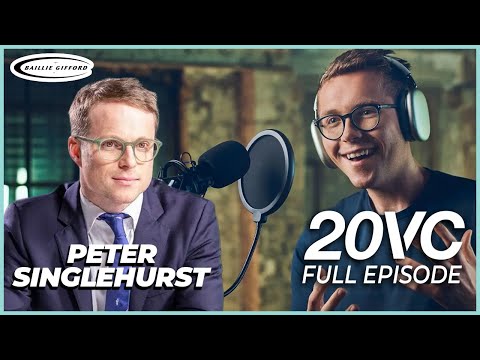
Peter Singlehurst: The Most Powerful Investor You've Never Heard of | 20VC #907
Peter Singlehurst (guest), Harry Stebbings (host)
In this episode of The Twenty Minute VC, featuring Peter Singlehurst and Harry Stebbings, Peter Singlehurst: The Most Powerful Investor You've Never Heard of | 20VC #907 explores philosopher-Investor Redefines Long-Term Growth Beyond Venture Capital Boundaries Peter Singlehurst of Baillie Gifford explains why he doesn’t see himself as a traditional VC, positioning his work instead as long-term, growth-focused investing that spans both private and public markets. He argues that the private–public divide is a financial construct, not a fundamental difference in how great businesses are built and analyzed. The conversation explores Baillie Gifford’s evergreen capital, low-fee model, and integrated research approach, along with its distinctive stance on alignment, portfolio construction, and risk. Singlehurst also reflects on personal investing lessons from wins, losses, and misses, and on building an enduring, cognitively diverse investment team.
Philosopher-Investor Redefines Long-Term Growth Beyond Venture Capital Boundaries
Peter Singlehurst of Baillie Gifford explains why he doesn’t see himself as a traditional VC, positioning his work instead as long-term, growth-focused investing that spans both private and public markets. He argues that the private–public divide is a financial construct, not a fundamental difference in how great businesses are built and analyzed. The conversation explores Baillie Gifford’s evergreen capital, low-fee model, and integrated research approach, along with its distinctive stance on alignment, portfolio construction, and risk. Singlehurst also reflects on personal investing lessons from wins, losses, and misses, and on building an enduring, cognitively diverse investment team.
Key Takeaways
Treat public and private investing as one continuum focused on great businesses.
Singlehurst argues that fundamentals—market size, management quality, competitive advantage, and business model—matter equally in private and public companies; only the trading venue changes, so research and ownership philosophy should be joined up across both.
Get the full analysis with uListen
Use permanent, low-fee capital to align with long-term company building.
Baillie Gifford’s 100+ year Scottish Mortgage Fund and partnership structure avoid the artificial time pressures and fee-driven behaviors of limited-life funds, enabling them to support compounding companies for 10–15+ years.
Get the full analysis with uListen
Be skeptical of traditional VC incentive structures and late-fund behavior.
Closed-end funds and carry can nudge investors to force exits or IPOs to crystallize returns and raise new funds, even when the optimal decision for the company and LPs is to keep compounding privately.
Get the full analysis with uListen
Build positions over time as conviction and competitive advantage deepen.
Rather than maximizing ownership at the first check, Baillie Gifford starts with standard positions and scales in as companies de-risk, execute, and their probability-adjusted upside improves—even if headline valuations are higher.
Get the full analysis with uListen
Focus diversification on capturing outliers, not just mitigating downside.
They target ~40–45 holdings with meaningful concentration in the top 10, grouping companies by underlying economic or technological commonalities (e. ...
Get the full analysis with uListen
Use scenario-based, probabilistic thinking—but stay humble about extremes.
They model upside cases with explicit probabilities while acknowledging that moats and defensibility evolve unpredictably; experiences like Intarcia taught Singlehurst to distrust both “near-certain” success and overly low odds on seemingly unlikely winners.
Get the full analysis with uListen
Take a clear stance on what value you *don’t* provide as an investor.
Baillie Gifford doesn’t sell operational “platform” services; instead it focuses on being an honest financial partner, particularly by helping companies think rigorously about whether, when, and how to go public and manage their shareholder base as a strategic asset.
Get the full analysis with uListen
Notable Quotes
“The public–private divide is an artifact of the financial universe rather than anything you’d come up with from first principles.”
— Peter Singlehurst
“We’re not aspiring or pretending to be venture capitalists… we’re trying to be a long-term partner that transcends private and public markets.”
— Peter Singlehurst
“If you are sufficiently long term, even in your most successful investments there will always be a time when you look and feel really stupid.”
— Peter Singlehurst
“A successful IPO is really about trying to find a relatively small number of aligned shareholders… you have to displease, frankly, most public market participants.”
— Peter Singlehurst
“What you can’t teach is cognitive diversity.”
— Peter Singlehurst
Questions Answered in This Episode
How would public markets behave differently if more large managers adopted an evergreen, low-fee, crossover model like Baillie Gifford’s?
Peter Singlehurst of Baillie Gifford explains why he doesn’t see himself as a traditional VC, positioning his work instead as long-term, growth-focused investing that spans both private and public markets. ...
Get the full analysis with uListen AI
What practical frameworks can investors use to assess evolving competitive advantage when moats are uncertain and built over time?
Get the full analysis with uListen AI
Where should founders draw the line between taking operational help from investors and preserving strategic independence and clarity of ownership?
Get the full analysis with uListen AI
How can LPs redesign fund structures and carry to reduce misalignment and avoid forced exits or premature IPOs?
Get the full analysis with uListen AI
What steps can younger investors take to build resilience and process discipline when their early careers coincide with extreme market volatility?
Get the full analysis with uListen AI
Transcript Preview
Three, two, one, zero. You have now arrived at your destination.
Peter, I'm so excited for this. I've been looking forward to this one for a very long time, actually. So I'm s- thrilled that we could do it. And thank you so much for joining me today.
Thank you for having me, Harry. It's a pleasure to be here.
Well, listen, I'm super excited for the discussion, but I do you want to start on you 'cause Baillie Gifford's a really fascinating organization. So I want to hear how did you make your way into the world of investing and come to be at Baillie Gifford and in the investing world?
Uh, in short, somewhat by accident. Um, uh, my ac- academic background was in philosophy. Uh, I did a master's in philosophy looking mainly at 20th century European philosophers. Finished my master's, didn't really know what to do, but heard about this thing called investment management, this firm called Baillie Gifford, and I quite liked the idea of, of living in Edinburgh. So I applied for the, uh, graduate training scheme, which is how pretty much all of our investors at Baillie Gifford start. Um, a lot of people go on to spend their entire careers here, and it's a partnership, uh, owned by people who started their careers on the, the, uh, the graduate training scheme. Um, so when I first joined, Baillie Gifford was really just a public markets, um, investment firm. Um, I spent time on various, uh, public teams, um, and then ended up on a team called the Long Term Global Growth Team within Baillie Gifford, which sort of does exactly what it says, um, on the tin. And it was roundabout this time that we started seeing more, uh, more of the businesses that we sort of always invested in, high growth companies, staying private longer. Um, and we sort of thought that, you know, maybe this was a structural change that was happening. We thought that maybe actually the process of analyzing these companies might be pretty similar to the process of analyzing a lot of the public companies that we'd always invested in, and that maybe we might be able to access some of these companies because, well, these were really the businesses we'd always invested in, these kind of pretty substantial high growth companies. Um, and so we, we start- we set off doing that from within, uh, a permanent pool of capital that we've managed for the last 114 years, uh, called the Scottish Mortgage Fund. It's confusingly named. It's got nothing to do with mortgages. Uh, it's a, it's a 100-year-plus permanent pool of capital. And we set about trying to do things a bit differently, so being very long term within this evergreen fund, being very low cost in terms of the, the fees that we charged our clients for investing in these companies, and doing it in such a way that was really joined up between our private and public company investing activities. And so that's how we started, uh, doing this, and we, we created a dedicated team in 2017, um, which has continued to grow. We've continued to deploy more of our client's capital into high growth private companies, and I think increasingly, we're cognizant that it's strategically important for how we invest for all of our clients, public and private. Um, and I think that sort of joined up approach is sort of integral, really, to how we operate.
Install uListen to search the full transcript and get AI-powered insights
Get Full TranscriptGet more from every podcast
AI summaries, searchable transcripts, and fact-checking. Free forever.
Add to Chrome