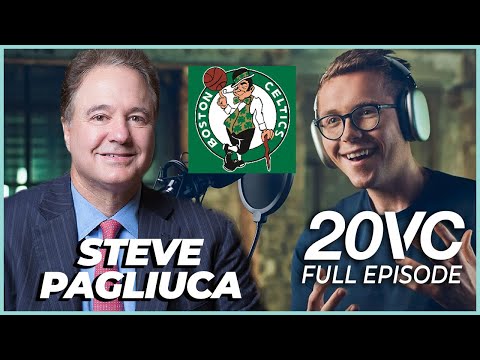
Celtics Owner Steve Pagliuca: What Went Wrong with the Chelsea FC Acquisition | 20VC #976
Steve Pagliuca (guest), Harry Stebbings (host)
In this episode of The Twenty Minute VC, featuring Steve Pagliuca and Harry Stebbings, Celtics Owner Steve Pagliuca: What Went Wrong with the Chelsea FC Acquisition | 20VC #976 explores celtics Owner Steve Pagliuca On Discipline, Sports, and Sensible Risk Steve Pagliuca traces his journey from modest beginnings and a green duffel bag at Duke to leading Bain Capital and owning elite sports franchises like the Boston Celtics and Atalanta. He emphasizes mentorship, humility, and a depression-era mindset around safety, even as he makes bold investments in sports, technology, and biotech. Pagliuca explains Bain’s fact-based, people-centric investing style, how discipline and culture enabled Bain’s global scale, and why growth plus clear paths to profitability matter more than hype. He also dissects the globalization and financialization of sports, why his Chelsea FC bid fell short, and how he thinks about risk, family, and legacy in the later stages of his career.
Celtics Owner Steve Pagliuca On Discipline, Sports, and Sensible Risk
Steve Pagliuca traces his journey from modest beginnings and a green duffel bag at Duke to leading Bain Capital and owning elite sports franchises like the Boston Celtics and Atalanta. He emphasizes mentorship, humility, and a depression-era mindset around safety, even as he makes bold investments in sports, technology, and biotech. Pagliuca explains Bain’s fact-based, people-centric investing style, how discipline and culture enabled Bain’s global scale, and why growth plus clear paths to profitability matter more than hype. He also dissects the globalization and financialization of sports, why his Chelsea FC bid fell short, and how he thinks about risk, family, and legacy in the later stages of his career.
Key Takeaways
Great mentors are critical but must be both candid and non-judgmental.
Pagliuca credits his Bain mentors for being “critical but not judgmental,” offering direct feedback while clearly rooting for his success; he replicates this with his own mentees and teams.
Get the full analysis with uListen AI
High performance means going beyond the brief and obsessing over details.
His best teams at Bain and the Celtics deliver more than asked—if you request two slides, they bring five—and rigorously dig into every detail, from analysis to execution.
Get the full analysis with uListen AI
Successful investing balances deep, fact-based analysis with people judgment.
Bain’s ethos is to do exhaustive due diligence—markets, models, customer research—then equally weigh the integrity, passion, and capability of the people running the business.
Get the full analysis with uListen AI
Growth still drives value, but must be paired with a credible path to profit.
He argues that the market is rightly moving away from “lose money forever” models; investors now demand both long-term growth and evidence the product earns real, sustainable margins.
Get the full analysis with uListen AI
Culture and discipline are what allow a firm to scale without losing its edge.
Bain maintained performance while reaching ~$160B AUM by keeping a central IC on every deal, fostering open dissent, and refusing to become an ‘asset gatherer’ focused only on deployment.
Get the full analysis with uListen AI
Sports teams are community assets that require long-term stewardship, not headline-driven decisions.
With the Celtics, Pagliuca focuses on continuity, community impact, and resisting media pressure; he cites keeping coach Doc Rivers and GM Danny Ainge through a losing season as vital to their later championship.
Get the full analysis with uListen AI
Risk tolerance can increase over time if your base is secure and diversified.
Coming from a scarcity mindset, he still diversifies heavily, but now allocates more risk to high-impact areas like biotech and AI, where returns can be financial and societal, as with stem-cell therapies for diabetes.
Get the full analysis with uListen AI
Notable Quotes
“All the world's a stage. People judge you by how you treat other people.”
— Steve Pagliuca (quoting mentor Harry Strachan)
“The only thing worse than losing a deal is doing a bad deal.”
— Steve Pagliuca
“You can’t be successful in this business without an ego, but I grew up in a family that thought the Depression was always just around the corner.”
— Steve Pagliuca
“There are not that many unicorns that will be created. Ninety percent of businesses cannot follow the ‘lose money forever’ model.”
— Steve Pagliuca
“Ubuntu means you are only here because other people have helped you get there, and so you need to help other people to get there.”
— Steve Pagliuca
Questions Answered in This Episode
How can investors more systematically evaluate the ‘people’ dimension of a deal, beyond standard reference checks?
Steve Pagliuca traces his journey from modest beginnings and a green duffel bag at Duke to leading Bain Capital and owning elite sports franchises like the Boston Celtics and Atalanta. ...
Get the full analysis with uListen AI
What mechanisms best protect long-term strategy in sports clubs from short-term media and fan pressure?
Get the full analysis with uListen AI
In a world of global fan bases and financial fair play, what does genuine competitive balance in football and basketball really look like?
Get the full analysis with uListen AI
How should investors distinguish between a ‘great idea ahead of its time’ and an idea that simply won’t work?
Get the full analysis with uListen AI
What practical steps can large investment firms take to preserve open dissent and avoid politicized decision-making as they scale?
Get the full analysis with uListen AI
Transcript Preview
What is this, your... I'm in your top 2,700 now or w- w- what, wh- which, which interview is this?
2,697. Yeah. We, we, we've been-
Okay. I'm only three short of the 2,700 mark. (laughs)
(laughs) (instrumental music) Steve, I am so excited for this. I've heard so many great things from Niv and Moshe at Shrug, so thank you so much for joining me today.
It's great to be here, Harry. It's, uh, fan- fantastic acro- across, across the seas.
Across the pond. Listen, I was listening to your fantastic talk at, I think it was a Goldman event, and you were talking about rocking up to Duke for your first day with nothing but a green duffel bag. And so I wanted to start on that. Tell me about that moment, and just take me there 'cause I love that story.
Oh, that seems like yesterday. It's a long time ago, but it was a very sunny day. I, I'd never been to Duke University, and I was amazed when we pulled up. I had, uh, offered to load up a truck, a moving van, with furniture. I'd, I'd worked there in the summer. And they said they would give me a ride to college. So we loaded up the truck, a 45-foot truck, all sorts of furniture, and the very last thing was my one duffel bag. That was 100% of what I owned at the, at the time. I think I had a lamp in there and, and three pairs of jeans and, and a Dopp kit, and a green duffel bag, army duffel bag. And so we pulled up to Duke and all these people were pulling up. My, my, my family had moved to Tokyo, so I was kind of on my own. He opened up the back of the truck and people were staring at us. It was a 45-foot van. And I pulled my duffel bag out and I looked around and I said, "I'll get the rest of the stuff later." And, uh, I proceeded down to the dorm. So, so that was my, my, my grand entry into Duke on a moving van.
Can I be really, um, intrusive and ask you... I, I've had situations like that before and I felt out of place. I felt like maybe I didn't belong. Di- did you at that moment? And, and how was that for you as a student when there were the wealthy students taking all their things out and you, you were saying, "I'll, I'll pick it up later"?
Oh, you know, I, I thought it was just funny. I, I, I, I, I, I don't really judge anybody, and I had a very good, good upbringing and, and, uh, great, great parents. And so it was just another day in life basically.
Can I ask, when you look back to, like, those days and your early days, did you, did you always believe that you would be a success? Did you know that... You may not know then how, but did you know that you would be a success?
Install uListen to search the full transcript and get AI-powered insights
Get Full TranscriptGet more from every podcast
AI summaries, searchable transcripts, and fact-checking. Free forever.
Add to Chrome