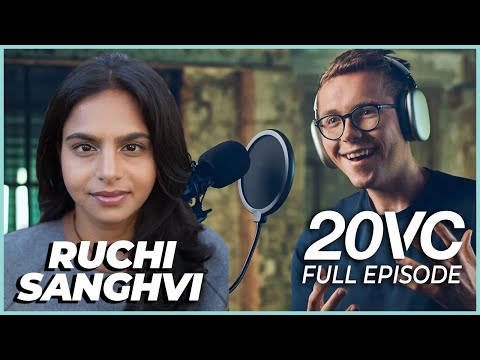
Ruchi Sanghvi: My Job Interview with Mark Zuckerberg; Deep Dive on DAOs | 20VC #895
Ruchi Sanghvi (guest), Harry Stebbings (host)
In this episode of The Twenty Minute VC, featuring Ruchi Sanghvi and Harry Stebbings, Ruchi Sanghvi: My Job Interview with Mark Zuckerberg; Deep Dive on DAOs | 20VC #895 explores from Facebook Engineer To DAO Innovator: Ruchi Sanghvi’s Venture Playbook Ruchi Sanghvi reflects on her journey from first female engineer at Facebook and executive at Dropbox to co-founding South Park Commons (SPC), a community and fund focused on the “-1 to 0” phase of company creation. She contrasts Facebook’s “move fast and break things” with Dropbox’s “sweat the details,” showing how culture and context must shape operating principles. She critiques how little traditional venture has innovated, explains SPC’s community-driven fund structure, and discusses how founders should choose and work with VCs. The conversation then dives into crypto, DAOs, and their implications for venture, before closing with candid reflections on ambition, ego, identity, and how to deliberately choose ideas and careers.
From Facebook Engineer To DAO Innovator: Ruchi Sanghvi’s Venture Playbook
Ruchi Sanghvi reflects on her journey from first female engineer at Facebook and executive at Dropbox to co-founding South Park Commons (SPC), a community and fund focused on the “-1 to 0” phase of company creation. She contrasts Facebook’s “move fast and break things” with Dropbox’s “sweat the details,” showing how culture and context must shape operating principles. She critiques how little traditional venture has innovated, explains SPC’s community-driven fund structure, and discusses how founders should choose and work with VCs. The conversation then dives into crypto, DAOs, and their implications for venture, before closing with candid reflections on ambition, ego, identity, and how to deliberately choose ideas and careers.
Key Takeaways
Culture and operating principles must match the product and context.
Facebook’s “move fast and break things” worked because network growth was paramount, while Dropbox’s “sweat the details” was essential for a product where trust and data integrity mattered most. ...
Get the full analysis with uListen AI
Founders should treat VC selection as a two-way, highly selective process.
Rather than optimizing for brand or PR, founders should ask VCs specifically how they’ll help hit milestones for the next round, where they add concrete value (recruiting, customers, company-building), and whether they have time and capital to support future financings.
Get the full analysis with uListen AI
Seed funds remain relevant by leading, concentrating, and innovating—not copying multistage behavior.
When a large multistage fund writes a small seed check, it’s often just cheap option value; a true seed lead putting $1–2M from a $50–100M fund is heavily incentivized to help. ...
Get the full analysis with uListen AI
A structured community can de-risk and improve the idea-selection (“pick”) phase.
SPC focuses on the “-1 to 0” stage—founder–market fit—by giving talented, usually technical people 6–9+ months to explore markets, do TAM and competition work, validate problems, and iterate before raising. ...
Get the full analysis with uListen AI
Innovating on fund structures and org design is a competitive edge in venture.
Ruchi argues VCs must treat their own firms like startups—experimenting with fund structure (e. ...
Get the full analysis with uListen AI
DAOs are promising but sit on a spectrum between decentralization and centralization.
SPC’s Founder Fellowship DAO uses a 3(c)(7) structure with up to 1,999 investors and proxies investment decisions to a small admin/GP group, trading some decentralization for efficiency. ...
Get the full analysis with uListen AI
Redefining ambition and relationship to money can prevent burnout and aimlessness.
Prompted by her father’s question—“Are you living life or chasing life? ...
Get the full analysis with uListen AI
Notable Quotes
“There is no silver bullet for success. Everything you’ve learned only matters in context.”
— Ruchi Sanghvi
“I think it’s bullshit that VCs ask their companies to innovate when they operate as old-school, white-collar legacy firms.”
— Ruchi Sanghvi
“Capital is a commodity. The question is: how do you bring smart money to the table?”
— Ruchi Sanghvi
“Negative one to zero is turning the chaos of possibility into the clarity of conviction.”
— Ruchi Sanghvi
“Are you living life or are you chasing life?”
— Ruchi Sanghvi’s father (as recalled by Ruchi Sanghvi)
Questions Answered in This Episode
How can a founder practically design their own “-1 to 0” period if they don’t have access to a community like South Park Commons?
Ruchi Sanghvi reflects on her journey from first female engineer at Facebook and executive at Dropbox to co-founding South Park Commons (SPC), a community and fund focused on the “-1 to 0” phase of company creation. ...
Get the full analysis with uListen AI
What specific questions should a first-time founder ask a VC to test whether they’re truly innovative versus just well-branded?
Get the full analysis with uListen AI
How might DAO governance evolve to balance efficiency with real decentralization, especially as larger institutional capital comes in?
Get the full analysis with uListen AI
In a capital-rich environment, what signals should convince a founder to walk away from an idea instead of raising a seed round anyway?
Get the full analysis with uListen AI
How can ambitious people in tech decouple their identity from their job without feeling like they’re losing their edge or relevance?
Get the full analysis with uListen AI
Transcript Preview
(beeping) Three, two, one, zero. You have now arrived at your destination.
Ruchi, I'm so excited for this one. I heard so many great things from Avatar and from many other people before, so thank you so much for joining me today.
It's great to be on the show, Hari. I've been a fan, and in the last couple of weeks alone, of the 3,000 episodes that you've done, I think I maybe heard four or five. (laughs)
I mean, that is fantastic. Uh, and you have many more that you can listen to if you have-
(laughs)
... some free time. Uh, I do wanna start though, pre-South Park days, and, you know, this is very unusual. Normally, we start with, you know, how you made your way into investing, but you have such a fascinating background, I wanted to kind of decouple it a little bit. So you were the first female engineer at Facebook and the first female exec at Dropbox. What was that like, first? Let's start there.
(clears throat) You know, I joined Facebook right out of college. I was optimistic, raring to go, working 24/7. I didn't really understand the concept of a ceiling. Everything was possible, and I wasn't afraid of anything, let alone being the only female engineer. Um, at Dropbox, I was a grownup who was hired to scale the company. So if you recall the world from Pulp Fiction, you know, he was the fixer. And that was my role at Dropbox. I managed functions like recruiting or marketing that didn't really have leaders. I created or built new teams like communication and international, and eventually hired people to run these functions who were experts. So the goal really was to work myself out of a job. Um, so the roles were quite different. Um, in one role, I was a kid. Um, you know, the, the individual contributor. Um, and in the other role, I was the manager who was brought in to manage all the kids.
Can I... Sorry. (laughs) Uh, one thing you learn is that I never stick to schedule. Was it difficult to make that transition? I've had to. It's not been easy. Was it difficult to make that transition?
It was extremely difficult, um, to make the transition. You really have to pull, um, on a different set of skills. But the key, when you come into an environment that has already been built, um, and that has, you know, a core culture to it, the key really is to listen and understand and internalize before going in and bringing the lessons you've learned or, you know, bringing your success m- rubric to the organization, but to really adapt to the organization's culture.
So if we look at the two, we've got Facebook and Dropbox, obviously, two very iconic companies. Uh, if you were to i- (laughs) Again, this is so hard on me, but like, if you were to isolate one or two takeaways from each-
Install uListen to search the full transcript and get AI-powered insights
Get Full TranscriptGet more from every podcast
AI summaries, searchable transcripts, and fact-checking. Free forever.
Add to Chrome