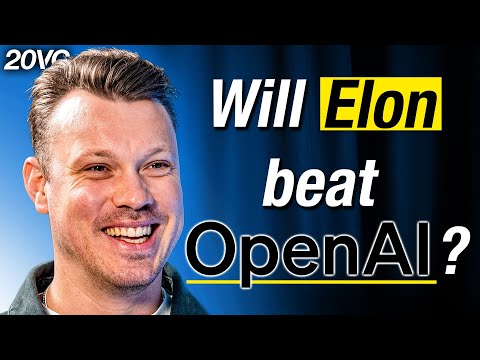
Victor Riparbelli, CEO @Synthesia: OpenAI vs Anthropic vs X.ai - Who Wins and Why | E1246
Victor Riparbelli (guest), Harry Stebbings (host), Narrator
In this episode of The Twenty Minute VC, featuring Victor Riparbelli and Harry Stebbings, Victor Riparbelli, CEO @Synthesia: OpenAI vs Anthropic vs X.ai - Who Wins and Why | E1246 explores synthesia CEO on AI Bubble, Content’s Future, and London’s Edge Victor Riparbelli, CEO of Synthesia, discusses the company’s funding journey from a difficult 2017 seed round to a $100M Series D at a $2.1B valuation, stressing how capital constraints and customer obsession shaped product–market fit. He argues we are in an AI bubble with plenty of wasteful spend and looming churn, but sees that as a natural Darwinian phase on the path to durable AI products.
Synthesia CEO on AI Bubble, Content’s Future, and London’s Edge
Victor Riparbelli, CEO of Synthesia, discusses the company’s funding journey from a difficult 2017 seed round to a $100M Series D at a $2.1B valuation, stressing how capital constraints and customer obsession shaped product–market fit. He argues we are in an AI bubble with plenty of wasteful spend and looming churn, but sees that as a natural Darwinian phase on the path to durable AI products.
Riparbelli outlines a vision where text-based communication is increasingly replaced by scalable video and audio, positioning Synthesia not as an avatar company but as a workflow platform that converts text and slides into enterprise video at massive scale. He believes foundation models are commoditizing and that winners will be defined more by distribution, workflow, and customer value than by raw model performance.
On the broader AI landscape, he weighs OpenAI, Anthropic, and xAI, saying he’d bet on X for its asymmetric upside, data, and distribution via the X platform, while emphasizing that compute, algorithms, and data all matter. He also explores content moderation, identity verification, and discovery in an AI-saturated media world, arguing for provenance systems and community-driven trust mechanisms.
Finally, he reflects on London versus Silicon Valley, the pros of building in Europe (especially loyalty and talent), what policymakers should and shouldn’t do to support AI ecosystems, and how his own generalist background, gaming habit, and secondaries have influenced his decision-making as a founder.
Key Takeaways
Capital constraints can sharpen focus and accelerate true product–market fit.
Riparbelli believes Synthesia benefited from raising smaller, leaner early rounds; being forced to charge customers early and ignore distracting side projects (like deepfake detection) helped them understand their market deeply and avoid dilution of focus.
Get the full analysis with uListen AI
Optimize for renewals, not initial AI contracts.
He argues many AI startups are mistaking easy pilots and innovation budgets for real traction; the true signal is whether customers renew after 12 months, which only happens when the product demonstrably solves a real, well-understood problem.
Get the full analysis with uListen AI
Winning AI applications will be workflow-first, not model-first.
While models matter, Synthesia’s large enterprise contracts are driven by end-to-end video workflows (script-to-edit-to-distribution) rather than just avatar tech; he predicts the biggest winners will own the value chain around specific jobs, using commoditized models underneath.
Get the full analysis with uListen AI
Text communication is a huge addressable market for AI video.
Synthesia frames its TAM not as existing video production but as all text and slide-based communication; Riparbelli believes as video/audio creation becomes as scalable as text, a significant share of documents, emails, and decks will be replaced by dynamic, personalized video.
Get the full analysis with uListen AI
We are in an AI bubble, but that is a feature, not a bug.
He expects large amounts of capital to be burned on shallow “agent” products and features that become cloud-commodity, but sees this experimentation as the Darwinian mechanism through which the few truly valuable, durable AI businesses emerge.
Get the full analysis with uListen AI
Content provenance and verification will be crucial in an AI-saturated ecosystem.
Riparbelli advocates for Shazam-like fingerprinting across all media plus identity verification and community-notes-style context, so users can see who created content, when, and how—even if the content is AI-generated, edited, or reused across platforms.
Get the full analysis with uListen AI
Europe (and London) can be globally competitive if it doesn’t over-regulate or over-tax.
He credits London’s talent pool, existing relief schemes, and emerging AI champions, but warns that aggressive taxation or EU-style regulation could push founders and developers away; he urges policymakers to protect entrepreneurial incentives and the UK’s “open for business” brand.
Get the full analysis with uListen AI
Notable Quotes
“Too much money too early is not healthy. One thing you cannot buy your way to is product–market fit.”
— Victor Riparbelli
“The real signal is not that you sign a contract. The real signal is renewal.”
— Victor Riparbelli
“Our market is not video production; our market is text and slides.”
— Victor Riparbelli
“We may be one of the last generations to read and write as the default way of communication.”
— Victor Riparbelli
“Europe has all the AI regulation and none of the AI companies.”
— Victor Riparbelli
Questions Answered in This Episode
If AI-generated video makes content creation nearly free, how will creators and platforms prevent quality and trust from collapsing under the sheer volume of output?
Victor Riparbelli, CEO of Synthesia, discusses the company’s funding journey from a difficult 2017 seed round to a $100M Series D at a $2. ...
Get the full analysis with uListen AI
How should early-stage AI founders rigorously measure ‘renewal readiness’ so they don’t confuse pilot enthusiasm with genuine product–market fit?
Riparbelli outlines a vision where text-based communication is increasingly replaced by scalable video and audio, positioning Synthesia not as an avatar company but as a workflow platform that converts text and slides into enterprise video at massive scale. ...
Get the full analysis with uListen AI
In a world where text is increasingly replaced by video workflows, what new skills become most valuable for knowledge workers—and which traditional skills decline fastest?
On the broader AI landscape, he weighs OpenAI, Anthropic, and xAI, saying he’d bet on X for its asymmetric upside, data, and distribution via the X platform, while emphasizing that compute, algorithms, and data all matter. ...
Get the full analysis with uListen AI
What governance model could realistically implement the kind of universal content fingerprinting and provenance trail Riparbelli describes without creating a centralized censorship tool?
Finally, he reflects on London versus Silicon Valley, the pros of building in Europe (especially loyalty and talent), what policymakers should and shouldn’t do to support AI ecosystems, and how his own generalist background, gaming habit, and secondaries have influenced his decision-making as a founder.
Get the full analysis with uListen AI
Given the commoditization of foundation models, what specific defensible moats can independent AI application companies still build over the next five years?
Get the full analysis with uListen AI
Transcript Preview
I mean, I think we're definitely in a bubble, right? There's a lot of money that's going to go up in flames in AI products. What I see a lot of in enterprise is buyers don't really know what they want. The real signal is not that you sign a contract. The real signal is renewal. (drill whirring)
Ready to go?
(Upbeat music) (suspenseful music) (clock ticking)
Viktor, dude, we met like six, seven years ago-
(laughs)
... when I was very, very young and, you know, very naive. I can't believe it's been that long. But thank you so much for joining me, dude.
I'm glad to be here, man.
(laughs)
(laughs)
I'm still, are we said before-
I'm sorry for you that we're meeting under these circumstances.
So am I.
You know-
I said to you before-
... it's a good time.
... I, I would have done better if I'd invested in every single company I'd ever met-
(laughs)
... because it would have been you, Deal, Vanta, ElevenLabs. I mean, oh, God. But I want to start today on some really exciting news that you have. So what is the exciting news you have for us today?
Yeah, so we just raised our series D, um, which is, which is super exciting, a big milestone for us. We raised $100 million led by NEA with participation from all of our existing investors. Um, so we're very excited to get to 25 with a big war chest and, you know, just, um, I think from our perspective, like get to escape velocity, shut down the category that we're in and win.
Dude, uh, first amazing news. Congratulations. Thank you again for rubbing it in my face. Um, my, my question to you is, we were talking beforehand actually about the kind of funding story of the business.
Mm-hmm.
Can you take me... And I know it's not, uh, scheduled but I so enjoy this. Can you take me to the seed round? People didn't get it. Just what happened and how was that?
So this is back in '17, so it's, you know, a long time ago now and, um, the very short story is that we were a bunch of people, uh, myself, my co-founder Stephan, my co-founder and professor ............................ And we had this sort of idea that, uh, you know, generative AI, which back then wasn't really a term that most people thought about, but generative AI would change how we create content. And the big shift was that back in s- 2017 when most people thought about AI it was about analyzing data, right, making decisions. That, that's kind of like that era of AI. Uh, but there was this early kind of GANs, uh, which was basically a neural network that could kind of produce new data instead of just analyzing existing data. Um, and, uh, we thought that this was gonna be a world-changing technology. We thought it was gonna change everything we know about how we create content from video, speech, audio, music, whatever, but we were focusing on video. It went out to the world with a great PowerPoint deck, uh, and we think a great vision. But, um, I think understandably most people thought we were pretty crazy, right? We basically went out and said, "Look, in ten years you're going to be able to make a Hollywood film from your laptop needing nothing else y- than your imagination." And, um, that wasn't a pitch that landed particularly well, especially not in Europe. We were based in London at the time.
Install uListen to search the full transcript and get AI-powered insights
Get Full TranscriptGet more from every podcast
AI summaries, searchable transcripts, and fact-checking. Free forever.
Add to Chrome