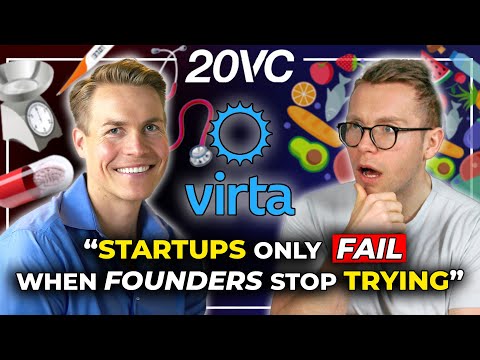
Sami Inkinen: "Why the Two Weeks Following Our IPO Were the Worst of my Life" | E1120
Sami Inkinen (guest), Narrator, Harry Stebbings (host), Narrator
In this episode of The Twenty Minute VC, featuring Sami Inkinen and Narrator, Sami Inkinen: "Why the Two Weeks Following Our IPO Were the Worst of my Life" | E1120 explores from IPO High To Existential Crisis: Sami Inkinen On Meaning Sami Inkinen, co‑founder of Trulia and CEO of Virta Health, traces his journey from a humble Finnish farm to Silicon Valley success, and how his IPO windfall triggered one of the lowest periods of his life. He describes realizing that money and achievement did not deliver lasting happiness, leading him to meditation, deeper self‑awareness, and a redefinition of ambition around impact and family. Inkinen discusses addictive founder tendencies, mental health, marriage, parenting, and why cultivating multiple identities beyond “founder” is essential for resilience. He also reflects on building Virta Health to reverse diabetes at scale and the long, mission‑driven nature of that work.
From IPO High To Existential Crisis: Sami Inkinen On Meaning
Sami Inkinen, co‑founder of Trulia and CEO of Virta Health, traces his journey from a humble Finnish farm to Silicon Valley success, and how his IPO windfall triggered one of the lowest periods of his life. He describes realizing that money and achievement did not deliver lasting happiness, leading him to meditation, deeper self‑awareness, and a redefinition of ambition around impact and family. Inkinen discusses addictive founder tendencies, mental health, marriage, parenting, and why cultivating multiple identities beyond “founder” is essential for resilience. He also reflects on building Virta Health to reverse diabetes at scale and the long, mission‑driven nature of that work.
Key Takeaways
Sudden financial success does not guarantee emotional fulfillment.
Inkinen describes a brief 48‑hour high after his first meaningful liquidity, followed by an IPO that coincided with panic and emptiness, highlighting that money resolves practical problems but doesn’t address deeper existential or psychological needs.
Get the full analysis with uListen AI
Founders must learn to observe their own thoughts and behaviors.
He likens meditation to “runtime debugging” of the mind; being able to step back and watch impulses (anger, over‑work, addictive tendencies) is a critical skill for avoiding self‑destructive extremes in work, sport, or life.
Get the full analysis with uListen AI
Cultivating multiple identities protects founders from burnout and fragility.
Inkinen deliberately holds three core identities—founder/CEO, athlete, and family man—so that his self‑worth is not entirely tied to company performance, making it easier to handle setbacks and still take bold risks.
Get the full analysis with uListen AI
Authenticity should be constant, but vulnerability must be situational.
He aims to be the same person at home and at work, yet argues that a CEO cannot be fully vulnerable in every context; leaders must manage how much of their fears or personal struggles they share so as not to destabilize their teams.
Get the full analysis with uListen AI
Working with your spouse is “high beta” and can endanger the relationship.
Inkinen and his wife worked together at Virta for six years and saw both the joy of shared mission and the risk of compounding stress; he generally advises against it because failure at work can spill over and damage the core relationship.
Get the full analysis with uListen AI
A strong support system outside the company is non‑negotiable for founders.
He credits long‑running peer groups like YPO forums—where he can be fully open without investor or board dynamics—as essential to processing stress and preventing the isolation that often precedes breakdowns.
Get the full analysis with uListen AI
Mission clarity matters more than raw ambition in sustaining a company.
At Trulia, his motivation faded once it felt like a job without a clear mission; with Virta, he anchored the company in a long‑term goal of reversing diabetes, which he believes is necessary to keep himself and the team engaged over decades.
Get the full analysis with uListen AI
Notable Quotes
“The two weeks after our IPO were probably the worst I’ve ever had in my life.”
— Sami Inkinen
“I realized I had trained my body and my intellect, but I had never gotten to know my own mind.”
— Sami Inkinen
“Startups only fail when founders stop trying—but sometimes you have to give up, and knowing when is very hard.”
— Sami Inkinen
“You can get rid of your co‑founder easier than your VC.”
— Sami Inkinen
“Cultivating multiple identities is critical; if you and your company are the same thing, that’s very dangerous.”
— Sami Inkinen
Questions Answered in This Episode
How can founders practically build the habit of “runtime debugging” their own minds before a crisis forces them to?
Sami Inkinen, co‑founder of Trulia and CEO of Virta Health, traces his journey from a humble Finnish farm to Silicon Valley success, and how his IPO windfall triggered one of the lowest periods of his life. ...
Get the full analysis with uListen AI
Where is the line between healthy perseverance and destructive stubbornness when deciding whether to continue or shut down a company?
Get the full analysis with uListen AI
How should a CEO decide what level of vulnerability is constructive versus destabilizing for their team?
Get the full analysis with uListen AI
What specific practices or guardrails can highly addictive personalities put in place to avoid sliding into harmful addictions while still channeling intensity productively?
Get the full analysis with uListen AI
If mission clarity is so crucial, what steps should early‑stage founders take to define a mission that can genuinely sustain their own motivation for decades?
Get the full analysis with uListen AI
Transcript Preview
I could see six figures-
(cash register dings)
... in my checking account. The company goes public, I might have yelled, like, "I'm, I'm rich." Two weeks after that, something wasn't working in our apartment, the silliest and the stupidest thing, and then suddenly, I feel this sort of panic attack. I should be happy. I'm not. What the heck is going on? (instrumental music plays)
Sammy, I am so excited for this. I cannot believe it has been seven years since we last did this. But thank you so much for joining me today.
Well, Harry, thanks for having me back. Uh, time flies when you're having fun, right? Seven years. (laughs)
I, I mean, it totally does. You look freaking younger. I look older, significantly. But I wanna start (laughs) with a little bit of backstory, because I think so much actually goes back to childhood. You know, I always remember my father and, like, my family kind of instilling this, "You'll be good enough when you live in a certain place." (laughs) It was Chelsea for us in London. I'm just intrigued. Take me through your childhood. Where did you live, and how was that relationship with your parents?
Yeah. Well, I grew up in Finland, uh, about 200 miles northeast of Helsinki, very close to the wonderful border with, uh, Russia. Um, and so I, I grew up on a farm, um, and, uh, it wasn't a ... It was a gentleman's farm, I guess I could say, in that my parents were factory workers. Um, so we had a farm, uh, lots of manual labor. I was their manual labor. So very kinda humble beginnings, picking potatoes, feeding chickens. Um, and so, so that's kinda how, h- how I was growing up. And I would say two things about my up- upbringing. In some ways, it was very kind of romantic in that, you know, growi- growing up on a farm, I could climb the trees, and it was very safe, and, like, it was a wonderful, wonderful, um, uh, place to live. I would say that. That's sort of the one thing. But the second thing I would say, I absolutely had no professional role models. And the fact that I'm living in America today, you know, building a company, and I have been here in, in the States for more than 20 years, it, it, my family, mom, it's still like, you know, I'm living in the moon or in the Mars. So it's a very, very kind of unlikely sequence of events. Uh, so my parents didn't even go to high school. They weren't professionally trained, so I had absolutely no, uh, role models of what might be possible beyond being a factory worker and, you know, picking potatoes, uh, to, to feed the family.
What was it that opened your eyes to the world? Where did you get this sense of ambition and this desire to, to conquer more of the world than the, the, the farm in Finland?
Install uListen to search the full transcript and get AI-powered insights
Get Full TranscriptGet more from every podcast
AI summaries, searchable transcripts, and fact-checking. Free forever.
Add to Chrome