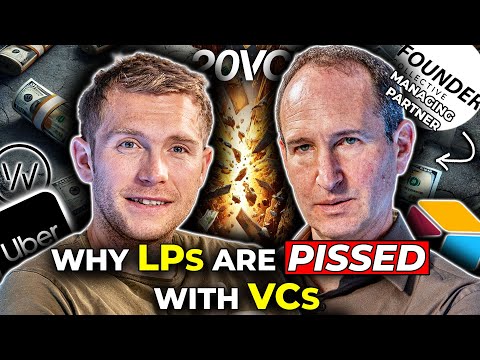
David Frankel, MP @Founder Collective: Investing Lessons from Seeding Coupang, Pillpack & Suno|E1214
David Frankel (guest), Harry Stebbings (host), Narrator, Narrator
In this episode of The Twenty Minute VC, featuring David Frankel and Harry Stebbings, David Frankel, MP @Founder Collective: Investing Lessons from Seeding Coupang, Pillpack & Suno|E1214 explores seed Investing, Reserves, and LP Liquidity in a Post-ZIRP World David Frankel of Founder Collective discusses how traditional, smaller seed funds can still thrive despite oversized seed rounds and AI-inflated valuations by focusing on non-consensus founders, markets, and disciplined ownership/time alignment.
Seed Investing, Reserves, and LP Liquidity in a Post-ZIRP World
David Frankel of Founder Collective discusses how traditional, smaller seed funds can still thrive despite oversized seed rounds and AI-inflated valuations by focusing on non-consensus founders, markets, and disciplined ownership/time alignment.
He dives deeply into reserve strategy, pro rata rights, and why many 2018+ vintage funds may face a structural DPI problem, forcing LPs to question venture’s liquidity profile while PE and secondaries step in selectively.
Frankel shares candid lessons from backing Coupang, Uber, Trade Desk, PillPack, Suno and others—on when to break rules, why patience and pain tolerance matter, and how overcapitalization in the ZIRP era hurt founders more than it helped.
The conversation also covers AI economics, LEACH incumbents, founder secondaries, board dynamics, and why small, aligned funds and true matchmaking to the right next-round partner can still be a powerful edge.
Key Takeaways
Small seed funds must win on non-consensus bets, not pricing.
Frankel argues seed isn’t dead; smaller funds should seek overlooked founders (non-traditional backgrounds, ‘failed’ second-timers, orphaned by big funds) and contrarian markets (e. ...
Get the full analysis with uListen AI
Time and ownership alignment matter more than just getting into great logos.
Writing tiny checks into trophy companies can be brand-enhancing but often misaligns effort vs outcome; if a partner is on your board, they need enough ownership that the outcome is meaningful at the fund level or their time will drift elsewhere.
Get the full analysis with uListen AI
Reserve policies are one of venture’s hardest and most dynamic problems.
Founder Collective moved from zero reserves to a 1:1 policy after seeing that only funding desperate companies created negative selection; but fixed reserve rules break as markets shift, making timing and follow-on discipline a constant challenge.
Get the full analysis with uListen AI
Pro rata rights can be structurally bad for struggling founders.
Frankel calls pro rata the “original sin” against entrepreneurs: later-stage insiders hold a free option, forcing founders to ‘test the market’ as stalking horses, which can complicate new rounds when performance is middling and external investors expect insiders to lead.
Get the full analysis with uListen AI
Overcapitalization in ZIRP created long-term damage for many startups.
Hyper-aggressive rounds (e. ...
Get the full analysis with uListen AI
DPI for 2018+ funds may be structurally delayed or impaired.
With ZIRP-driven markups, later-stage mega-rounds and now-muted IPO/M&A markets, many funds raised from 2018 onward have minimal realizations; PE-led rollups and mid-sized exits will likely drive near-term liquidity rather than blockbuster IPOs, frustrating LPs.
Get the full analysis with uListen AI
Data-rich vertical SaaS and applied AI can quietly compound outside the hype.
Frankel believes owning unique, structured data in vertical/horizontal SaaS gives enormous AI leverage; AI infra may be over-capitalized short term, but applied use-cases (e. ...
Get the full analysis with uListen AI
Notable Quotes
“I still think of pro rata as the original sin against entrepreneurs.”
— David Frankel
“You own your own destiny by minding your monthly burn.”
— David Frankel
“I think that DPI could be dead… LPs are looking at this asset class right now and going, ‘Where is the DPI?’”
— David Frankel
“The most unfair feature of capitalism is the most you can lose is all your money; the most you can make is unlimited.”
— David Frankel
“If we can’t, with high conviction, 10x a company, we shouldn’t invest.”
— Eric Paley (via David Frankel)
Questions Answered in This Episode
How should early-stage founders negotiate or rethink pro rata structures to avoid becoming ‘stalking horses’ for their own cap tables?
David Frankel of Founder Collective discusses how traditional, smaller seed funds can still thrive despite oversized seed rounds and AI-inflated valuations by focusing on non-consensus founders, markets, and disciplined ownership/time alignment.
Get the full analysis with uListen AI
In a world where many 2018–2021 vintages may never fully recover, how should LPs recalibrate their expectations of venture DPI and pacing?
He dives deeply into reserve strategy, pro rata rights, and why many 2018+ vintage funds may face a structural DPI problem, forcing LPs to question venture’s liquidity profile while PE and secondaries step in selectively.
Get the full analysis with uListen AI
What practical signals can founders use to distinguish an aligned, time-committed board member from a ‘call option’ investor at multistage firms?
Frankel shares candid lessons from backing Coupang, Uber, Trade Desk, PillPack, Suno and others—on when to break rules, why patience and pain tolerance matter, and how overcapitalization in the ZIRP era hurt founders more than it helped.
Get the full analysis with uListen AI
Given the capital intensity of AI, where is the realistic opportunity for small, disciplined seed funds to participate without overpaying?
The conversation also covers AI economics, LEACH incumbents, founder secondaries, board dynamics, and why small, aligned funds and true matchmaking to the right next-round partner can still be a powerful edge.
Get the full analysis with uListen AI
How can startups balance ambitious growth plans with responsible burn management when growth investors still push for aggressive scaling?
Get the full analysis with uListen AI
Transcript Preview
I would say reserves and how to do the reserve thing is actually one of the most challenging aspects of venture. I still think of, like, pro rata as, like, the original sin against entrepreneurs. You own your own destiny by minding your monthly burn. I think that DPI could be dead. LPs are looking at this asset class right now, I think, and going, "Where is the DPI?" Those guys were just like a casino. One call to John or Tiger, like 20 on 80, no problem.
Ready to go? David, I am so excited for this, man. We were literally just saying how much more special it is to do it in person. So thank you so much for joining me in person.
Harry, it's so awesome to be here. I love being here with you in person in London.
Dude, I wanna start on, um, one of my biggest, most pressing concerns actually right now, which is we are seeing these massive seed rounds, like 6 to $10 million. How can traditional seed funds, 50 to 100 million seed funds, play-
Yeah.
... in this new world?
I mean, I think you still can, right? I, you know, I'm gonna appeal to the inner, you know, uh, McKinsey consultant in you. I know it exists. But, you know, if you think of right/wrong, consensus/non-consensus, look, you don't have to only do kind of right non-consensus, but that's where you do do well. And there's lots of ways of still being non-consensual, I think. So, you know, if you think of non-consensus, y- uh, founders, so, uh, you know, people who come from less traditional backgrounds, people who come from secondary schools, right, that, like, mainstream's not gonna back. That still very much exists. Frankly, founders who've had, who failed, right, who haven't done well and, uh, and, like, you know, the mainstream's kind of like, "Mm, wouldn't touch that." There's still founders who've been orphaned. So founders who come back and go, "You know, I took money from one of those large funds." They went through the distance. They had to feel the pain, right? They say, "I took money from that, one of those large funds, and man, like, I got orphaned," right? Uh, "They, they left me." They come back. So, you know, non-consensus founders. Non-consensus market still, right? And I think this is where b- it's everyone says, "You gotta be right in non-consensus." But I often think, "Well, what do you mean by non-consensus?" So you've got, you know, if you were really early in new markets, 2009, the best bet, like everybody was, like, chasing, I don't know, nanotech, right? Bitcoin had to have been the greatest investment in 2000. 2015, Ethereum. I know everybody is, whatever is chasing DTC, right? Like that's where the whole market's going, you go Ethereum. So new markets non-consensus, you can still do very w- you-
Mm-hmm.
And then old markets non-consensus. Harry, do you know one of the best portfolio companies in m- that I'm on the board of right now? Smalls. It's cat food. Dude, it's cat food. Nobody likes cats. Like dogs get all the love. DTC is dead. Nobody will touch DTC. We tried to raise money for this business, Smalls, right? Doing 50 million ARR. Try to raise money in December. Nobody would look at us. Nobody would look at us 'cause people hate cats, full stop, right? Cats get no love. And everybody then looks at like, you know, this didn't work, farmer's market, whatever, it didn't work in dogs, right? So you can be in old markets, right? You can still be non-consensus.
Install uListen to search the full transcript and get AI-powered insights
Get Full TranscriptGet more from every podcast
AI summaries, searchable transcripts, and fact-checking. Free forever.
Add to Chrome