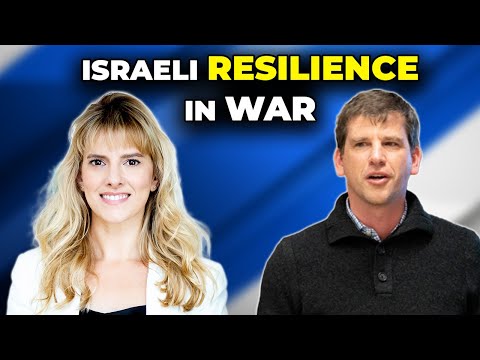
Michael Eisenberg and Adi Levanon: Israeli Resilience in Crisis | E1072
Harry Stebbings (host), Michael Eisenberg (guest), Adi Levanon (guest)
In this episode of The Twenty Minute VC, featuring Harry Stebbings and Michael Eisenberg, Michael Eisenberg and Adi Levanon: Israeli Resilience in Crisis | E1072 explores israeli Founders Describe War, Grief, And Extraordinary National Resilience Harry Stebbings speaks with Israeli investor Michael Eisenberg and VC Adi Levanon as they describe the immediate aftermath of the Hamas attacks, blending personal loss, national trauma, and ongoing military mobilization.
Israeli Founders Describe War, Grief, And Extraordinary National Resilience
Harry Stebbings speaks with Israeli investor Michael Eisenberg and VC Adi Levanon as they describe the immediate aftermath of the Hamas attacks, blending personal loss, national trauma, and ongoing military mobilization.
They explain what reserve duty looks like in practice, how nearly every Israeli is directly impacted, and how the tech community has rapidly reorganized for both war-time logistics and business continuity.
The conversation highlights a surge of grassroots mutual aid, global political and tech-industry support, and anger at Western institutions that equivocate on terror.
They argue that this is not only an Israeli or Jewish issue but a human one, urging people worldwide to speak out against barbarism while emphasizing that Israeli society will emerge more resilient and innovative.
Key Takeaways
Nearly every Israeli is directly affected, creating a shared sense of urgency and purpose.
Both guests stress that in a country of under 10 million, everyone knows someone who has been murdered, kidnapped, or injured, which drives collective mobilization and mutual support.
Get the full analysis with uListen AI
Reserve duty is immediate, disruptive, and deeply personal but widely accepted as necessary.
Men and women are called up by SMS, leave families and jobs within hours, and deploy to the front; this includes founders, executives, and ordinary citizens alike.
Get the full analysis with uListen AI
The tech community has pivoted into emergency operations while keeping companies alive.
Founders and engineers are building rescue and logistics systems in real time, coordinating flights and equipment, redistributing teams abroad, and using volunteers to backfill roles for called‑up employees.
Get the full analysis with uListen AI
Maintaining economic and startup continuity is seen as both moral and strategic.
Despite trauma, funds are closing rounds, solving tax bottlenecks, and holding partner meetings because salaries must be paid and resilience depends on a functioning economy.
Get the full analysis with uListen AI
Moral clarity—condemning barbarism without “nuance”—is viewed as non‑negotiable.
They sharply criticize institutions and campus groups that equivocate or rationalize Hamas’s actions, arguing there can be debate on policy but not on deliberate atrocities against civilians.
Get the full analysis with uListen AI
Silence and passivity in the face of hate are treated as complicity.
Invoking “Never Again” and the Niemöller quote, they argue that people who see hate and do nothing—especially within universities and online communities—help enable it to spread.
Get the full analysis with uListen AI
Resilience is expressed through everyday life: weddings, births, and youth volunteering.
Stories of a wedding held on the Gaza border, a father attending his son’s bris via Zoom from the front, and teens running supply centers illustrate a determination to choose life amid war.
Get the full analysis with uListen AI
Notable Quotes
“We're wounded, but not down.”
— Michael Eisenberg
“We're safe, but we're not okay.”
— Adi Levanon
“In unstable times, you want to invest in the most resilient people.”
— Michael Eisenberg
“Your morals matter more than your metrics.”
— Michael Eisenberg, quoting Josh Kopelman
“If you're aware of it and you're not doing anything to stop it, you're just as bad as the problem itself.”
— Adi Levanon
Questions Answered in This Episode
How should investors and founders outside Israel practically support Israeli teams while respecting their trauma and constraints?
Harry Stebbings speaks with Israeli investor Michael Eisenberg and VC Adi Levanon as they describe the immediate aftermath of the Hamas attacks, blending personal loss, national trauma, and ongoing military mobilization.
Get the full analysis with uListen AI
Where is the line between legitimate criticism of Israeli policy and complicity in antisemitism or terror apologism?
They explain what reserve duty looks like in practice, how nearly every Israeli is directly impacted, and how the tech community has rapidly reorganized for both war-time logistics and business continuity.
Get the full analysis with uListen AI
What long-term psychological and societal effects might this level of shared national trauma have on Israeli tech culture?
The conversation highlights a surge of grassroots mutual aid, global political and tech-industry support, and anger at Western institutions that equivocate on terror.
Get the full analysis with uListen AI
How can universities and tech platforms meaningfully reform to address moral failures in their initial responses to atrocities?
They argue that this is not only an Israeli or Jewish issue but a human one, urging people worldwide to speak out against barbarism while emphasizing that Israeli society will emerge more resilient and innovative.
Get the full analysis with uListen AI
In what concrete ways might this crisis reshape global capital flows toward or away from Israel over the next decade?
Get the full analysis with uListen AI
Transcript Preview
I'm so grateful to you both for joining me today. I think this is probably one of the most important shows that I've ever done. So first, thank you so much for joining me today.
Thanks for having us, Harry.
Thank you so much.
Now, honestly, I'd just love to start, we said before we don't really have, uh, a structure to this. I just wanna start by asking both of you, are your families safe? And I just wanna check in there first.
You know, my family is safe. I have two sons who've been called up to reserve duty. My son-in-law was called up yesterday. Actually, my third son, who is not on the frontline, was called up also yesterday. And, uh, I have a son-in-law who was wounded in a previous, uh, set of battles, who's gone to do res- uh, kind of, guard duty down in the south of Israel. We're all, thank God, fine. Unfortunately, as you know, Harry, I lost a cousin of mine in battle on the first day when he, he went in to protect a town called Kfar Aza, uh, which is a border town, uh, where, uh, tens of people were massacred, and he was literally the first, uh, Jeep in. Uh, and he was unfortunately killed, really in the first hour of battle. We had the funeral last night.
I'm so sorry for that, Michael.
Yeah.
Um, Adi?
Um, Michael, of course, I'm, my huge condolences to you and your family, and I'm glad everybody's safe. We are, we are safe, thank God. It's, it's, uh, I, I feel also like difficulty even answering that question because, uh, w- I live in Tel Aviv. I don't, uh, I'm not anywhere near the south. My family is fine. We left Tel Aviv because honestly, I have, I have a soon-to-be four-year-old and the idea of having her hear the sirens was just too much. You know, I, we've tried to make a game out of it, like most families, like, "Let's go downstairs," and there's a siren again, and we try to explain, but it's difficult, so we left. We're more north. Everybody's fine, everybody's safe, but, um, I think the honest answer is we're safe, but we're not okay.
I'm gonna ask a series of questions, which are probably quite basic, but I think there's a lot of things that people don't know, and they look in. Where are we now? Because we see news and we see continued attacks on both sides, and I'm just looking, going, "I don't actually really know where we are now." Can we just lay the, the f- the kind of groundwork of where are we today?
Well, first, I don't like doing numbers, but I think it's important to understand the, the size and the magnitude of what's happening here. So at this point, the equivalent, uh, in size of this massacre that's being done obviously is about, you know, over 25,000 Americans, which is eight times 9/11. Just so you understand where we are at, what we've seen, the numbers of, of casualties at this point. Um, and that doesn't include those injured.
Install uListen to search the full transcript and get AI-powered insights
Get Full TranscriptGet more from every podcast
AI summaries, searchable transcripts, and fact-checking. Free forever.
Add to Chrome