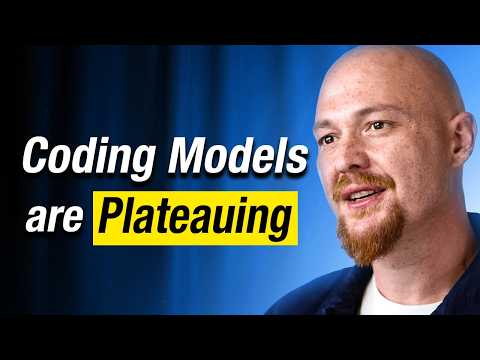
Replit CEO: Why the SaaS Apocalypse is Justified & Why Coding Models are Plateauing | Amjad Masad
Amjad Masad (guest), Harry Stebbings (host)
In this episode of The Twenty Minute VC, featuring Amjad Masad and Harry Stebbings, Replit CEO: Why the SaaS Apocalypse is Justified & Why Coding Models are Plateauing | Amjad Masad explores replit CEO on agentic coding, SaaS disruption, and model plateaus Masad argues the key unlock was agentic AI that can take long-horizon actions, enabling non-engineers to build software without “learning to code.”
Replit CEO on agentic coding, SaaS disruption, and model plateaus
Masad argues the key unlock was agentic AI that can take long-horizon actions, enabling non-engineers to build software without “learning to code.”
Replit’s advantage comes from an “agent lab” stack: model evaluation, routing tasks across Anthropic/Gemini/custom models, proprietary benchmarks, and A/B testing—plus adding and removing infrastructure as models improve.
He claims a “SaaS apocalypse” is partially justified: systems of record (e.g., Salesforce) remain, but many point-solution and vertical SaaS tools face replacement by custom apps built atop APIs or data warehouses.
Despite token costs, Masad prioritizes performance over cost early, treating optimization as a later phase; he views free/cheap inference as a user-acquisition lever (“inference is the new sales and marketing”).
He predicts IDEs are “dead for all intents and purposes” for most work, though they persist for high-assurance, life-or-death software where verification and control matter.
Key Takeaways
Agentic capability—not just code generation—changed the market in 2024.
Masad distinguishes early LLM coding (GPT-3 era) from “agentic AI” that can execute multi-step plans over longer horizons, which makes end-to-end building accessible to non-engineers.
Get the full analysis with uListen
Winning “agent labs” treat model choice as a routing problem.
Replit decomposes work into sub-agents and assigns tasks (e. ...
Get the full analysis with uListen
The durable product edge is harness + evaluation, not allegiance to one model.
Masad describes engineers as “psychologists” who learn each model’s limits, then codify that via proprietary benchmarks and A/B tests—sometimes producing better outcomes than the model vendor’s own product.
Get the full analysis with uListen
Training your own model is cyclical; the strategic goal is optionality.
He argues building custom models can be smart when open source is strong and coding models plateau, enabling fine-tunes that outperform frontier models in a narrow domain for 3–6 months—enough to win enterprise deals.
Get the full analysis with uListen
Performance-first beats cost-first until the improvement curve flattens.
Masad warns that optimizing for cost too early can lock you into an “asymptotic plateau” on the S-curve; teams should push capability first, then enter deliberate optimization periods.
Get the full analysis with uListen
SaaS disruption will hit point solutions more than systems of record.
He doesn’t see enterprises ripping out Salesforce/Workday, but does see teams building on top of them via APIs (MCPs/hooks) or skipping SaaS layers to build directly on data warehouses (e. ...
Get the full analysis with uListen
Maintenance becomes a product feature, not an afterthought, in vibe-coding.
Replit invests tokens in code review, automated testing (including browser-based testing), and production security agents that monitor dependencies and supply-chain risks to keep AI-written software maintainable.
Get the full analysis with uListen
Notable Quotes
““We’re approaching a certain plateau in how good coding models could get.””
— Amjad Masad
““I no longer think you should learn how to code.””
— Amjad Masad
““Cost question is secondary to the performance question.””
— Amjad Masad
““That is the core competency IP of an agent lab.””
— Amjad Masad
““For all intents and purposes, IDEs are dead.””
— Amjad Masad
Questions Answered in This Episode
When you say coding models are “plateauing,” which specific capabilities are flattening (reasoning, tool use, long-horizon planning, codebase understanding), and what evidence do you see internally?
Masad argues the key unlock was agentic AI that can take long-horizon actions, enabling non-engineers to build software without “learning to code.”
Get the full analysis with uListen AI
Can you walk through a concrete example of Replit’s task routing (core loop vs sub-agents)—what gets sent to Anthropic, what to Gemini, and what triggers a fallback?
Replit’s advantage comes from an “agent lab” stack: model evaluation, routing tasks across Anthropic/Gemini/custom models, proprietary benchmarks, and A/B testing—plus adding and removing infrastructure as models improve.
Get the full analysis with uListen AI
You mention deleting guardrail code as models improve; what were the biggest infrastructure components you removed between Agent V1/V2/V3 as autonomy became “built into the model”?
He claims a “SaaS apocalypse” is partially justified: systems of record (e. ...
Get the full analysis with uListen AI
On custom models: what’s the minimum proprietary data advantage needed for a fine-tune to beat frontier models in a narrow domain, and how do you prevent quick commoditization?
Despite token costs, Masad prioritizes performance over cost early, treating optimization as a later phase; he views free/cheap inference as a user-acquisition lever (“inference is the new sales and marketing”).
Get the full analysis with uListen AI
If “inference is the new sales and marketing,” what retention mechanics matter most once free tokens stop—workflow lock-in, artifacts, team features, or enterprise compliance?
He predicts IDEs are “dead for all intents and purposes” for most work, though they persist for high-assurance, life-or-death software where verification and control matter.
Get the full analysis with uListen AI
Transcript Preview
We're approaching a certain plateau in how good coding models could get. And so
We could not have a more relevant guest than Amjad Masad, co-founder and CEO at Replit, joining us in the hot seat.
Cost question is secondary to the performance question. When you focus on cost is when you reach a certain asymptotic plateau in the S curve.
The man is reshaping what it means to be a great product manager, product leader, and Replit is one of the leading vibe-coding tools alongside the likes of Lovable
The name of the game is just staying one, two, three, four, ten steps ahead.
This was an incredible discussion with Amjad, and I'm really excited for you to hear it.
For all intents and purposes, IDEs are dead.
Ready to go? [upbeat music] Amjad, dude, I'm so excited for this. I've wanted to make this one happen for a while, so thank you so much for joining me once again today.
My pleasure. Great to be here.
Uh, we were just chatting about kind of the depths that the Replit's been through and, like, the amazing position today. Did it take a long time for the world to see what Replit was, or did technology take a long time to catch up to your vision of what it could be?
It's, it's more the latter, right? So the core insight that I had, even before we started the company, maybe at this point 20 years ago, was that software is much more transformative than, than we actually think it is. You know, Marc Andreessen wrote, you know, "Software is eating the world" and all of that, but I thought it's transformative for, for people's lives and for the prospect of wealth creation, wealth distribution, entrepreneurship, all of that. Well, it's, it's sort of my story, you know, the impact it had on my life, you know, as a kid growing up in Jordan, coming to the US, and now running a multibillion-dollar company. And I've seen that even earlier than that. When I was 15, I bu- I built a little, a little business. I was making hundreds of dollars, and that was amazing amount of money for me. I took my entire class to McDonald's when it, when it, when it opened up in Amman. And, um, a-and, and so that was the kind of the core insight. And initially when I came to the US, I was -- I worked at Code Academy, and the goal was, like, let's teach everyone how to code. Let's make it as simple as possible. And I started seeing the stories back then even. Like, if a fitness guy learns a little bit of coding, launches an app on the App Store, makes a million bucks. It's like, wow, this is, this is amazing. And so when we started the company, Replit, in 2016, the goal was how do you make programming more accessible? How do you get to a point where there's a billion developers, not just, you know, 20 million developers at the time? But the ... A-a-and so we started solving one problem at a time, right? Solving the development environment. Replit was the first in-browser IDE. Solving the hosting environment, solving the package management, the maintenance, the iteration, the version management, the multiplayer. We solved all these problems, but there's one bottleneck, and that is people don't wanna learn how to code.
Install uListen to search the full transcript and get AI-powered insights
Get Full TranscriptGet more from every podcast
AI summaries, searchable transcripts, and fact-checking. Free forever.
Add to Chrome