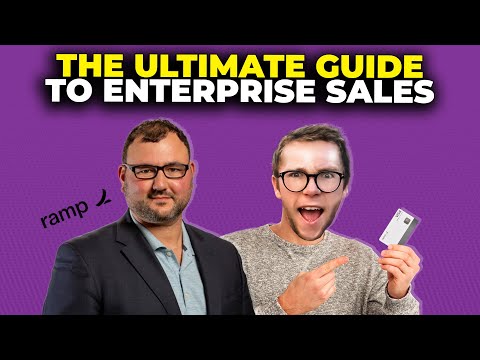
Mark Goldberger: The Ultimate Guide to Enterprise Sales | E1003
Mark Goldberger (guest), Harry Stebbings (host)
In this episode of The Twenty Minute VC, featuring Mark Goldberger and Harry Stebbings, Mark Goldberger: The Ultimate Guide to Enterprise Sales | E1003 explores from Wine Sales to Ramp: Mark Goldberger’s Enterprise Sales Playbook Mark Goldberger, Head of Enterprise Sales at Ramp, shares his journey from wine distribution and a bootstrapped SaaS startup into leading high-performing enterprise sales teams at TripActions/Navan and now Ramp.
From Wine Sales to Ramp: Mark Goldberger’s Enterprise Sales Playbook
Mark Goldberger, Head of Enterprise Sales at Ramp, shares his journey from wine distribution and a bootstrapped SaaS startup into leading high-performing enterprise sales teams at TripActions/Navan and now Ramp.
He breaks down how to sell and build playbooks before true product-market fit by focusing on product–customer fit, deep qualification, and ruthless prioritization of pipeline.
Goldberger outlines his frameworks for champions, multi-threading, MEDDPICC qualification, hiring 10x reps using his “four H’s” (hunger, hustle, humility, heart), and why founders must think beyond traditional sales hiring rubrics.
He also covers comp design, quota setting, outbound, onboarding, and the importance of grit, mentorship, and executive involvement in transformational enterprise deals.
Key Takeaways
Prioritize product–customer fit before product–market fit.
Early enterprise success often comes from finding specific customers whose needs closely match your current capabilities, then doubling down on that 20% of accounts that can drive 80% of revenue instead of trying to sell to everyone.
Get the full analysis with uListen AI
Test your champion by insisting on access to the executive buyer.
You only know you have a real champion if they can and will bring you to the CFO or true EB; if they can’t or won’t, you either have a coach, a low-influence stakeholder, or you haven’t yet earned the right.
Get the full analysis with uListen AI
Run toward risk: systematically ask how you could lose the deal.
Great enterprise sellers avoid ‘happy ears’ by actively mapping every possible failure mode—champion leaving, CFO objections, competing champions—and then building plans to preempt or handle each scenario.
Get the full analysis with uListen AI
Qualify much deeper than first-level pain to create urgency.
Most reps stop after surface discovery and start pitching; Goldberger pushes for second- and third-order implications of pain so the customer fully feels the cost of inaction, reducing reliance on discounting.
Get the full analysis with uListen AI
Hire for 10x potential using the four H’s, not resumes.
He optimizes for hunger, hustle, humility, and heart (grit) plus creativity and adaptability, often in candidates who wouldn’t pass traditional ‘logo-based’ filters, because these traits compound with a strong product into 100x outcomes.
Get the full analysis with uListen AI
Founders should hire sales earlier than $1M ARR and focus on logos.
The first reps (often junior) should help validate the motion and collect credible early logos, references, and case studies; revenue matters less than social proof and learnings at this stage.
Get the full analysis with uListen AI
Outbound is non-negotiable; pipeline is everyone’s responsibility.
Despite its discomfort, consistent cold calling and emailing are still the backbone of hitting quota, because a large self-generated pipeline allows strict qualification and protects against misses.
Get the full analysis with uListen AI
Notable Quotes
“The difference between winners and losers is that losers practice until they get it right. Winners practice until they never get it wrong.”
— Mark Goldberger (quoting John McMahon)
“You don’t need product–market fit to sell enterprise; you need product–customer fit.”
— Mark Goldberger
“Rose-colored glasses people are great fun at parties, but they make for shit sellers.”
— Mark Goldberger
“If you want 10x productivity, you need to think outside the horse. You need a race car, not a race horse.”
— Mark Goldberger
“Each subsequent hire has to raise the bar for the entire team. If they don’t have the potential to be as good or better than everyone else in seat, why are you hiring them?”
— Mark Goldberger
Questions Answered in This Episode
How can an early-stage founder practically distinguish between product–customer fit and random one-off wins?
Mark Goldberger, Head of Enterprise Sales at Ramp, shares his journey from wine distribution and a bootstrapped SaaS startup into leading high-performing enterprise sales teams at TripActions/Navan and now Ramp.
Get the full analysis with uListen AI
What are concrete signals during discovery that you should ‘walk’ from an opportunity instead of trying to force a fit?
He breaks down how to sell and build playbooks before true product-market fit by focusing on product–customer fit, deep qualification, and ruthless prioritization of pipeline.
Get the full analysis with uListen AI
How can non-sales founders adopt MEDDPICC and the Lean–Pivot–Walk framework without overcomplicating their first few deals?
Goldberger outlines his frameworks for champions, multi-threading, MEDDPICC qualification, hiring 10x reps using his “four H’s” (hunger, hustle, humility, heart), and why founders must think beyond traditional sales hiring rubrics.
Get the full analysis with uListen AI
In a world of PLG and inbound, how should teams balance SDR-led outbound with founder and AE prospecting?
He also covers comp design, quota setting, outbound, onboarding, and the importance of grit, mentorship, and executive involvement in transformational enterprise deals.
Get the full analysis with uListen AI
What specific interview exercises best reveal whether a candidate truly has hunger, hustle, humility, and heart?
Get the full analysis with uListen AI
Transcript Preview
There's a great quote from John McMahon, who was a tremendous sales leader, "The difference between winners and losers is that losers practice until they get it right. Winners practice until they never get it wrong."
(quirky music) Mark, I am so excited for this. I heard so many great things from so many former colleagues of yours and current colleagues of yours. So thank you so much for joining me today.
Harry, my man, it is so good to be here. Thanks so much for having me on the show.
Now, we have a lot to dive into, but I wanna start with, actually, the move, uh, to Ramp and leading Ramp's enterprise sales team. So how did you make your way into the world of enterprise sales, and how did you most recently come to lead Ramp's enterprise sales team?
Yeah. It's a great question, Harry. Uh, I came to the world of enterprise sales from the world of wine. Uh, I recognize (laughs) that's not the typical journey one makes, uh, but it is my own story. Uh, so I was working in, in Massachusetts, uh, as a salesperson for a wine distributorship while I was going to business school. And upon graduating, it was the Great Recession. Not a great time to leave a good-paying job for an unpaid internship somewhere.
Ah.
So I actually founded my own company. I bootstrapped a, a, a SaaS business back then, uh, knowing nothing about SaaS, mind you, uh, but built a, a cloud-based company with, uh, with tools in the cloud specifically for, uh, for the wine industry. Uh, bootstrapped it, we had paying customers, uh, it was a wild, incredible experience. Uh, after a few years, ultimately I did decide to, to wind down that business. Uh, my wife and I moved out to Silicon Valley when she took a role with, uh, a little startup in Mountain View called Google.
(laughs)
I don't know if you've heard of them. Uh, and so, uh, so I found myself, uh, out here in Silicon Valley, and I said, "Okay, I'm gonna be an account executive now, again, for, for SaaS companies." And I, I sent my resume out to about 100 companies, and the response was... Well, there was no response. Literally could not get an interview. More than 100 resumes sent out, I had founded my own company that was a SaaS company, I had always been a top performer in sales, and yet no one was interested in even interviewing me. It was a, a frustrating experience, it was a humbling experience, uh, but ultimately, as someone who ha- has already had a giant chip on my shoulder, uh, it drove me, uh, to, to go out there and s- and, and perform. Harry, you-
Le-
... you look like you've got a question, man.
Yeah. I mean, you, you're the master of also being cold outbound, being the enterprise leader that you are. You must also self-analyze, like, what was wrong with your approach and why did that happen?
Install uListen to search the full transcript and get AI-powered insights
Get Full TranscriptGet more from every podcast
AI summaries, searchable transcripts, and fact-checking. Free forever.
Add to Chrome